📶 WiFi Adapter Lifespan Calculator
Find out how long your WiFi adapter will last based on type, usage & environment
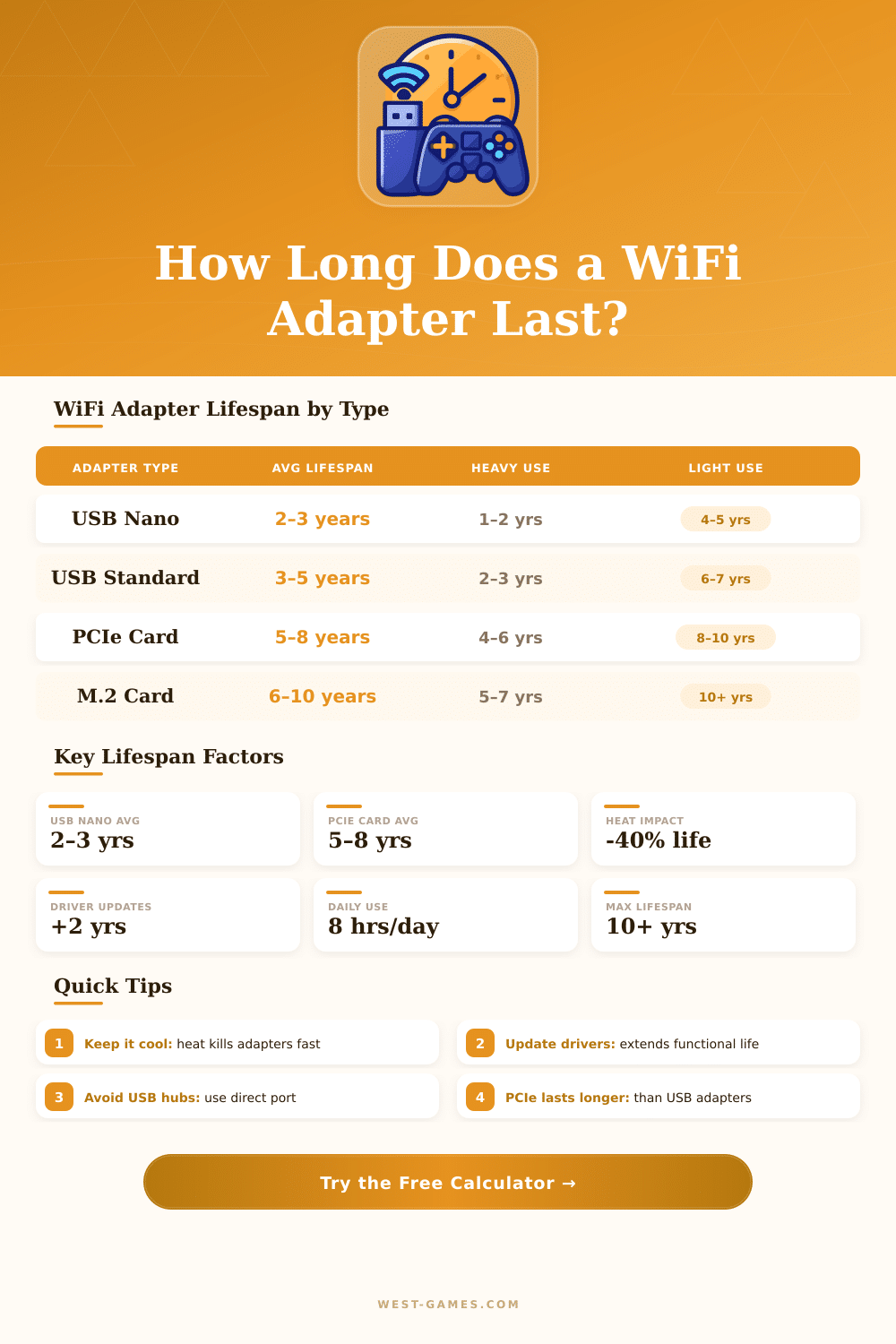
| Adapter Type | Avg Lifespan | Light Use | Heavy Use | Always-On |
|---|---|---|---|---|
| USB Nano Adapter | 2–3 years | 4–5 years | 1–2 years | 6–18 months |
| USB Standard Adapter | 3–5 years | 5–7 years | 2–3 years | 1–2 years |
| USB Desktop (large) | 4–6 years | 6–8 years | 3–4 years | 2–3 years |
| PCIe Card | 5–8 years | 8–10 years | 4–6 years | 3–5 years |
| M.2 / Mini PCIe Card | 6–10 years | 10+ years | 5–7 years | 4–6 years |
| Laptop Internal Module | 5–8 years | 8–10 years | 4–6 years | 3–5 years |
| Operating Temp | Lifespan Impact | Typical Cause | Mitigation |
|---|---|---|---|
| Below 40°C (104°F) | +20–30% longer life | Well-ventilated PC case | Maintain airflow |
| 40–60°C (104–140°F) | Baseline (normal) | Standard room use | Standard care |
| 60–75°C (140–167°F) | –25–40% shorter life | Near CPU/GPU, poor airflow | Reposition, add fans |
| Above 75°C (167°F) | –50–70% shorter life | Overclocking, blocked vents | Immediate action needed |
| Symptom | Likely Cause | Severity | Action |
|---|---|---|---|
| Frequent disconnections | Degraded antenna/chip | Medium | Update drivers first |
| Slower speeds than expected | Hardware degradation | Medium | Test on another device |
| Not detected by OS | Failed chipset | High | Replace adapter |
| Overheating / hot to touch | Failing capacitors | High | Stop use, replace |
| Intermittent signal drops | Antenna connector wear | Low–Medium | Check connections |
| Driver crashes / BSOD | Firmware corruption | High | Reinstall or replace |
Plug a wifi adapter in the USB port of your computer and quickly you have wireless connection without any trouble with built-in device. That is simply an external wireless card for your computer. Desktop computers and less new laptops commonly require such tools, especially when they came without WiFi or the current link seems bad.
Want to improve weak wireless signal? A good wifi adapter fits that also.
How to Choose a WiFi Adapter
The market offers several kinds to choose. USB adapters form the easiest way, they feed in a port and give reliable speed with stability, without issues. PCIe adapters install inside your computer, skipping entirely the USB way, and commonly they prove safer during long time.
There also exists the option of an M.2 WiFi card, that works if your main board has the right slot for it. Options like the Intel AX200 M.2 card usually work well and come with antenna parts.
PCIe and M.2 adapters usually beat USB ones, if we talk honestly. USB models sometimes warm too much. For best results, choose internal setup with PCIe or M.2, assuming that you feel yourself comfortable opening the case and check fit before.
USB adapters work when you want only simple and fast setup, without opening your computer.
Speed does matter hear. Choose adapters that back dual-band mode, both 5 GHz and 2.4 GHz. Some models reach around 1300 Mbps.
Even so, not everything depends only on that. When your router uses 802.11ac on 5 GHz, you need a USB 3.0 adapter with alike kinds to truly reach those speeds. Have an older 802.11n router?
Then a USB 2.0 adapter will do for the task. The point is though: only changing the wifi adapter, you do not gain a lot, unless both parts match the same modern standard.
WiFi 5 delivers speeds up to around 250 Mbps without big effort. Otherwise, WiFi 6 is the better choice. Almost every current WiFi 6 adapter is based on the Intel AX200 chip.
The new WiFi 6E standard moves to the AX210 chip, and you can expect speeds near 700 Mbps, even from across the whole home.
Gaming goes well with USB wifi adapter tools for casual play and less demanding games. Things get risky when you play complex games with weak links, lag starts showing. Even so, wireless technology grew a lot.
You can stream HD video and play competitive games without delays, if you choose a prime wifi adapter. The difference in delay between PCIe and USB adapters is almost not noticeable, unless one of them truly fails.
Built-in WiFi in a laptop depends on a small antenna hidden in the cover, that strangely sticks to the computer itself. Sometimes the whole trouble comes down to a loose or damaged internal antenna cable. Switching to a wifi adapter with warranty and easy setup, you easily fix the WiFi.
Stick to reliable brands, and you mostly staysafe. Even so, powerline adapters deserve thought as another option.