🎮 Vertical to Horizontal FOV Calculator
Convert vFOV to hFOV for any aspect ratio — games, cameras & displays
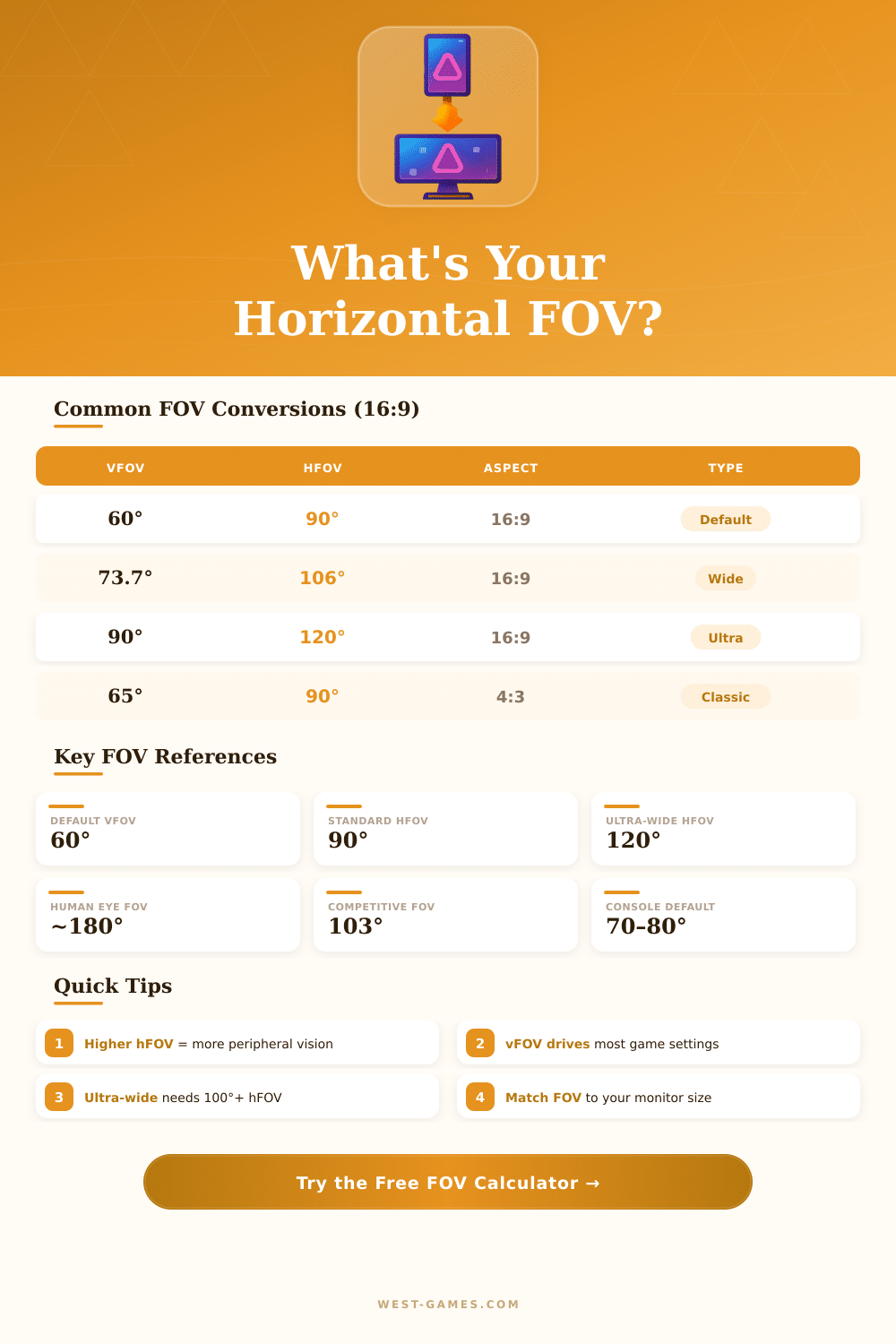
| vFOV (°) | hFOV (°) | hFOV (rad) | Feel / Use Case | Common Game |
|---|---|---|---|---|
| 50° | 79.4° | 1.386 | Very narrow | Cinematic / cutscenes |
| 60° | 90.0° | 1.571 | Standard | Most defaults |
| 65° | 96.4° | 1.682 | Slightly wide | CS:GO default |
| 73.7° | 106.2° | 1.854 | Competitive FPS | Apex / Warzone |
| 80° | 112.9° | 1.971 | Wide | Overwatch 2 |
| 90° | 122.6° | 2.141 | Very wide | Quake / arena |
| 100° | 130.8° | 2.284 | Extreme | Custom modded |
| 110° | 137.8° | 2.405 | Fisheye-like | Specialty VR |
| Aspect Ratio | Ratio Value | hFOV (°) | Typical Display |
|---|---|---|---|
| 4:3 | 1.333 | 80.0° | Old CRT / classic monitor |
| 5:4 | 1.250 | 75.7° | Square monitor |
| 16:10 | 1.600 | 93.5° | MacBook / productivity |
| 16:9 | 1.778 | 90.0° | Standard gaming monitor |
| 21:9 | 2.333 | 107.0° | Ultra-wide gaming |
| 32:9 | 3.556 | 123.2° | Super ultra-wide |
| 2.39:1 | 2.390 | 107.9° | Cinematic projection |
| Game | Default vFOV | Equivalent hFOV (16:9) | Max Allowed | Recommended |
|---|---|---|---|---|
| Apex Legends | 70° | 102° | 110° (h) | 90°–110° hFOV |
| Call of Duty: Warzone | 80° (h) | 80° (h-native) | 120° (h) | 100°–110° hFOV |
| Fortnite | 80° | 106° | Locked | 80° vFOV |
| CS2 (Counter-Strike) | 68° | 90° | 68° (v) | 68° vFOV |
| Valorant | 103° (h) | 103° (h-native) | 103° (h) | 103° hFOV |
| Minecraft (Java) | 70° | 90° | 110° (v) | 70°–90° vFOV |
| Overwatch 2 | 103° (h) | 103° (h-native) | 103° (h) | 103° hFOV |
| Cyberpunk 2077 | 60° | 90° | 100° (v) | 75°–85° vFOV |
Note: This article is based on reliable information gathered from different websites about calculators for FOV.
Calculator for FOV is a basic tool that finds the ideal field of sight. It works for video games, fake drives and similar camera setups. The main idea is not hard to grasp.
How to Use a FOV Calculator for Games and Cameras
Imagine looking through a window. The more near you stand to it, the more you see outside. And a bigger window itself shows more view.
Like this also works the calculator of FOV. It takes the size of your monitor and the distance where you sit, then finds the right number for real sight.
In fake drives, getting the precise FOV matters a lot. Professional players race only with the right field of sight. Right settings of FOV help feel comfortable in the simulation, which leads to faster and stable drive.
Using a calculator for FOV can really improve your driving. It changes the game for many setups.
Most calculators for FOV need some data. Among them is the ratio of the screen, its size in inches and the distance between your eyes and the monitor. Typical ratios include 16:10, 24:10 and 32:10.
Then the device computes the best vertical and horizontal FOV according to those elements. Some of them also handle single screen, curved monitor or three-screen system. With three screens, one can recieve horizontal FOV, vertical FOV and the side corners all at once.
One hard spot is that some games apply horizontal FOV, while others favour vertical. If a game requires vertical FOV, the calculator can convert from the usual horizontal to that. That matters, because choosing the wrong kind causes weird looks.
In games on Source-engines, one adjusts too the ratio by means of stretching the horizontal FOV, so that the vertical stays same. Like this one gives advantage to players with broader screens, compared to those that use the same FOV number.
Some games limit the values of FOV. The calculator maybe fails with something above 180 degrees. For three-screen setups with 190 degrees or more, the in-game slider does not reach that height.
Here manual fixes by means of keyboard shortcuts become needed. Some games themselves have their own built-in calculator for FOV, and if the data is right, those internal tools ensure right sight.
For FPS games, 110-degree FOV is usually seen as good, because it brings fast moves more near to the centre, which helps them stay in focus. Even so on smaller screens, 100 or even 90 FOV maybe works better. Calculators for FOV also exist for cameras, where one enters the focal length of the lens, the size of the sensor and thedistortion to compare and describe the field of sight of the camera.