🖥️ GPU Lifespan Calculator for Gaming
Estimate how long your graphics card will last based on usage, thermals, and workload intensity
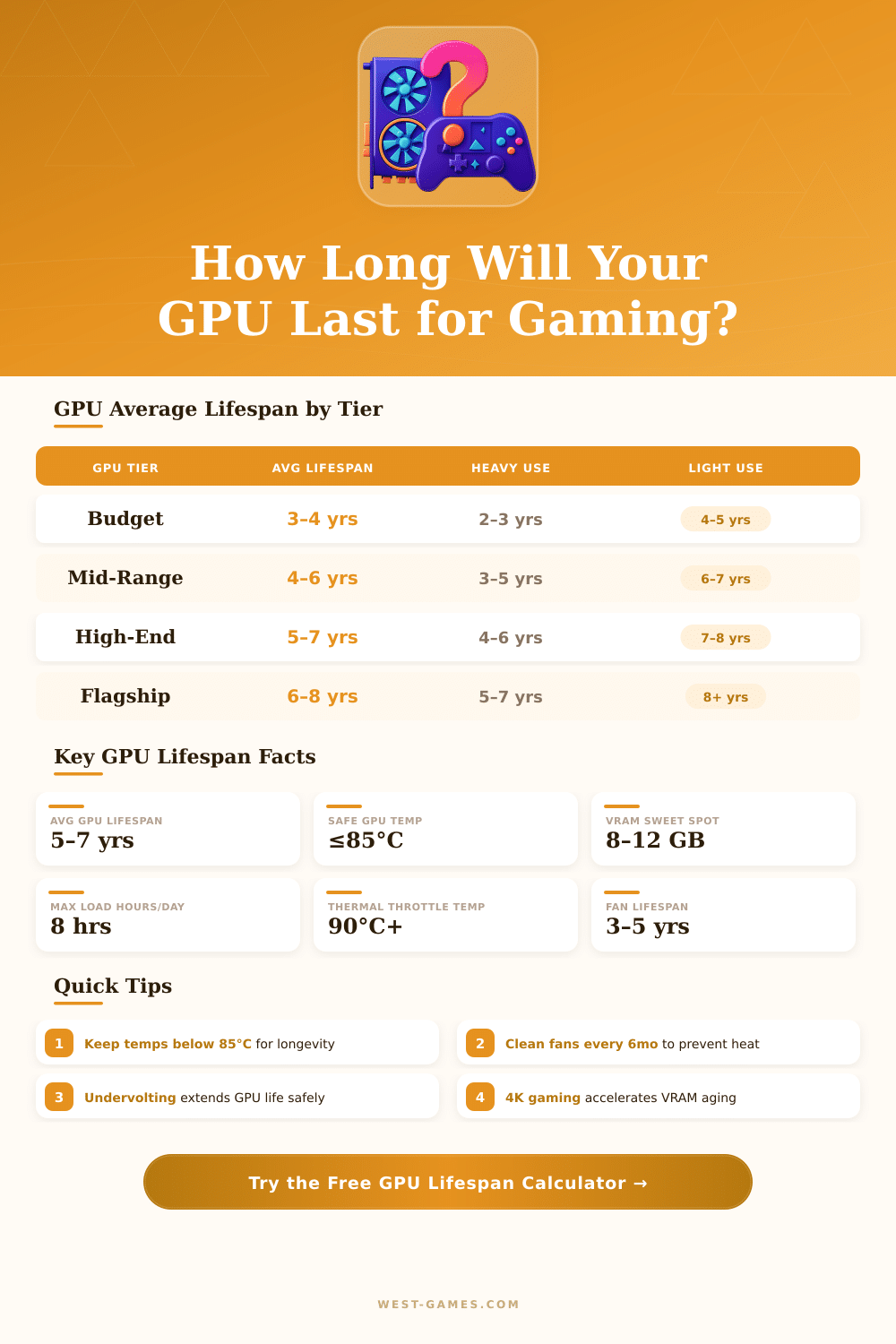
| GPU Tier | Typical Lifespan | Heavy Use | Light Use | VRAM (GB) | TDP (W) |
|---|---|---|---|---|---|
| Budget | 3–4 Years | 2–3 Years | 4–5 Years | 4–8 GB | 75–130 W |
| Mid-Range | 4–6 Years | 3–5 Years | 6–7 Years | 8–12 GB | 130–200 W |
| High-End | 5–7 Years | 4–6 Years | 7–8 Years | 12–16 GB | 200–285 W |
| Flagship | 6–8 Years | 5–7 Years | 8–10 Years | 16–24 GB | 285–450 W |
| Temp Range (℃) | Temp Range (℉) | Status | Lifespan Impact | Action Needed |
|---|---|---|---|---|
| Below 75℃ | Below 167℉ | 🟢 Ideal | +20% lifespan | None — great airflow |
| 75–85℃ | 167–185℉ | 🟡 Normal | Baseline | Monitor occasionally |
| 85–90℃ | 185–194℉ | 🟠 Warm | −15% lifespan | Clean fans, check airflow |
| 90–95℃ | 194–203℉ | 🔴 Hot | −30% lifespan | Repaste, add intake fans |
| 95℃+ | 203℉+ | ⚠️ Critical | −50%+ lifespan | Immediate action required |
| Use Case | Avg Daily Hours | GPU Load % | Annual Hours | Lifespan Modifier |
|---|---|---|---|---|
| Casual / Indie Games | 1–2 hrs | 40–60% | 365–730 hrs | +15% |
| Competitive FPS | 2–4 hrs | 50–70% | 730–1,460 hrs | Baseline |
| AAA / Open World | 3–5 hrs | 70–90% | 1,095–1,825 hrs | −10% |
| 4K Ultra + Raytracing | 3–5 hrs | 90–99% | 1,095–1,825 hrs | −20% |
| Streaming + Gaming | 4–8 hrs | 80–95% | 1,460–2,920 hrs | −25% |
| Crypto Mining (24/7) | 24 hrs | 95–100% | 8,760 hrs | −50% |
GPU with steady power will last an average of 5 to 8 years. This range changes a lot based on how one uses the card. Even so some GPU operate even longer than that.
For instance, cards from 2005 still worked for playing games today, which makes them almost twenty years old. Cards bought around 2000 now have around 25 years and still operate well.
How Long Do GPUs Last and How to Make Them Last Longer
GPU do not have a fixed lifetime. They commonly last 10 to 20 years without any trouble. Even so overclocking can shorten that period.
Lowering the voltage of the card helps to reach the maximum length of life for it. On the other hand, the lifetime of GPU does not truly shrink, if it does not use everything from its skill.
The heat is the main enemy for many computer parts and the most deciding factor for setting the lifetime. Every extra 15 degrees Celsius can change how long the GPU lasts. It helps to keep the temperature under 80 degrees Celsius, to stop the thermal death because of too fast wear.
For GPU there is a general safe limit around 80 degrees Celsius. If one goes past that during long times, the danger gorws that the silicon breaks down more quickly. There is no single safe limit, only constant change between the working heat and the hoped length of life.
Also good power supplies are important. A computer with stable energy and good airflow helps the GPU live longer. Removing the dust is also useful.
If one uses the card under full load for around 8 to 10 hours a day with fair heats, the GPU will last at least 5 years, no matter the brand. The things that kill GPU are overclocking, power shocks, or overheating. Also factory damages happen, and some cards arrive not fully working from the box.
Crypto mining puts strong stress on the GPU. The constant work leads to overclocking and problems with overheating. In such cases the lifetime of GPU falls too roughly 2 to 3 years.
In data centers, where one does AI work at 60 to 70 percent of usage, GPU usually last between one and two years, at most three. Those units use 200 to 500 watts.
One commonly misunderstands that GPU age after 5 to 6 years. The warranties for GPU rarely pass 5 or 6 years for the best models, which hints that the makers expected risk of failure around that time. But the real usable life can actually be six years or even more.
It is good to buy mid-range GPU for 3 to 4 years of usage and later swap it out. One can reduce the thermal stretching and shrinking by avoiding constant changes between heavy and light work. Using it only some hours a day gives more length than nonstop use.
Maybe the fans wear out or the capacitors dry up, butgood care pushes that much further into the future.