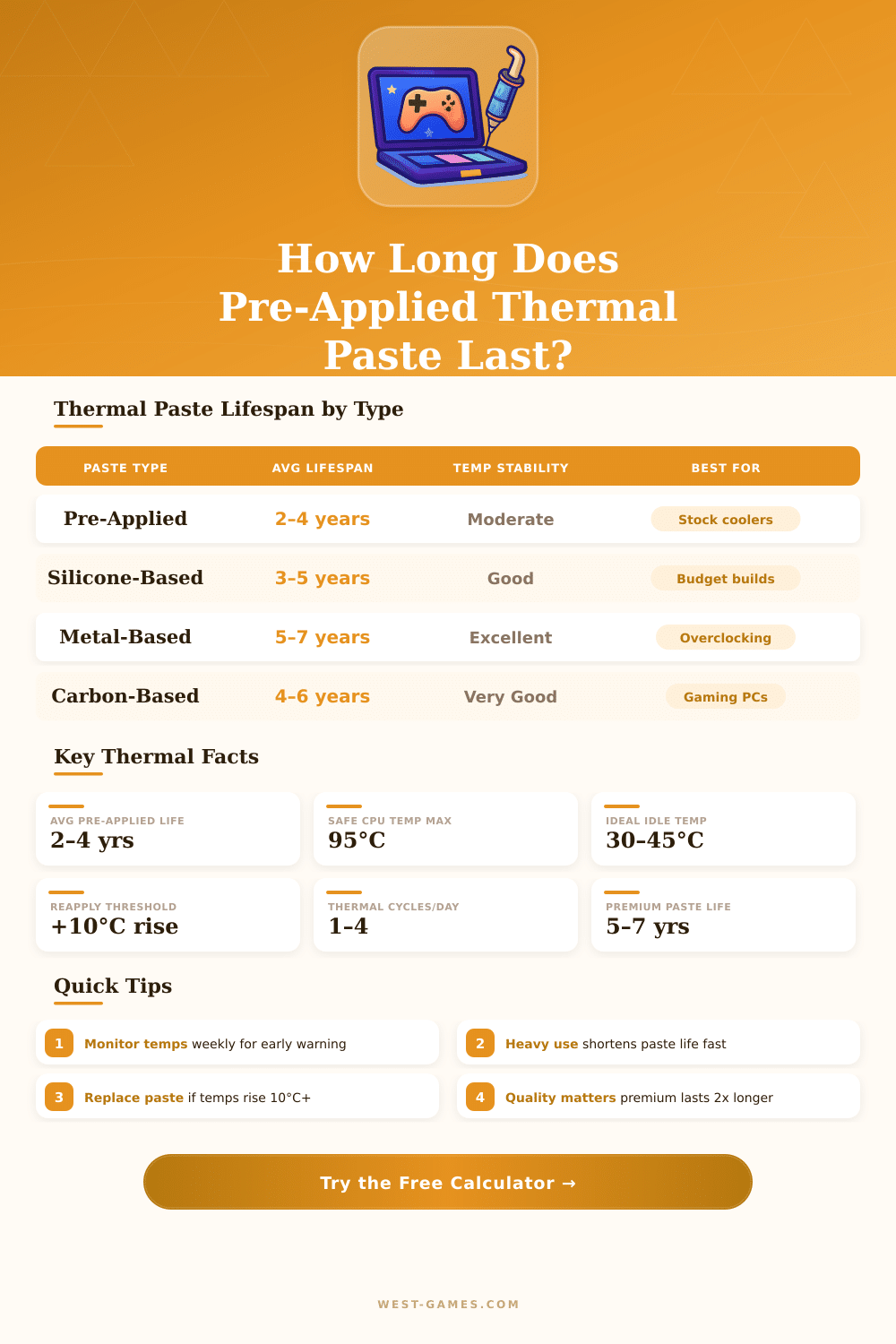
🌡️ Pre-Applied Thermal Paste Life Calculator
Estimate how long your thermal paste will last & when to replace it
| Paste Type | Typical Lifespan | Temp Range | Conductivity | Best Use Case |
|---|---|---|---|---|
| Pre-Applied Pad (Stock) | 1–3 years | Up to 150°C | 4–6 W/mK | Basic office / light use |
| Pre-Applied Compound (Boxed CPU) | 2–4 years | Up to 150°C | 5–8 W/mK | Standard gaming builds |
| Silicone-Based (Aftermarket) | 3–5 years | Up to 200°C | 3–6 W/mK | Budget builds, beginners |
| Carbon-Based (Aftermarket) | 4–6 years | Up to 200°C | 6–12 W/mK | Gaming, workstations |
| Metal-Based / Liquid Metal | 5–8 years | Up to 300°C | 30–80 W/mK | Overclocking, extreme cooling |
| Diamond / Nano Compound | 5–10 years | Up to 250°C | 8–20 W/mK | Enthusiast / server grade |
| Usage Type | Daily Hours | Avg Load Temp | Estimated Pre-Applied Life | Reapply Interval |
|---|---|---|---|---|
| Light (Office / Web) | 2–4h | 45–60°C | 3–4 years | Every 4 years |
| Moderate (Casual Gaming) | 4–6h | 60–75°C | 2–3 years | Every 2–3 years |
| Heavy (Daily Gaming) | 6–10h | 75–88°C | 1.5–2 years | Every 18 months |
| Workstation / Rendering | 8–12h | 80–90°C | 1–2 years | Every 12–18 months |
| Server / 24-7 Load | 24h | 70–85°C | 1–1.5 years | Every 12 months |
| Warning Sign | Severity | Action |
|---|---|---|
| CPU temps risen 5–10°C vs. before | ⚠️ Moderate | Monitor weekly, plan replacement |
| CPU temps risen 10°C+ vs. baseline | 🔴 High | Replace paste immediately |
| Thermal throttling during normal tasks | 🔴 Critical | Immediate replacement required |
| System older than 4 years, never replaced | ⚠️ Moderate | Proactive replacement recommended |
| PC crashing or shutting down from heat | 🔴 Critical | Stop use, replace paste & inspect cooler |
| Visible paste dried / cracked (if visible) | 🔴 High | Replace paste immediately |
thermal paste has many names. One also calls it thermal building, thermal fat, warm paste, thermal gel, fat for CPU, material for warm pipe and thermal cover or simply TIM. No matter as one says to it, it does the same task.
thermal paste is meant to cover little tiny spaces between the chip and the cooler. The surfaces of chips and bases of coolers are covered by tiny holes and bumps. Because air blocks heat, those spaces stop good heat transfer.
What Is Thermal Paste and How to Use It
The paste closes them and allows that heat spreads evenly from the cover of the CPU to the pipe. Without it chip does not cool well.
In short words, thermal paste works as a bridge for heat transfer. One must use a slim layer, and it should be as thin as possible. Too much paste rather indeed expands the resistance instead of lowering it.
Enough amount equal to half of a grain for a pair of CPU and cooler, whether in laptops or in desktops.
One can apply it in many ways. For instance, one lays a dot in the center of the CPU and later press the cooler downward. That pressure spreads the paste in oval form without trapping air.
Also the X-form is advised, because it escapes bubbles. One can extend it before by means of a card, but risk to create tiny pockets, if the CPU or cooler are not fully flat. Both the mode of apply and the quality of the paste affects the result.
Arctic MX-4 is a liked choice. It is made up of carbon tiny bits, that closes holes on surfaces and gives high heat flow together with fast heat supply from CPU or GPU. Arctic makes also MX-5, MX-6 and MX-7 pastes.
Thermal Grizzly Kryonaut one rates among the most effective, but it is not cheap and requires care during use. Noctua NT-H1 is another reliable option, that does not have metals. Chieftec KPx apparently lasts around six to eight years.
Life span depends on the heat, on changes in temperature and on the amount of heat cycles. Factory thermal paste can serve years long. One computer worked eight years with original paste without any troubles.
Strong usage and high heats boost the wear. Renewal of paste in a laptop can lower temperature clearly. In laptops, refill of old paste dropped the heat of center from 80th grades to high 70th and low 80th.
Thermal paste one must lay on the CPU before installing thecooler.