💠 WoW Legendary Drop Rate Calculator
Estimate World of Warcraft legendary farming odds from weekly raid lockouts, boss attempts, bonus rolls, bad luck protection, target pieces, and time per character.
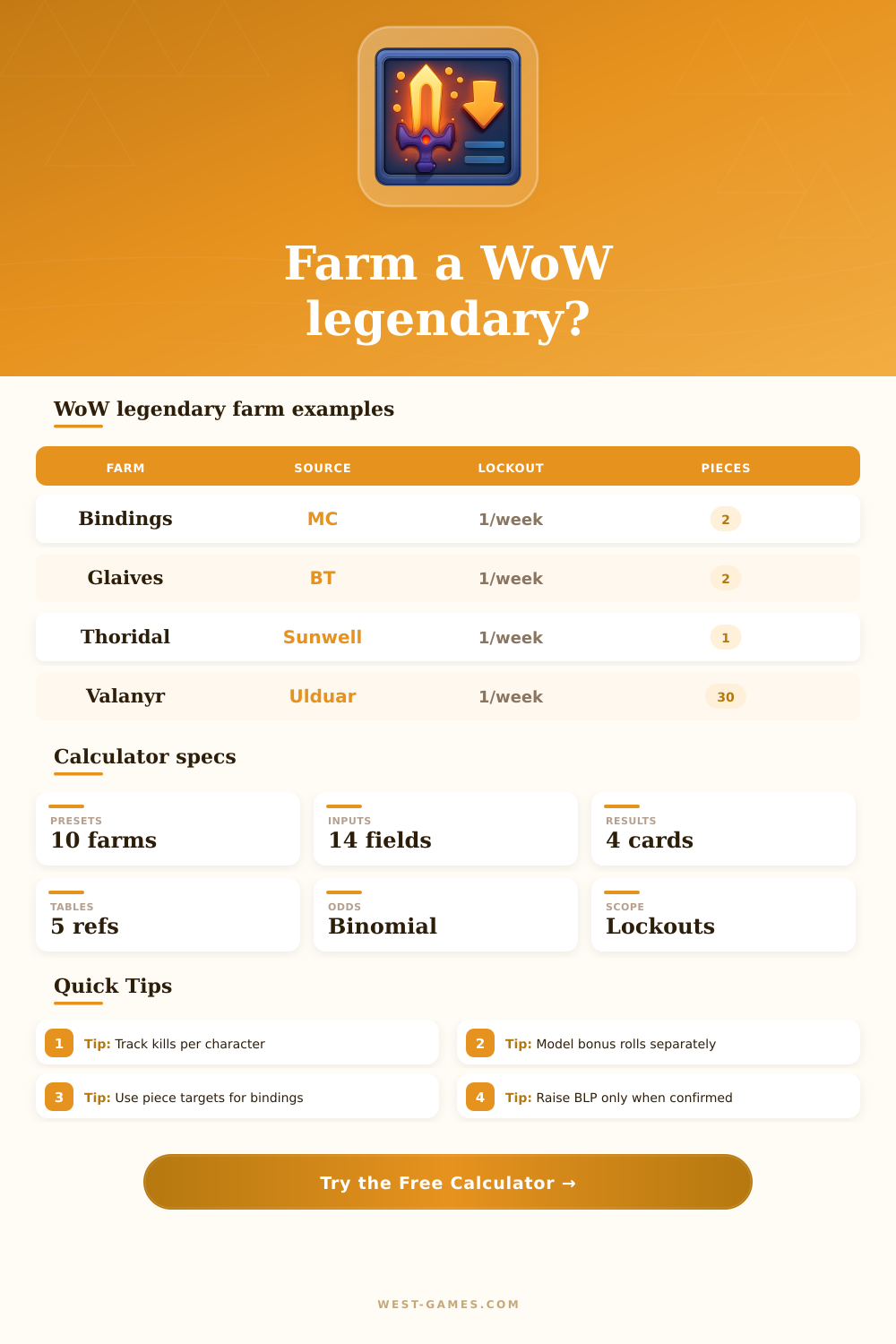
| Legendary farm | Typical source | Input setup | Planning note |
|---|---|---|---|
| Thunderfury bindings | Molten Core bosses | 1 boss each, 2 target pieces | Track Garr and Baron Geddon separately when one binding is already collected. |
| Warglaives of Azzinoth | Illidan in Black Temple | 1 boss, target 2 pieces | If you only need one hand, set current pieces to 1 and target to 2. |
| Thori’dal | Kil’jaeden in Sunwell | 1 boss, target 1 piece | Use a direct-drop model with no bonus rolls for legacy planning. |
| Val’anyr fragments | Ulduar bosses | Many bosses, target 30 pieces | Fragment farms are sensitive to eligible boss count and difficulty assumptions. |
| Shadowmourne shards | Icecrown Citadel bosses | Many bosses, collection target | Set current pieces to your shard count and target to the required total. |
Use current-game loot eligibility and lockout rules for your region, version, and character level.
| Mode | Modifier | Use when | Caution |
|---|---|---|---|
| Legacy 10-player | 0.85× | Smaller loot table assumption | Only if source supports it |
| Legacy 25-player | 1.00× | Default legacy raid planning | Good neutral baseline |
| Heroic legacy | 1.10× | Heroic-eligible source | Do not double count lockouts |
| Mythic fixed | 1.00× | One fixed weekly lockout | Alt count matters most |
| Event version | 0.75× | Timewalking or special event | Confirm loot table first |
The modifier is a planning control, not a claim that every difficulty changes every legendary table.
| Chance band | Examples | Feel per week | Best input |
|---|---|---|---|
| 0.1% to 1% | Very rare cache style | Long-tail grind | Repeat attempts |
| 1% to 5% | Legacy rare boss piece | Alt army helps | Characters |
| 5% to 15% | Fragments or boosted rolls | Steady progress | Boss count |
| 15% to 40% | Quest or collection step | Predictable | Current pieces |
| 40%+ | Guaranteed-like step | Near schedule | Target weeks |
If your source has separate tables for each item, enter the chance for the item or piece you still need.
| Extra source | Where to enter it | Weight idea | When to avoid |
|---|---|---|---|
| Bonus roll token | Bonus rolls field | 100% | If legendary not on token table |
| Weekly cache | Bonus or repeat field | 25% to 100% | If cache cannot award it |
| Repeat dungeon | Repeat attempts | 100% | If loot locked after first run |
| World rare loop | Repeat attempts | 50% to 100% | If daily locked |
| Bad luck protection | BLP field | Small percent | Legacy raids without BLP |
Extra attempts are weighted before the probability formula so uncertain sources do not inflate the result too aggressively.
| Setup | Characters | Time profile | Calculator focus |
|---|---|---|---|
| Main only | 1 | Low time, low volume | Weeks to confidence |
| Small alt roster | 3 to 5 | One evening route | Clear minutes |
| Alt army | 10 to 25 | Route optimization | Travel minutes |
| Fragment push | 1 to 4 | Many bosses per clear | Boss eligibility |
| Repeatable grind | Any | Many short attempts | Attempts per week |
A shorter route with fewer eligible bosses can be worse than a longer route when target pieces can drop from many bosses.
Remember that moment when you’re facing a raid boss for the tenth time this month? Everyone’s tired, the loot table seem rigged, and yet you desperate want that legendary weapon everybody claims no one can ever get. It’s not that you suck at the game; it’s not that your gear sucks either. Pure math are working against you.
And this particular frustration illustrates point: hope doesn’t plan; plan does. Legendary farming is treated by most players as going to the casino, pulling handle on slot machine without ever figuring out house edge. They don’t know when they’ll hit something big or small, or if they’ll even hit anything at all.
Turn Gambling Into A Plan
The calculator above does that hard math of binomial probability for you, but it require you to know what that translates into in terms off both your sanity and bank balance. It turns your nebulous worry into clear-cut expectation, “Will I get lucky?” becomes “How many times do I have to go through this?” And that’s a whole different ballgame.
People gets this wrong by counting their attempts in the wrong way, they believe there’s only one shot to get the drop on a boss, which is why they assume they ran one raid. If you’re farming bindings, then each eligible boss are a lottery ticket, which means you need to enter number of eligible bosses per character so the system weighs them correctly. You enter how many eligible bosses per character, and the tool weights those correctly so you don’t inflate your odds with phantom attempts. It makes all the difference between wishful thinking and realistic planning.
There are also wild card variables. The game include other sources for extra loot, such as “bonus” rolls, that can influence the process. Sometimes, these aren’t weighted equally, they come from a different pool, or they’re not even true shot at the item. With that in mind, the calculator let you change how effective those additional chances are. This way, if you have a bunch of extra tokens but don’t assume each one give you an equal chance to win the real thing, you assign weight to match whether the particular legendary is included in that reward table or cache. Again, precision matters.
The second hidden cost is time. While many players estimate weeks before deciding on a farm, they don’t account for hours per week spent on their farm. Two hours getting from character to character isn’t helpful if you can clear a raid in ten minutes flat. To reflect this friction, the tool ask you to input your travel overhead and your clear time separately. It then spits out total amount of work needed to complete project.
This is critical information for deciding if you should trade for the piece or just buy it, as there are certain times when purchasing is more cost effective than sacrificing twenty hours of grind time.
The other complication is bad luck protection, which may or may not have a role in your particular expansion/era of WoW. Some games, if you fail a couple times, they will increases your chance of getting a drop; other games don’t do that. If your game does have that mechanic, then you can plug that into the tool. But if you play one of these older expansions that doesn’t has that mechanic, just keep that field blank, and it won’t skew prediction. You’ll still have to put in more time, and adding phantom luck won’t help you realize that any sooner. If your inputs are honest, your output will be honest.
The tables on the page split out various kinds of legends since those is all handled differently: They’re either a volume game (collecting fragments) or a long shot game (boss drop). One big hit just isn’t going to get you anywhere in the latter, whereas you can collect 30 pieces instead. The calculator also takes into account what profile you pick. It knows fragments has to be accumulated steadily instead of breaking through suddenly. Knowing this distinction enables you to set reasonable week-by-week goals and not expect same amount of luck to come from everywhere.
At its core, farming a legendary is an exercise in project management: keeping track of resources, managing time, and coming to terms with statistical reality. By feeding it your constraints, the tool takes the guesswork out of that equation. It spits out a timeline for you. This gives you the ability to go into every run knowing exactly how you stack up against distribution of possible outcomes.
This lets you make informed decisions about what to trade and when to stop. It turns a blind chase into a planned pursuit, and in doing so it provides something that’s worth far more then any single item drop could of ever been: clarity.