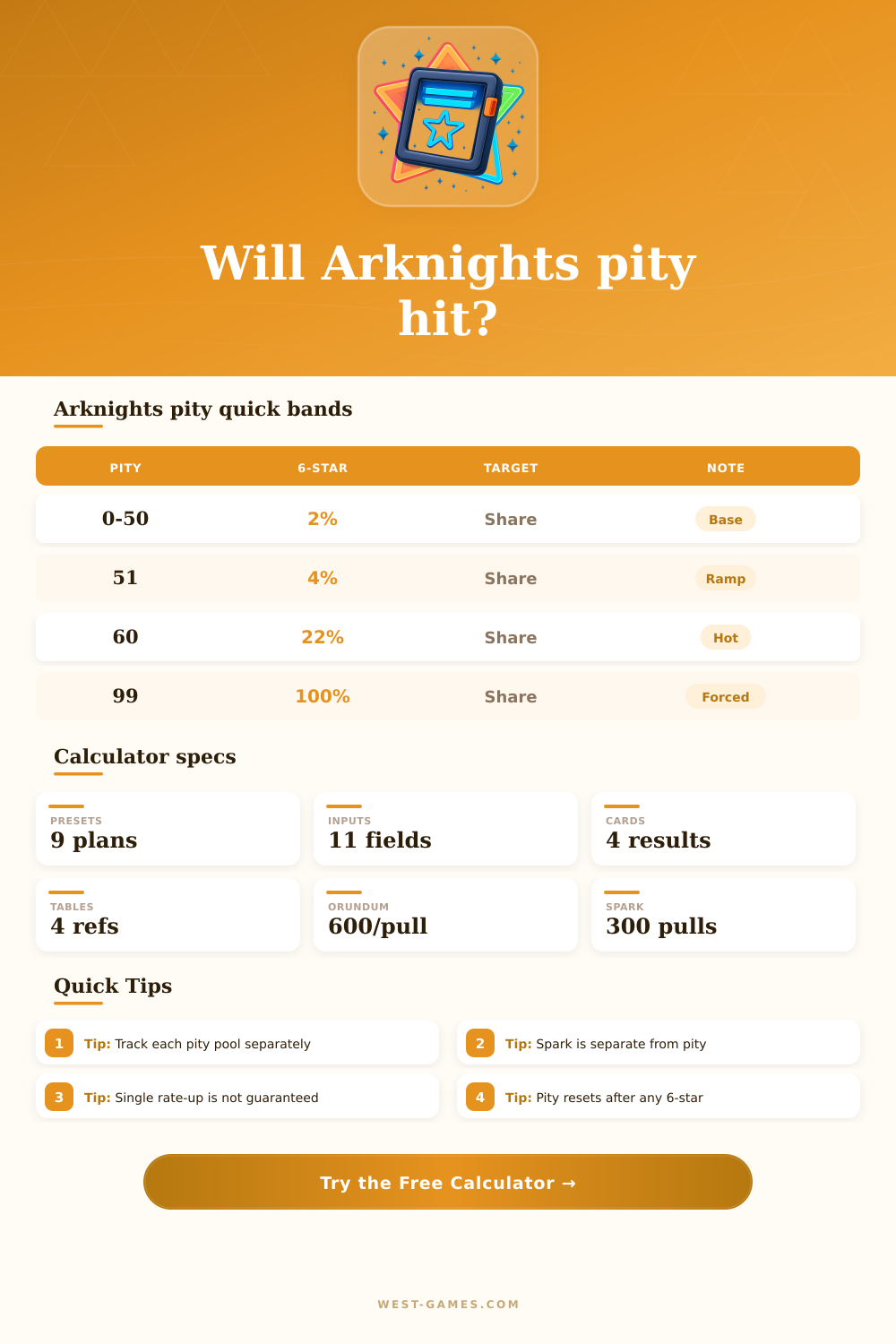
🎯 Arknights Pity Calculator
Estimate 6-star odds, featured target chance, orundum conversion, tickets, pity ramp, guarantee context, and limited spark progress before committing pulls.
| Pity before pull | Next 6-star rate | Meaning | Planning note |
|---|---|---|---|
| 0 to 49 | 2% | Base rate | Variance heavy |
| 50 | 4% | Ramp begins | First boosted pull |
| 60 | 24% | High pressure | Many accounts hit soon |
| 70 | 44% | Very high | Target share still matters |
| 98 | 100% | Forced 6-star | Any 6-star resets pity |
The calculator treats the next pull after 50 misses as the first boosted pull and raises the 6-star rate by 2 percentage points each pull.
| Banner target | Share on 6-star | Best selection | Risk note |
|---|---|---|---|
| Single event operator | 50% | Single featured | No normal hard target |
| One of two standards | 25% | One of two | Can hit other rate-up |
| New limited unit | 35% | Limited single | Spark may rescue |
| Either new limited | 70% | Limited either | Broader target |
| Any 6-star | 100% | Any 6-star | Pity-only check |
Use the rate-up type to define what counts as success. A 6-star hit is not automatically the operator you want.
| Resource | Pull value | Calculator field | Note |
|---|---|---|---|
| Orundum | 600 = 1 pull | Orundum available | Remainder tracked |
| Single permit | 1 pull | Tickets | Add directly |
| 10-pull permit | 10 pulls | Tickets | Enter as 10 |
| Event pulls | 1 pull each | Extra pulls | Same banner only |
| Data contract | 1 per limited pull | Spark count | Limited banners |
The planned pull cap lets you reserve part of your saved pulls while still counting your full resource pool in the gap.
| Scenario | Main risk | Useful input | Watch result |
|---|---|---|---|
| Fresh event | Low early 6-star odds | Pity 0, 50% target | Expected pulls |
| Near soft pity | Off-banner 6-star | Pity 50+ | Chance within plan |
| Limited spark | Long contract path | Spark progress | Resource gap |
| Joint Operation | Four-way split | 25% target | Confidence pulls |
| Any 6-star | No target filter | 100% target share | Next pity timing |
For banners with separate counters, keep separate pity notes instead of mixing all historical pulls together.
Gacha systems is a combination of patience and probability. Pulling an operator has a base two percent chance for six-stars. Pity bumps up those chances if it doesn’t work out. You weigh the risk of inconsistent results against savings. While most pullers are interested in any six-star unit available, it’s realy about which one. Some banners has a 50/50 chance at the unit they feature while others divide that between several units. If you’re after a limited operator and hit pity on a regular unit, it still stings even though the regular unit is six-star.
To avoid tracking down your own pulls, the calculator can figure out numbers based off your resource pool and target. The pity ramp also explains why the game works as it does. Your odds don’t stay the same; they shift with time. From the moment you fail to get a six-star after 50 pulls, the chance starts increasing. By pull 60, it’s up to 22%. At pull 99, it’s 100%. This means if you go 40 pulls without getting anything back, it is not unlucky but statistically within the norm. Pity isn’t just inevitable, it’s expected.
How Gacha Pity Works
There are two more parts to this system… Limited banners introduce a new twist via spark contracts. These give you a shot at a particular operator no matter what happens during a single pull, so long as you gather enough Headhunting Data Contracts. Instead of trying to predict probabilities, best course of action becomes resource management. Depending on how far along you are in your contract pile, the tool recalculate the number of pulls required to unlock an operator.
There’s also the issue that many players simply save up all their currency and don’t think about which banners drop what. Banners change frequently while Orundum build up gradually. Saving up too much may result in you missing out on an operator who won’t reappear for years. Unless the character completes a hole in your team, it isn’t smart to go all-in on a normal event.
Before parting with any money, think about how many total pulls this represents and what else you could of gotten from it. Looking at the expected number of pulls helps put this decision in perspective. Because starting rate is so low, it takes about sixty or even seventy pulls for most accounts to get a six-star. That’s your baseline number to use when planning for how much to save up. With only enough tickets for twenty pulls, the chances aren’t high unless you’re already deep into pity mode. Understanding this allow you to better decide if you should spend now or wait.
Your pity counter gets reset too for duplicates. If you need ascension materials and get a six-star operator you already have, it doesn’t advance your roster. It’s going to be a bummer if this happens late in the pity ramp. It’s modeled in the calculations this way: Anytime you get a six-star, it’s like a reset point where the odds will start from the base rate. That way, the model ensures that your subsequent odds starts from the base rate again.
The idea with gacha is more about managing risk than predicting things. There is no way for you to know exactly what operators you’ll see or how much free currency you’ll get. All you can control are when you pull and how aggressively you’ll spend resources. Protect yourself from chasing your losses by setting a hard limit before starting. For that matter, maintain distinct record-keeping for every headhunting pool. Kernel, limited and standard banners has their own counters, and they don’t mix. So make sure to track your pulls carefully, and check back after every play to know how far away (or near!) you are to pity thresholds.
Self-control is what fills your wallet and keeps your inventory stocked. Just like your tactical skill, the game also challenges your resolve. Know which resources are worth it, know how rates change, and you’ll flip random chance into a calculated investment. Maybe you won’t get it right from the start, but at least you’ll know just how close.