🧬 Marvel Rivals MMR Calculator
Estimate hidden matchmaking rating, hero-role fit, visible rank pressure, team and enemy lobby strength, match result impact, party noise, streak momentum, and expected rank movement.
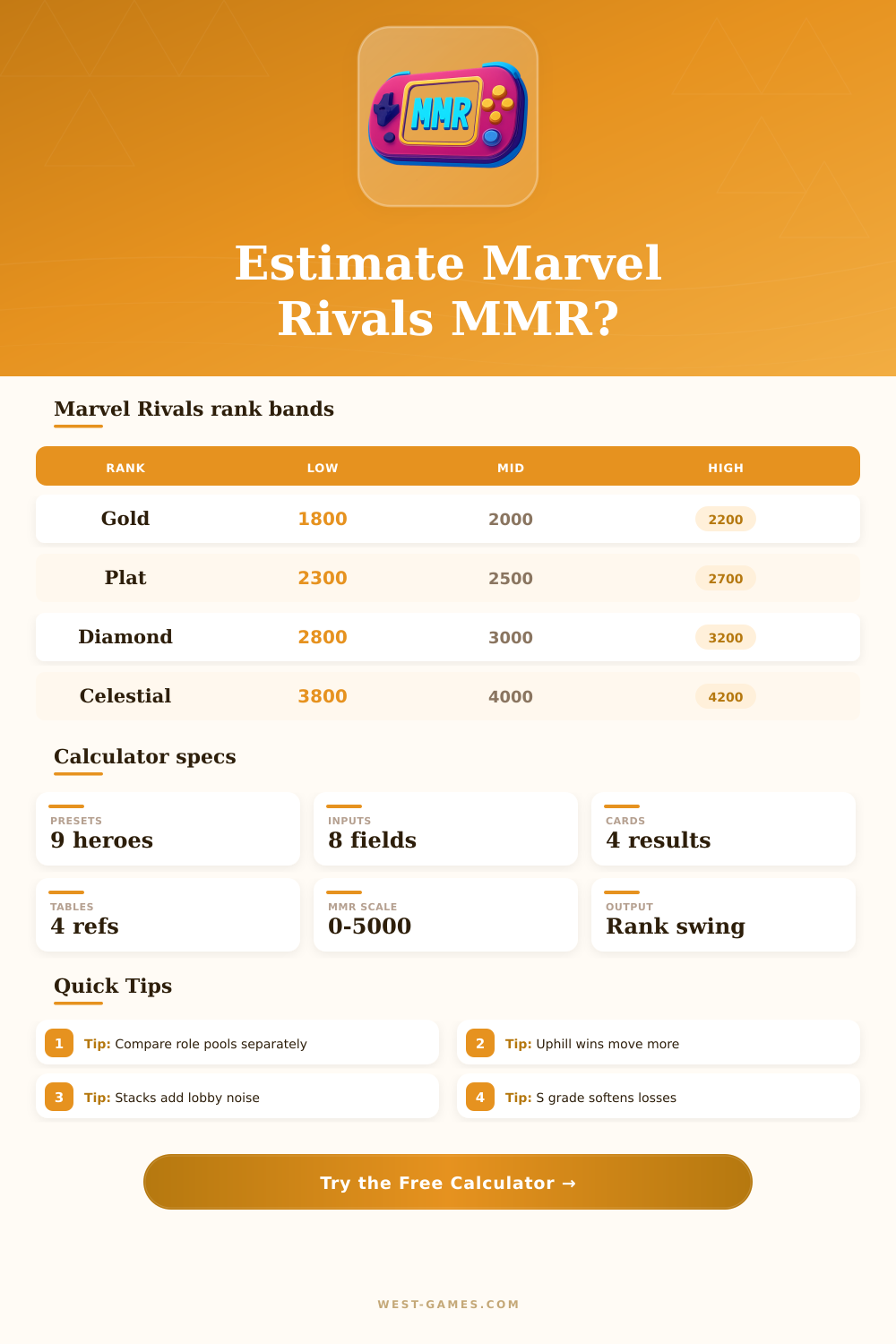
| Rank | Tier III | Tier II | Tier I | Planning note |
|---|---|---|---|---|
| Bronze | 600 | 800 | 1000 | Early ladder spread |
| Silver | 1200 | 1400 | 1600 | Basics stabilize |
| Gold | 1800 | 2000 | 2200 | Team play tested |
| Platinum | 2400 | 2600 | 2800 | Role duty matters |
| Diamond | 3000 | 3200 | 3400 | Mistakes punished |
| Grandmaster | 3600 | 3800 | 4000 | High lobby speed |
| Celestial | 4200 | 4400 | 4600 | Elite consistency |
| Eternity | 4700+ | Points continue | ||
| One Above All | Top band | Leaderboard range | ||
This is an estimator scale for calculator math, not an official hidden MMR conversion chart.
| Archetype | Volatility | Perf weight | Typical signal |
|---|---|---|---|
| Vanguard anchor | 1.02x | Normal | Space and peel |
| Brawl Vanguard | 1.08x | High | Engage timing |
| Hitscan Duelist | 1.05x | High | Pick pressure |
| Dive Duelist | 1.12x | High | Backline breaks |
| Main Strategist | 0.96x | Normal | Uptime and saves |
| Flex counter | 1.00x | Normal | Swap value |
Volatile roles can move faster, but only when the match result supports the performance signal.
| Result | Base signal | Lobby effect | Meaning |
|---|---|---|---|
| Clean win | Strong gain | More if uphill | Clear positive read |
| Close win | Solid gain | Cleanest compare | Good MMR proof |
| Draw | Flat | Performance only | Low movement |
| Close loss | Small loss | Soft if uphill | Competitive lobby |
| Rough loss | Strong loss | Worse if favored | Rating pressure |
The calculator separates result, lobby difficulty, and personal grade so the output is easier to audit.
| Profile | Party | Streak | Model effect |
|---|---|---|---|
| Solo hot | 1 | +3 | Momentum boost |
| Solo cold | 1 | -3 | Loss pressure |
| Duo | 2 | +/-2 | Slight dampening |
| Trio | 3 | 0 | More noise |
| Stack | 4-6 | +/-3 | Team context |
Larger groups can win cleanly, but the model treats stacked results as less purely individual.
But then you win that brawl, dominate the fight, yet still get dropped in rank. That’s annoying! What gives?
That’s math. You see, there’s a visible rank: the one you can see and what people sees as your rank. But that doesn’t reflect how match making sees you. The true number is called Matchmaking Rating (MMR). Knowing about MMR will help you ascend ranks in Marvel Rivals.
What Is MMR and Why It Matters
While most players look at their tier, they forget about engine behind it all. How much stronger was the other team? How many member were in your party? Did you perform well or poorly? Those are all part of formula used by the calculator up top. It’s more accurate than just looking at win/loss records. The core concept is simple once you stop looking at results and start looking at context.
So let’s say your MMR is around Platinum I but you’re ranked Gold III. Well, the system believe you’re good. To test this assumption, it queues you up against tougher competition. When you defeat them, you get more points since you’ve proven your ability. When you don’t win, you drop fewer points; the system assumed a win wasn’t going to happen. That’s why some players level up rapidly while other player get stuck. Even though they’re in the same bracket, they’re playing different game.
How do you know? You must know what the system is measuring. It’s not measuring damage per second. It’s measuring how you perform compared to rest of the lobby. It turns out, your hero choice matters more than most people realize. A Duelist who gets one pick and dies creates a different signal than a Vanguard anchor who holds a position for twenty seconds. That difference is why the tool apply volatility multipliers based off hero type.
Results vary wildly with dive duelists, which mean higher variance. Strategists’ value is tied to uptime, so their curve are steadier. You can’t compare an individual clutch play to playing defensively without considering each person’s role. Those differences are well illustrated in the tool’s reference tables. They’ll tell you that damage saved and space made carry less weight for someone filling a particular role.
Noise comes from party dynamics. Solo players don’t experience these same dynamics. If you’re playing with your friends, the system will have trouble separating skill from everyone else’s contributions: maybe you won because everyone’s good at it or maybe one of your teammates carried you through the win. To account for this uncertainty, the model reduce point changes for larger parties. Winning in a 6 stack contribute less towards personal improvement than winning alone.
It gets more complicated still when we consider streaks. A winning streak implies momentum; a losing one imply tilt. These ratings modifiers shift gains/losses accordingly so that over time the rating remain accurate. They also prevent drastic reactions based on hot hands/bad luck.
The ranking system combines both gameplay reality and ranking psychology in its performance grades. For example, losing while performing an S grade will get you a much smaller point reduction. It informs the system that you are playing beyond your skill level and lost as a result of outside forces. Winning with a D grade can also lead to near zero-point gain as it flags that you performed poorly but still managed to win over inferior opponents. This ensures players cannot simply pick their safe heroes in weak lobbies and farm out wins. Consistent execution earn gains. Simply being present in the lobby doesn’t count.
Most climbing advice focuses on hero mastery or map knowledge. While those certainly have there merit, nothing matters more than knowing what wins you points. Win matches with high impact grades and before you know it, you’ll jump several ranks. The moment your MMR exceeds the rank you’re showing, points start pouring in. Prove you deserve to be here and you will be.
But fail to keep pace with your MMR and every match becomes a battle. Gains are fewer and farther between; losses sting even more. It is a small difference but an important one. Because when you take off the curtain, you don’t play Marvel Rivals anymore, you negotiate against an algorithm looking for your ceiling.
When you see the numbers pulling the strings, the aggravation goes away. And that’s where strategy matters. Change the foundation and the visible rank follow suit.