🎮 TFT MMR Calculator
Estimate Teamfight Tactics LP and hidden MMR movement from rank, tier, LP, placement, lobby strength, streak pressure, top-four rate, and set calibration.
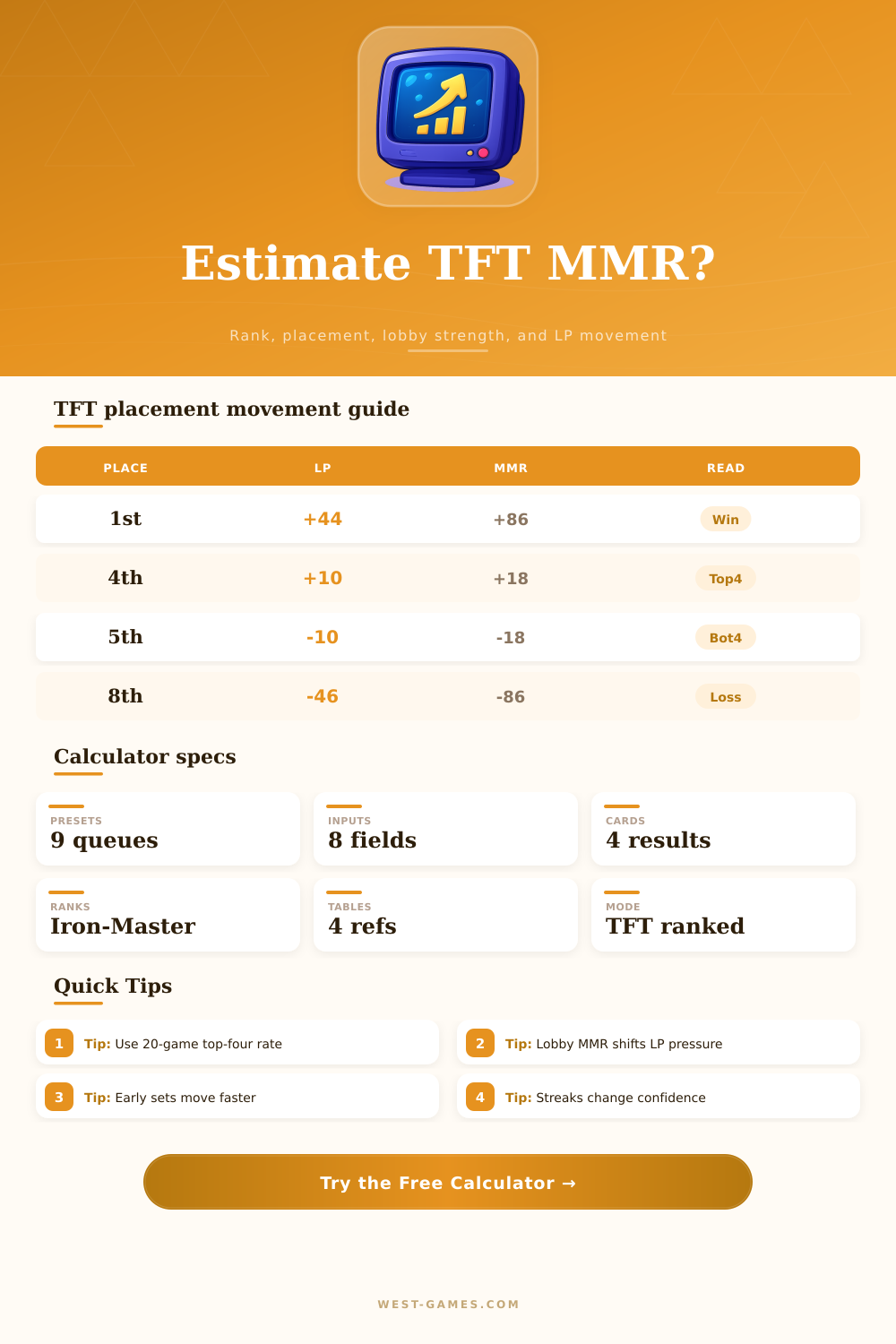
| Place | Base LP | Base MMR | Signal |
|---|---|---|---|
| 1st | +44 | +86 | Lobby win |
| 2nd | +31 | +58 | Strong top two |
| 3rd | +20 | +36 | Clean top four |
| 4th | +10 | +18 | Safe positive |
| 5th | -10 | -18 | Narrow loss |
| 6th | -22 | -40 | Clear loss |
| 7th | -34 | -62 | Heavy loss |
| 8th | -46 | -86 | Last-place hit |
Real LP varies by account state. These baselines are adjusted by lobby MMR, rank pressure, streak, top-four rate, and calibration.
| Rank band | MMR anchor | LP swing | Common read |
|---|---|---|---|
| Iron-Bronze | 700-1050 | Wide | Fast correction |
| Silver-Gold | 1200-1800 | Normal | Form matters |
| Platinum-Emerald | 1950-2550 | Tighter | Lobby gap matters |
| Diamond | 2700-3150 | Strict | Bot fours punish |
| Master+ | 3300+ | MMR led | LP mirrors rating |
The calculator uses these anchors to estimate whether your visible rank is above, near, or below hidden matchmaking strength.
| State | LP factor | MMR factor | Use when |
|---|---|---|---|
| Placements | 1.24x | 1.34x | First ranked games |
| Early set | 1.14x | 1.20x | New set climb |
| Normal | 1.00x | 1.00x | Regular queue |
| Stable | 0.90x | 0.86x | Large sample |
| Returning | 1.10x | 1.16x | Long break |
Volatile accounts react more to single games; established accounts require repeated results to shift hidden MMR.
| Recent top-four | Form score | LP pressure | MMR read |
|---|---|---|---|
| 60%+ | Hot | Positive | Rank may lag |
| 53-59% | Good | Slight gain | Healthy climb |
| 47-52% | Neutral | Flat | Fairly placed |
| 40-46% | Cold | Negative | Rank pressure |
| Under 40% | Risk | Demotion drag | MMR falling |
Top-four rate is best read with sample size. A few games can swing hard, but 20 games gives a practical ranked signal.
After playing a good game of Teamfight Tactics where you finish in the top four using a strong build and playing well, you win some games and expect to earn a lot of League Points (LP). Instead, you get just a handful. Last week, that exact same score netted you double the points then. Was it luck? No, it was your secret Matchmaking Rating (MMR).
While the ranks displayed is simply a show for you, it’s this MMR that drives or hinders you. Knowing the ins-and-outs of this relationship will ensure you’re getting consistent progress instead of being stranded at lower-tier rank. This site lets you input those numbers and crunches them for you. And once you understand what it’s measuring, you can have confidence in those numbers.
How Hidden MMR Works in Teamfight Tactics
Here’s how it works: hidden MMR runs on expectation. Winning when you’re weaker than the players you’re matched with mean big-time gains. You beat the odds, and that’s worth a lot. Losing against a stack of stronger player? Not so much; after all, they were expected to win.
The reason new placement sets seem fickle is because system doesn’t yet know where you really belong. It’s weighing every game heavily, attempting to get a grasp on your actual tier. In ranked matchmaking, consistency isn’t everything, context is. The second variable is lobby strength.
Playing a game against someone of greater estimated MMR are equivalent to the system testing your level. If you beat them and place top four then yes, you’re good enough for their level, and the hidden rating will spike upwards sharply. Placement combined with baseline modifier is shown on the reference table. Not only does it matter if you placed fourth, but it matters if you placed fourth against people you “shouldn’t” have placed fourth against.
This also helps explain the experience of those who feel as though they are stuck even with a fifty percent top-four rate. Maybe they are consistently placing fourth in lobbies that is slightly weaker than themselves. In that case, every time they top-four, they just confirm what the system already knows instead of showing anything new.
Then there’s stats like streaks. Momentum matter: you get more LP from winning streaks and less from losing ones because they don’t want you to coast on luck. If you’re on a five-game top-four streak, the algorithm know your performance level has changed, that it’s not just dumb luck. You’ve played better! And if you forget about that, you’ll make bad choices, like trying to force a play style so you can keep up your streak (which will usually bite you). Better to suffer a little loss and restart your trend than risk a bigger one and pay more MMR down the line.
The level of aggressiveness for adjustment depends on volatility. Volatile means new account or an old account that has been dormant for a while. So swings the estimate pretty hard based off a single game. Low volatility refers to established accounts where it take many similar outcomes to affect things at all. The first time you come back from a hiatus it’s painful. It doesn’t know who you were before, so it starts over by needing proof of what you are good at now. One fluke win doesn’t do it. You’ve gotta earn trust again by playing many games to recieve it.
That’s not true for master tier players, they live in the world of MMR, where LP doesn’t represent another currency but simply a reflection of their rating relative to others. Everyone else is always a few steps behind. Your hidden ranking might be higher, meaning you get tougher competition and barely pick up any LP. Or it might be lower, meaning you get an easier lobby and don’t drop ranks.
Knowing what situation you’re in helps avoid getting angry. If you’re playing well but seeing no improvement, look around at your underlying rating, maybe it’s caught up to your public rank already. The ladder likes people who can see past its shiny outside and into the gears that make it tick. Be patient; panic gets you nowhere. You should of waited more.