⏱ PoE Cooldown Calculator
Plan Path of Exile guard skills, travel charges, warcries, trigger locks, charge banks, and uptime windows without reducing the build to only cooldown recovery.
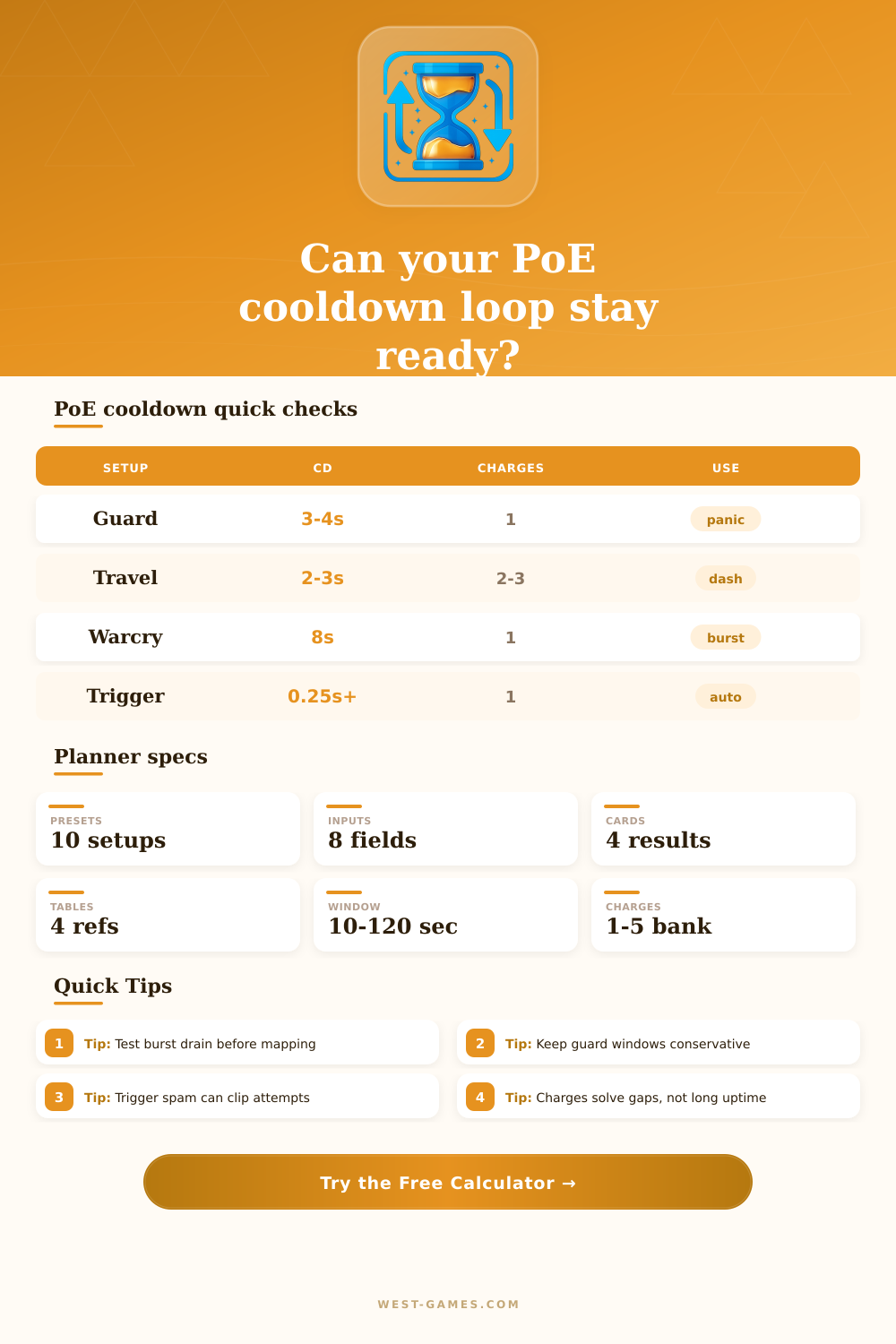
| Family | Typical check | Risk signal | Best result |
|---|---|---|---|
| Guard skill | 3-4 second base | Boss hits inside downtime | Uptime covers danger |
| Travel skill | 2-3 charges | Empty bank after burst | One charge held back |
| Warcry | Long utility cycle | Exert plan desyncs | Predictable rhythm |
| Trigger | Internal lockout | Many events clipped | Attempts match unlocks |
Use the calculator fields to overwrite these ranges for the gem level, supports, or build condition you are testing.
| Charges | Burst feel | Recovery ask | Common use |
|---|---|---|---|
| 1 charge | Single answer | Wait full refill | Guard or warcry |
| 2 charges | Double tap | One refill cushion | Dash chain |
| 3 charges | Mapping bank | Can over-dash | Flame Dash |
| 4-5 charges | Deep bank | Long full reset | Utility stacking |
Charges reduce short-term danger but do not create permanent uptime if the long-window demand is too high.
| Attempt gap | Cooldown | Result | Interpretation |
|---|---|---|---|
| Faster than CD | Locked | Clips | Events are wasted |
| Near CD | Even | Stable | Good trigger rhythm |
| Slower than CD | Ready | Idle | Cooldown is not the limit |
| Burst events | Banked | Drains | Check full-bank time |
A trigger setup can look strong on paper but lose value if most incoming events happen during the lockout.
| Uptime | Status | Build meaning | Action |
|---|---|---|---|
| 0-30% | Spot use | Panic or dodge only | Save for danger |
| 31-60% | Partial | Good boss timing helps | Track downtime |
| 61-85% | Strong | Covers many patterns | Plan around gaps |
| 86-100% | Near loop | Effect nearly overlaps | Check trigger clips |
High uptime can still be unsafe if the downtime lines up with the enemy hit that actually matters.
Cooldown management are a central part of the game Path of Exile. Cooldown management will determine whether a player’s builds succeeds or fail. Builds succeed when the player utilize there skills at the appropriate time within their cooldown.
However, builds fail when the player utilizes skills during their cooldowns when those skills isnt yet ready for use by that player. Thus, players must understand the difference between the amount of time between when a skill becomes ready and when that same player must use that skill again. There are several types of cooldowns within Path of Exile.
How to Manage Skill Cooldowns in Path of Exile
Guard skills, for instance, have a base cooldown of four second. During that guard skill cooldown, the player is protected from one hit. However, during this same cooldown, the player may become vulnerability to the next incoming hit.
Additionally, travel skills dont use the same type of cooldown timers as guard skills. Instead, travel skills use charge banks. Thus, players must understand how many charge they have available to utilize these travel skills.
Warcries is another type of cooldown that is different than both guard skills and travel skills. The value of warcries is found within their recovery window as well as their exert window. Finally, triggers are yet another type of cooldown that is more different from the other cooldown types.
The difference between triggers and other skills is that internal locks prevents the skill from firing. The calculator presented on this page yields mathematical results after the player enter information regarding the base cooldown of a specific skill, the charge count of that specific skill, and the spacing between each time the player desires to attempt to utilize that skill. Based off these entries, the calculator will show the player how many use of that specific skill can fit within a given window of time.
Additionally, the calculator will also show the player how long it will take for the player to regain there full bank of charge after utilizing a burst of there charges. These outputs from the cooldown calculator can help a player to understand whether their rhythm for utilizing their skills will lead to periods of lacking those skills during periods of pressure, or whether they will experience idle periods between the use of their skills. Furthermore, the reference tables included on the page display the most common cooldown ranges for different type of builds within Path of Exile.
These tables can allow a player to understand whether they should invest in cooldown abilities, or if they should save one of their charges as an extra. In many cases, players may only consider the base cooldown of the skills that they wish to utilize. The base cooldown is, therefore, not the only cooldown that players should consider.
For instance, consider that a skill may have a relatively short cooldown but do not have any charges associated with it. In this case, the player will fail to use that specific skill if they require the use of two skills within a short period of time. In another example, consider a skill that has a long cooldown but has multiple charge.
In this case, the skill will feel more responsive when the player uses it due to the charges on the skill. Boss fights is one way that the theory of cooldowns can become contrasted with the practice of cooldown management. For instance, guard skills may appear strong in theory but may leave the player vulnerable in practice during a boss fight.
During each boss fight, the guard skill has a downtime after each use of the guard skill. Thus, during the downtime of the guard skill, the player is vulnerability to an enemy attack. Mapping in the game is different from boss fights in that mapping require movement.
Thus, players must manage their charge banks during map building. This cooldown calculator allows players to test the outcomes of spending several charges in quick succession with the goal of mapping an area. The calculator will reveal at what point the next charge will return to the player.
This information can help a player to decide if one charge should of been saved to account for an unexpected threat or if the full bank of charges should be used to navigate the game area. Some common mistake that players make in relation to cooldown management is the failure to recognize the differences between cooldown types. For instance, applying the same cooldown recovery as is applied to guard skills can be applied to warcries, despite the two types of skills having different functions within the game.
In addition to this example, some players may apply the same amount of importance to triggers as they do to other types of skills, despite the internal locks of triggers that prevent them from firing after each instance. Cooldown planning is the process of adjusting a player’s skills to ensure that they match the rhythm that the player encounters within the game. The cooldown calculator allows a player to test different skill rhythms prior to entering a boss fight arena.
Thus, if the numbers within a player’s build match the rhythm of the content that the player will encounter, the player will find that their build function properly during gameplay.