🦖 Dino Stat Calculator
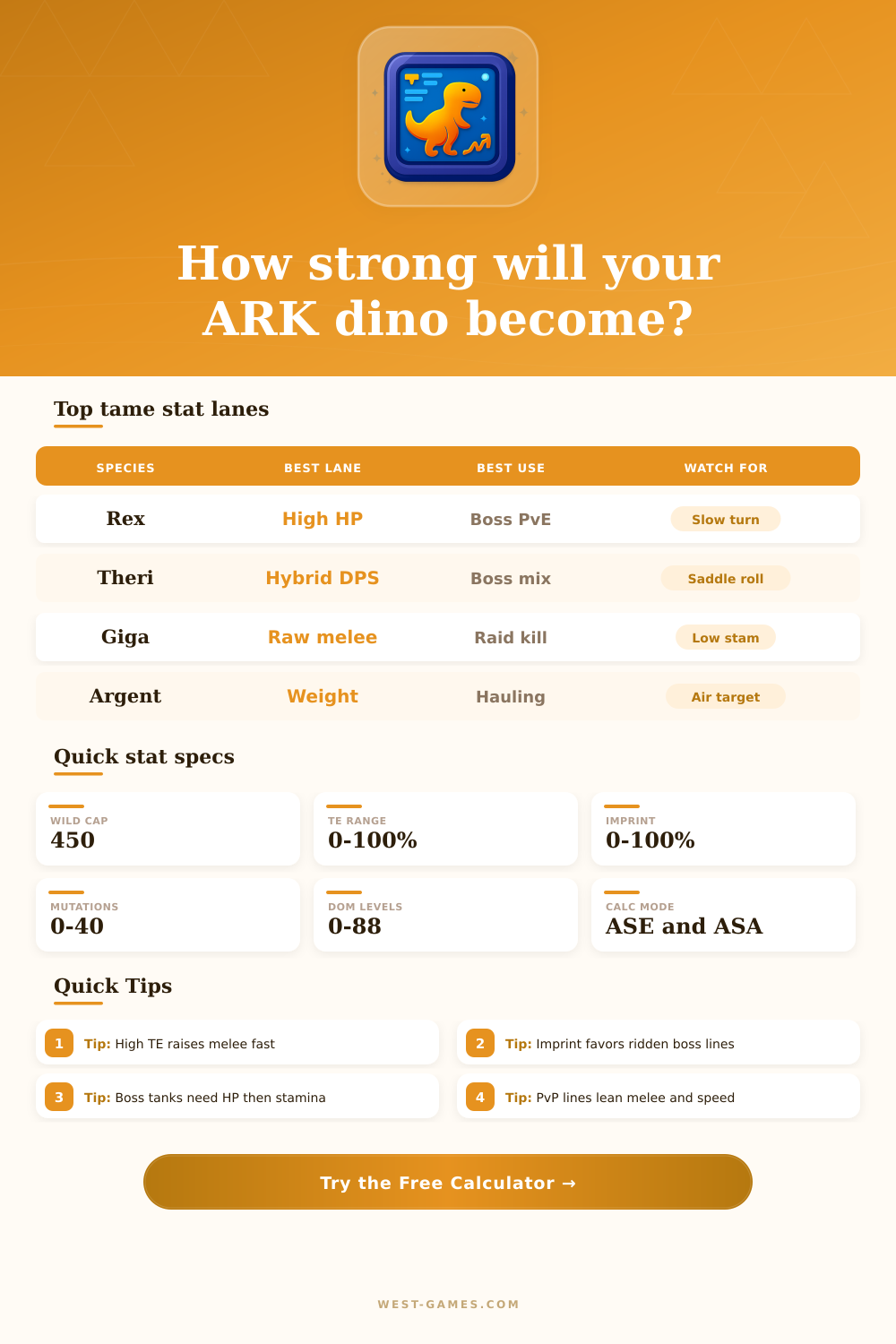
Estimate ARK tame outcomes with wild points, taming effectiveness, imprint, and domestic levels before you lock a breeding or PvP line.
| Species | Base HP | Base Stam | Melee / pt |
|---|---|---|---|
| Rex | 1100 | 420 | 5.5% |
| Therizino | 870 | 450 | 5.0% |
| Giganotosaurus | 80000 | 400 | 5.0% |
| Argentavis | 365 | 400 | 3.0% |
| Shadowmane | 825 | 400 | 4.0% |
| Managarmr | 730 | 300 | 3.5% |
| Basilosaurus | 1000 | 650 | 4.0% |
| Wyvern | 1725 | 315 | 5.0% |
Use this as the baseline before wild points, taming effectiveness, and domestic levels are applied.
| Lane | Low roll | Strong roll | Elite roll |
|---|---|---|---|
| Health | 20-28 pts | 29-38 pts | 39+ pts |
| Stamina | 15-22 pts | 23-30 pts | 31+ pts |
| Melee | 22-32 pts | 33-42 pts | 43+ pts |
| Weight | 10-18 pts | 19-26 pts | 27+ pts |
Strong wild rolls reduce domestic level pressure and leave more room for goal-specific tuning.
| Goal | Main split | Secondary split | Focus note |
|---|---|---|---|
| Boss Tank | HP 50% | Melee 25% | Survive long phases |
| PvP Burst | Melee 45% | HP 28% | Short kill windows |
| Utility Carry | Weight 45% | Stam 25% | Haul and travel |
| Travel Speed | Stam 40% | Melee 20% | Distance uptime |
| Harvest Grind | Weight 35% | Melee 30% | Farm sessions |
| Breed Foundation | HP 35% | Melee 30% | Balanced breeders |
These splits define how domestic levels are allocated by the calculator for each playstyle target.
| Profile | Wild mult | Tame mult | Practical cap |
|---|---|---|---|
| Official PvE | 1.00 | 1.00 | 450 wild |
| Small Tribes | 1.00 | 1.00 | 450 wild |
| Boosted PvP | 1.20 | 1.25 | 450 wild |
| Private Breed | 1.50 | 1.35 | 450 wild |
Higher multipliers increase point impact, so target lanes can cap earlier than official baselines.
To prepare a dinosaur for combat or utility in the game ARK, you must project the final statistics of the dinosaur that you intend to tame. Projecting the statistics of the dinosaurs are necessary because the statistics of the dinosaurs determine the performance that it put forth in various scenarios within the game. By failing to project these statistics before taming a dinosaur, you may find yourself investing into a dinosaur that dont have the necessary health or damage to perform certain tasks.
In order to successfully project the statistics of a dinosaur, you must consider its wild levels, the taming effectiveness of that specific dinosaur, and the distribution of its domestic levels. The wild levels of a dinosaur will determine the strength of the dinosaur in its wild state. However, the taming effectiveness will determine how many of those levels will be retained after you tame the dinosaur.
How to Plan Your Dinosaur’s Stats Before Taming in ARK
The higher the taming effectiveness, the more points that will be added to the dinosaur’s domestic statistics. Domestic levels can then be distributed into different categories, such as health, melee damage, stamina, and weight. Depending on the use of the dinosaur, different statistics is more important than others.
For instance, if the goal is to utilize the dinosaur in fights with game bosses, health will be more important than other statistics. In contrast, if the goal is to use the dinosaur to transport items, then weight would be more important. The different species of dinosaurs have different base statistics.
To successfully project their statistics, you must become familiar with the different statistics of each of these species. For instance, the Tyrannosaurus Rex has high base health, so each point placed into health will contribute to the health of the dinosaur. Argentavis dinosaurs have different statistics, so weight could be a more important category than others.
The Giganotosaurus has very high health statistics, but due to the taming penalty, melee damage may take priority. If these statistical quirks are not accounted for, the health of the dinosaur could be high, but the stamina may be lacking, which would prevent it from being able to fight other dinosaurs for long period of time. To prepare your dinosaurs appropriately, you should create goals for what you would like the dinosaur to do.
If you would like to use your dinosaur as a boss tank, you should allocate half of the domestic levels to health. This will allow the dinosaur to survive the fights with the games bosses. If you are playing player versus player battles, you may want to allocate 45% of the domestic levels to melee damage.
High melee damage will allow your dinosaur to kill the other players quick. For utility dinosaurs, such as an Argentavis, the domestic levels should be distributed into the weight and stamina statistics. These stats will increase the weight that the dinosaur can push or the length of time that it can remain in the air on its flights.
Creating these goals ensures that the domestic levels are distributed appropriately. Random distributions of domestic levels will result in dinosaurs that are not as useful as they could of been for their roles. The levels of the dinosaurs at the time of its capture will have a variable impact on the projected statistics of the dinosaur.
If the dinosaur features high stats in relation to melee, you will need fewer domestic levels to allocate to melee damage. High health statistics will require fewer domestic levels to be allocated to health statistics for the dinosaur. Many players make the mistake of taming a dinosaur based on the total level of the dinosaur but neglecting to check whether the individual stats are beneficial to its role.
The server multiplier that the game features also multiplies the statistics of a dinosaur, so players must be aware of the rules of there server. Another factor that will impact the statistics of a dinosaur is imprinting. When a dinosaur is fully imprinted, it will have a 20% bonus to its health and a 30% bonus to its melee damage when the dinosaur is ridden.
These statistics will significantly impact the effectiveness of the dinosaur in combat scenarios. Mutations are another factor that can be considered. Through mutation, the stats of a dinosaur will increase across generations if bred consistently.
Each mutation will provide additional multipliers to the stats of a dinosaur. When breeding and taming dinosaurs, it is essential to avoid some common pitfalls. One of the most common is focusing too early on obtaining the perfect taming effectiveness for the dinosaur.
This will waste valuable time hunting for other dinosaurs. In player versus player battles, many players make the mistake of overstacking melee damage while neglecting stamina. If the stamina bar of the player’s dinosaur is low, it will not be able to battle opponents for long periods of time.
Breeding also introduces other common pitfalls, such as focusing too much on pumping one statistic of a dinosaur, which results in offspring with unbalanced statistics. Maintaining a balance in the breeding of dinosaurs will result in offspring with beneficial statistics. Using preset builds for different types of dinosaurs can significantly reduce the chances that players make mistakes in breeding their dinosaurs.
Preset builds are already tuned for specific tasks, such as breeding Tyrannosaurus Rex dinosaurs or Giganotosaurus raiders. By utilizing these preset builds, players can view how their specific wild levels will perform given their domestic levels. By calculating the total power score of the dinosaur using the combat, survivability, and utility stats, players can determine how effective each dinosaur will be for the player’s goals.
Before using kibble to tame a dinosaur, players should view the dinosaur as a collection of its projected statistics. These statistics will provide an idea of what the player will need to prepare the dinosaur for its specific roles in the game.