🛠 Rust Crafting Calculator
Plan blueprint batches, station speed, and resource totals before you queue the next craft run.
Pick a recipe to see how the batch, quality tier, and station choice shape the resource pile.
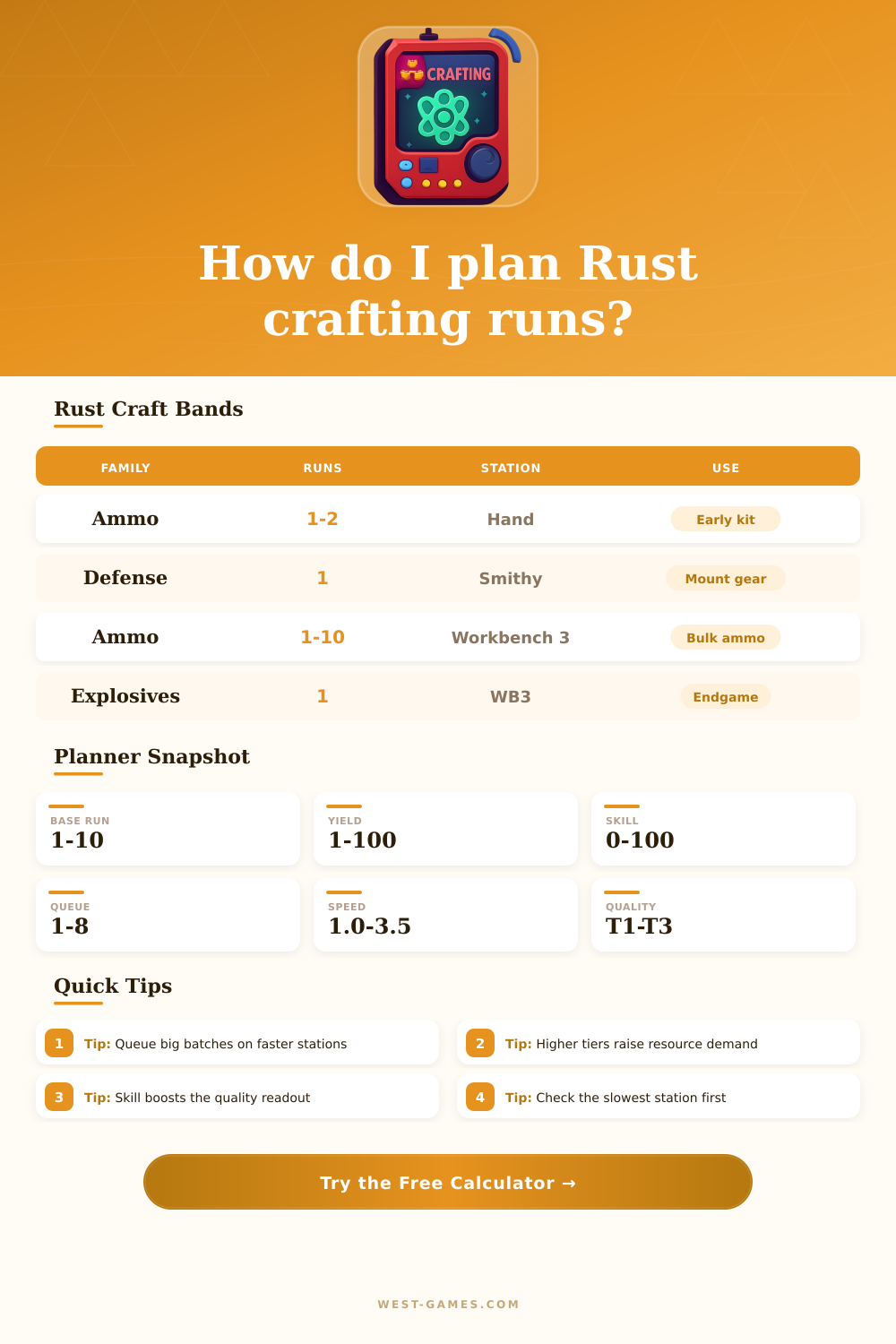
| Family | Yield | Base time | Best station |
|---|---|---|---|
| Starter tools | 1 | 1.2m | Hand craft |
| Stone base | 1 | 1.8m | Smithy |
| Defense | 1 | 2.0m | Smithy |
| Ammo | 100 | 0.8m | Workbench 3 |
| Metal kits | 1 | 2.4m | Forge |
| Explosives parts | 1 | 5.2m | WB3 |
Use the family table to spot which jobs are batch-friendly and which ones need a stronger station to stay practical.
| Station | Speed | Queue | Best for |
|---|---|---|---|
| Hand craft | 1.0x | 1 | Small tools |
| Smithy | 1.35x | 2 | Early gear |
| Workbench 3 | 2.05x | 4 | Ammo, tech |
| Chem bench | 2.30x | 5 | Chemicals |
| Industrial forge | 2.75x | 6 | Metal bulk |
| Explosives replicator | 3.50x | 8 | High end |
Queue size matters almost as much as raw speed when the recipe turns into a long batch run.
| Tier | Cost mult | Time mult | Skill push |
|---|---|---|---|
| Primitive | 1.00x | 1.00x | Low |
| Ramshackle | 1.14x | 1.05x | Small |
| Apprentice | 1.28x | 1.10x | Mid |
| Journeyman | 1.42x | 1.14x | Strong |
| Mastercraft | 1.60x | 1.19x | Heavy |
| Ascendant | 1.84x | 1.25x | Huge |
Blueprint tier pushes both resource pressure and craft time, so high rolls should be matched with a good station.
| Skill | Class | Quality readout | Use |
|---|---|---|---|
| 0-19 | Rough | Low output | Starter craft |
| 20-39 | Solid | Stable | Mid game |
| 40-59 | Sharp | Better rolls | Daily gear |
| 60-79 | Elite | Strong | Advanced batch |
| 80-89 | Prime | Very strong | High tier |
| 90-100 | Ascendant | Top tier | Endgame |
Skill scores help you compare crafters, but the station and tier still decide how fast the batch clears.
Crafting is a process that turns materials into useful items. To reach the crafting menu, press Q by default. Here you can look at an item to see what resources are required for it.
Search for the needed items, click on them and then click the button to craft. Also it is possible to decide how many of each item to produce. When players progress in Rust that menu becomes more important.
How to Craft Items in Rust
There are four levels of crafting: Basic, Level 1, Level 2 and Level 3. To make basic items, a player only requires the materials. Some items cannot be crafted unless you built a base with a workbench of Tier 1 until 3 and the blueprint of the item was learned by breaking it in a Research Table.
Crafting forms the base of survival in Rust. Through it raw materials from the wilderness turn into tools, weapons and structures to survive. Rust has a focus on crafting, although it is limited at first until you find items in the open world of the game.
Crafting certain things still requires rare items, but many of them are now easier to find than befor and many even can be crafted.
The first things that you must craft are the Stone Hatchet and Stone Pickaxe. The starting rock is terrible for harvesting, so you require something more efficient to build a base from wood and stones. Most basic items, like a stone hatchet or campfire, can be made from materials found on Rust Island, like stone or wood.
Other items require special materials, like wooden planks or refined metal.
Hatchet and pickaxe are very efficient, and they do not feel too bad to lose when someone kills you. For more advanced gear the cost of crafting, for example for a semi-auto rifle, is 1 Semi-Auto Body, 450 Metal Fragments, 1 Metal Spring and 4 High Quality Metal.
Bows are another option. One kind of bow uses wood, metal fragments and rope for building. The Bone Knife is a basic object made from bones gathered by cutting animals.
For a furnace you require to kill animals, gather their fat, then use fat and cloth to get low grade fuel.
Skins add style to crafting. Once skins are bought, they can be crafted, but without purchase it does not matter what materials you have. Putting on skins is easy, either during crafting or at the repair bench to apply them to the right items.
Players find skins in the Item Store, third party websites and the Steam Community Market.
Rust is a multiplayer survival game, debuting in 2013 for PC and later with console versions. It focuses on survival and crafting, inspired by DayZ. The only goal in Rust is to survive.
Everything wants to kill players. Animals of the island, the environment and other survivors. The team of Rust is improving the system of crafting, to add more depth and use with futureupdates.