⛵ Anno 1800 Resource Calculator
Plan Anno 1800 population demand, workforce tiers, production chains, input and output tons per minute, island storage, trade route buffers, building counts, electricity, working conditions, and item boosts.
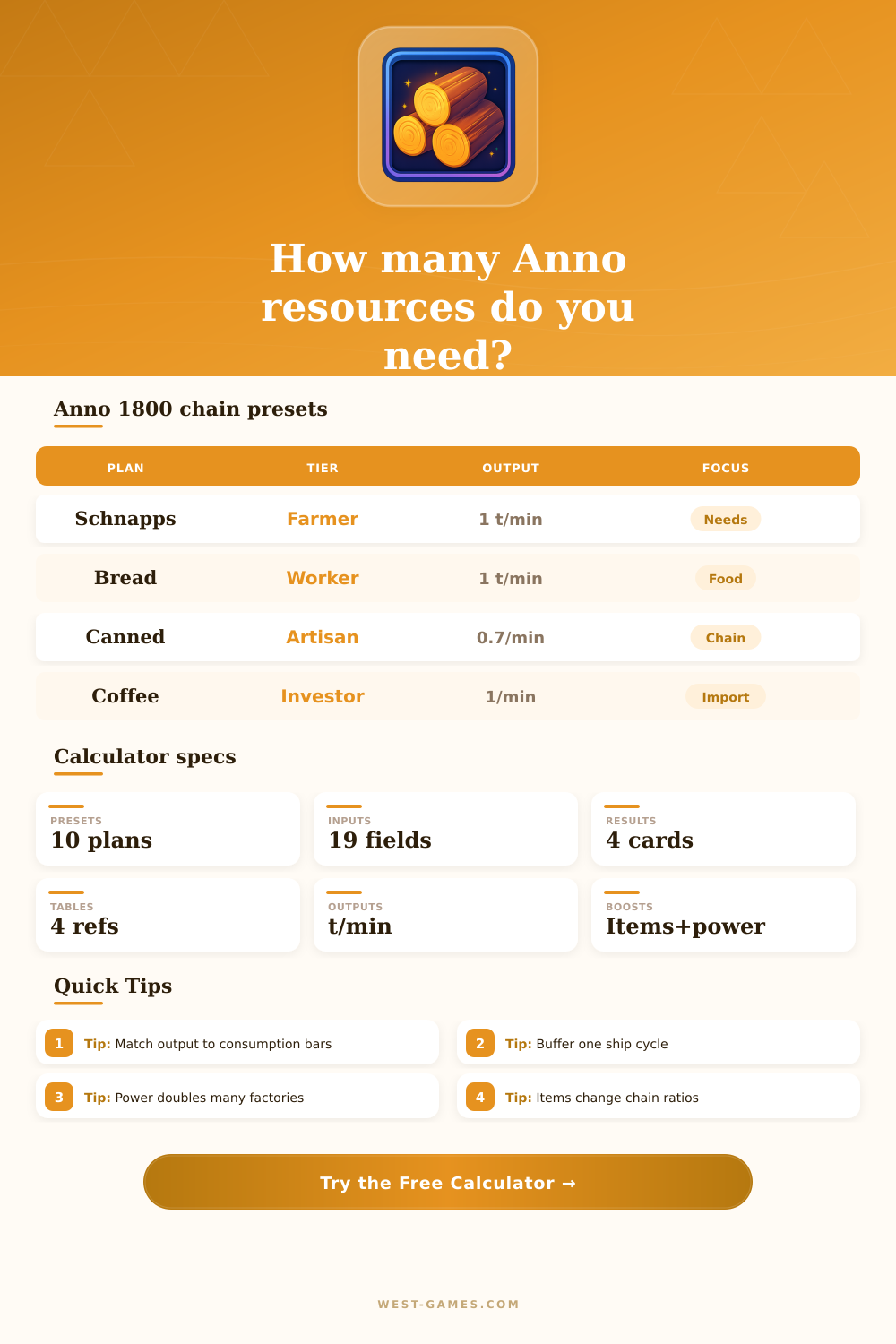
| Chain | Final building | Base output | Input focus |
|---|---|---|---|
| Schnapps | Distillery | 1.00 t/min | Potatoes |
| Work Clothes | Framework Knitter | 1.00 t/min | Wool |
| Bread | Bakery | 1.00 t/min | Grain and flour |
| Beer | Brewery | 0.50 t/min | Grain, malt, hops |
| Canned Food | Cannery | 0.67 t/min | Goulash and iron |
Rates are planning baselines in tons per minute. If your statistics screen shows different values from items, specialists, or DLC settings, enter those as productivity or item boosts.
| Good | Main tier | Demand style | Planner note |
|---|---|---|---|
| Schnapps | Farmers and workers | Low but steady | Good early buffer good |
| Bread | Workers and artisans | Core food | Flour can hide shortages |
| Beer | Workers and artisans | Luxury chain | Hops islands need routes |
| Canned Food | Artisans | Complex chain | Iron and goulash both matter |
| Coffee | Engineers and investors | Import heavy | Route cycle often bottlenecks |
The population model is intentionally editable. Use it for what-if planning, then compare final values with the game statistics screen.
| Chain group | Main workforce | Support workforce | Common pressure |
|---|---|---|---|
| Farmer goods | Farmers | Farmers | Many small farms |
| Worker goods | Workers | Farmers and workers | Shared grain and pigs |
| Artisan goods | Artisans | Workers | Input chains expand fast |
| Engineer goods | Engineers | Artisans and workers | Electricity changes counts |
| Investor goods | Engineers | Multi-region support | Routes and storage dominate |
This calculator reports a main workforce estimate plus the upstream support total, so a low final building count can still reveal a large island labor footprint.
| Status | Stock hours | Route cycle | Best adjustment |
|---|---|---|---|
| Fragile | Under 1 h | Any delay hurts | Add stock or production |
| Tight | 1 to 2 h | One late ship matters | Buffer one cycle |
| Good | 2 to 5 h | Stable for normal play | Watch trend arrows |
| Deep | 5 h plus | Safe but may overstore | Move space to exports |
For imported goods, reserve enough storage for your safety hours plus at least one delivery cycle. Long routes need more margin than short harbor shuttles.
At some point, all players of Anno 1800 will experience this particular type of anxiety: you’re an expert planner; everyone works, your island thrive. And then you add just one new distillery or brewery. The demand bar for your beer or schnapps turn red. The carefully balanced system feels shaky, panic sets in.
The game penalizes you for ignoring the scale of things. Fixing a slight imbalance with ten farmers is simple. Move one worker here, there… but when it’s five hundred, you need a full-blown logistical overhaul.
How to Plan Better in Anno 1800
Once you’ve expanded a bit, the calculator will save you from having to guess at chain ratios and coefficients each time. It plugs in your current output and population tiers and does math for you.
That’s where most players go wrong, they spend all their time thinking about the end result without paying attention to what supports it. “I need to make some bread, so I’ll just build some bakeries.” Wrong! That’s only half the equation: Each bakery requires bakers. Those bakers need sustenance in the form of food and schnapps. And those bakers also needs grain produced by farms that require yet more workers.
On the page, reference table shows this very clearly; input chains expand faster then final outputs. This may seem like a small thing, but it has a huge effect on island space! Before you run out of food, you’re going to run out of room if you don’t factor in extra work required just to support your bread production. You’ll be able to simulate this cascading demand with the tool and view your total labor footprint before laying single foundation.
Storage is where most mid-game plans fail. You can produce precisely what you consume (in theory). Trucks gets caught in traffic. Ships don’t arrive when they should. Someone decides to prioritize beer over bread one week and suddenly your warehouses are full of the wrong stuff. You’ll want some sort of buffer stock. Using this, you’re able to calculate how much margin for error you really have given your existing storage levels and trade route times.
If you’ve got 10 minutes‘ worth of stock in the warehouse but your route takes 20 minutes to run then you’re headed for trouble. One delayed ship and suddenly everyone’s starving, unable to work, and production halts, making the shortage worse until it becomes a vicious cycle. It feels personal when it happen.
The boosts make all the difference, and in strange ways. Powering a factory doubles its production, but doesn’t require twice as many worker within that structure. Some boosts, like those from the Trade Union, increase production by huge percentages. This helps reduce number of buildings you need to build. But those buildings don’t shrink. They will still take up a large section of your limited island real estate.
If you provide special schnapps to your farmers, you may be able to reduce number of distilleries necessary to fuel them. But each distillery still takes up a huge part of your limited island space. People misinterpret this aspect and assume they’ve optimized their game. They optimize for building count and forget about spatial efficiency. With this tool, you’ll be able to plug-in these boosts and observe what impact they have on both manpower distribution and space use.
But the true art of Anno 1800 isn’t making stuff. The real skill is anticipating demand for it. You want to have built out enough extra space by the time your pop hits a new level. When you build for current demand, you’re already behind. Use the planner to predict what the future looks like. Estimate how much more population you’ll acquire during this coming hour of play. Adjust your coverage percentage to be more than 100% to cover the lag time as well. Do all of this proactively and it’ll feel like smooth growth rather than a frantic race to catch up.
You go from being reactive with red bars to proactive with anticipatory ones. Anticipating demand is the difference between a pleasant game and an annoying grind. In the end, it’s all about the logistics masquerading as city building. Each good has its own tale, involving several islands, various climates, complex shipping routes, etc. Knowing these tales allows you to construct strong (rather than merely workable) systems.
Your redundancy and buffers will bail you out when crisis strike (and strike they will). You don’t have to remember any production ratios. Recognize how your decisions affect things. This lets you plan for those effects. That’s where the planning tools shine: they allow you to try new ideas without risking damage to your real game. Run simulations. Break stuff. Understand why. Then go back and build a better world.
The math may be cold, but once the strategy behind it clicks into place, it’s warm and fulfilling. Trust me, it’s always easier to look forward than backward at a broken supply chain. You should of seen it coming.