🐉 King of Avalon Resource Calculator
Estimate food, wood, iron, and silver for King of Avalon stronghold upgrades, building pushes, research projects, troop batches, alliance helps, dragon boosts, gathering marches, production boosts, shortfalls, and completion time.
| Preset | Type | Main bottleneck | Timer style |
|---|---|---|---|
| Stronghold 20 Push | Stronghold | Wood and food | Medium construction |
| Stronghold 25 Gate | Stronghold | Wood, iron, silver | Long construction |
| Stronghold 30 Prep | Stronghold | Silver and iron | Very long timer |
| Economy Research | Research | Silver | Research speed |
| T9/T10 batches | Troops | Food and iron | Training speed |
Preset amounts are editable planning baselines. Use your in-game numbers when a kingdom event, discount, or update changes requirements.
| Target | Food | Wood | Iron | Silver |
|---|---|---|---|---|
| Stronghold | High | Very high | High | Medium-high |
| Wall | Medium | Very high | High | Medium |
| Academy | Medium | High | Medium | High |
| War research | Medium | Medium | High | Very high |
| Troop training | Very high | Medium | High | Low-medium |
Use the pressure row to decide which resource your marches should target first.
| Boost | Applied to | Formula effect | Planning note |
|---|---|---|---|
| Resource discount | Need | Need x discount | Use only confirmed active reductions. |
| Production boost | City income | Hourly output | Works all day in the model. |
| Dragon economy | Income | Production + gather | Useful for farm and dragon talent plans. |
| Gather speed | March income | Tile yield per hour | Limited by gathering hours per day. |
| Alliance helps | Timer | Minutes removed | Applied before speedup shortage. |
| Route | Best use | March split | Risk |
|---|---|---|---|
| Balanced | Unknown bottleneck | Equal resources | May overfarm surplus |
| Largest gap | One clear shortage | Most marches to gap | Needs frequent checks |
| Iron focus | Buildings and troops | Iron first | Wood can lag behind |
| Silver focus | Research targets | Silver first | Slow tile return |
| Food focus | Troop batches | Food first | Can be consumed quickly |
| Preset | Food | Wood | Iron | Silver | Base hours |
|---|---|---|---|---|---|
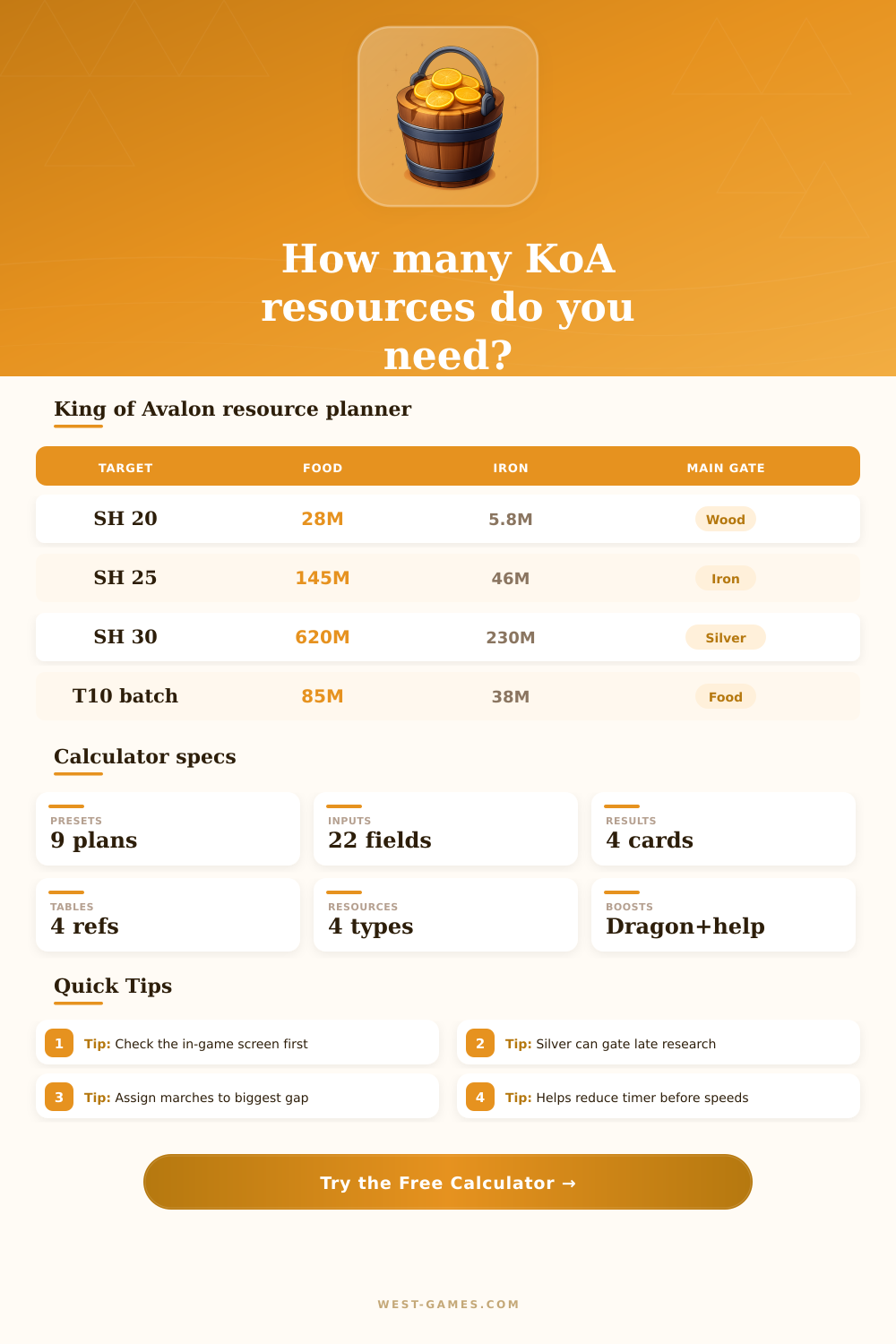
| Stronghold 20 Push | 28M | 42M | 5.8M | 1.4M | 72 |
| Stronghold 25 Gate | 145M | 210M | 46M | 12.5M | 168 |
| Stronghold 30 Prep | 620M | 840M | 230M | 92M | 520 |
| War Research Sprint | 90M | 115M | 82M | 74M | 210 |
| T10 Cavalry Batch | 85M | 34M | 38M | 7.5M | 48 |
In King of Avalon, when you’re staring at a stronghold upgrade screen with your resource bars looking low, it’s not testing your patience. It’s testing your arithmetic. Click the upgrade button on instinct, hope for alliance help, then spend the next three days wondering what happened. That’s where this calculator come in. It takes guesswork out of equation and turns vague dread into a concrete timeline. With that, you can decide if you want to push now or wait another week.
In truth, however, resource management isn’t really the point of this game. Sure, you can eventually produce all wood and food you want, with enough time. It’s typically silver and iron that becomes scarce. There are far fewer “high yield” tiles that let you collect them. They also take much longer to come in compared to other resources. If you scroll down to the reference table on that page, you will see how War Research and Stronghold 30 rely heavily on these rarer resource.
How to Use the Upgrade Calculator
That shifts the whole strategy. Wood? Just march out to a few forest tiles and leave it alone. Silver? Oh no, now you’ve got to make the most of boosts you’re getting from each city. You also has to plan for certain events so you can get some. Silver is tougher to scrounge up than wood; you have to pay attention to your timer pressure here.
“Rather than memorize some formulas, understand what goes into them.” Your inventory isn’t a fixed number but a rolling one. Inputting your own gathering hours and production rate is something you do. Those are the tools you use. A lot of people will estimate how much they make each day and forget to include bonuses like alliance territory bonuses or dragon boosts. Those omissions can double the size of any shortfall. Plug in your real-world gather rate per march and model shifts the timeline to match what’s happening on the ground, not what might happen in best case scenario. There’s no way you’re going to run 12 marches all day long, every single day. It takes into account that most likely, this doesn’t apply to you.
Now let’s talk about timer management. This is where most plans fail. You have a limited number of alliance helpers, and they’re not unlimited. In real life (and in this tool), those helpers are applied before determining how much speedup you’ll need. That’s because you want to apply free helpers first, and then go at whatever is left with paid time. Otherwise you’re wasting your premium currency paying for things your neighbors would of given you for free. So the tool displays how many hours you’d still be looking at once the free helper is applied. Now you know if it’s worth gold/silver to knock it out now.
Scenarios act as bases for what we expect For example, a Stronghold 25 push requires much more time and resources than a troop training batch. The former is an exercise in amassing huge amounts up front. The latter is about managing a steady stream. Being able to look at what’s on your plate and place it within the right bucket, to know if this is a thing that benefits from stockpiles vs. Gathering based off your route helps you avoid looking for food solutions when you actualy have an iron problem. Each activity has distinctly different requirements, and knowing where you sit ahead of time keeps you from misaligning them.
Ultimately the best strategy is to think of the calculator not as a be-all end-all but a planning buddy. Things will change: Events shuffle priorities, game updates alter the numbers, and your own situation won’t always remain the same. Plug in what your largest deficit is and apply your marches to match to seal off that weak point initially. That way you don’t waste time sitting back with your fingers crossed watching an upgrade counter count down to zero as you’re out of stores right before you finish. When you plan for it, it’s no longer chaos, it becomes routine. You step by step tackle the bottlenecks.