🏰 Rise of Kingdoms Resource Calculator
Estimate food, wood, stone, gold, city hall upgrades, research projects, troop batches, resource tokens, gather commanders, alliance helps, buffs, march load, and completion time.
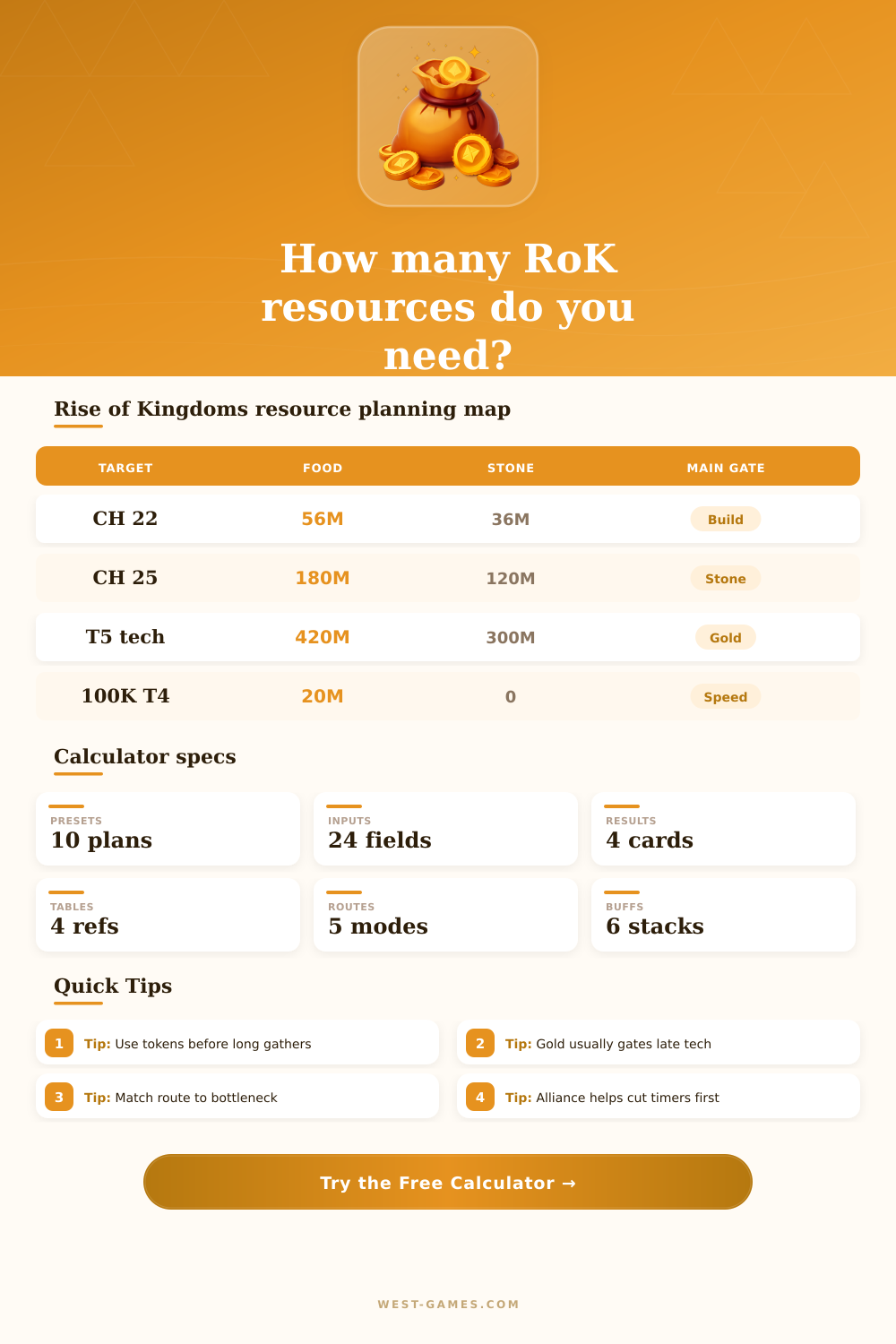
| Preset | Food | Wood | Stone | Gold |
|---|---|---|---|---|
| City Hall 22 Push | 56M | 52M | 36M | 9M |
| City Hall 25 Finish | 180M | 180M | 120M | 30M |
| Academy 25 Prep | 120M | 150M | 110M | 42M |
| T5 Infantry Research | 420M | 390M | 300M | 260M |
| 100K T4 Cavalry | 20M | 16M | 0 | 5M |
These are editable planning examples, not a live patch database. Always overwrite the four requirement fields with the current in-game screen before spending resources.
| Commander pair | Speed | Load | Best use |
|---|---|---|---|
| Constance plus Sarka | 15% | 10% | Early food and wood runs |
| Joan plus Matilda | 22% | 18% | Balanced mid-game gathering |
| Cleopatra plus Seondeok | 30% | 22% | High-load alliance territory farms |
| Ishida plus Gaius | 24% | 14% | Flexible stone and wood route |
| Centurion plus Gaius | 10% | 6% | Backup march while main gatherers are busy |
Commander bonuses are simplified planning values. Gear, talents, alliance territory, city skin, runes, and resource node level can change your real pace.
| Timer input | Calculator treatment | Planning note | Risk |
|---|---|---|---|
| Alliance helps | Help count times help percent, capped at 30% | Get helps before spending large speedups | Inactive alliance slows completion |
| Building speed | Used for city hall, wall, academy, and other building plans | Stack title, rune, VIP, alliance tech | Wrong buff family overstates savings |
| Research speed | Used for academy and technology plans | Late military tech often needs gold too | Gold gap can be larger than timer gap |
| Training speed | Used for training and healing style plans | Batch size decides resource pressure | Hospital fills can change the target |
| Universal speedups | Subtracted after helps and speed buffs | Keep event requirements in mind | Overspending may weaken later events |
The calculator models timer reduction in a consistent order: base time, selected speed buff, alliance helps, then speedups.
| Token type | Best moment | Calculator input | Common bottleneck |
|---|---|---|---|
| Food tokens | Before troop training or healing | Total food item value | Infantry and healing batches |
| Wood tokens | Before building or archer work | Total wood item value | Academy and wall upgrades |
| Stone tokens | Before city hall or castle pushes | Total stone item value | CH 24 and CH 25 planning |
| Gold tokens | Before high-tier military research | Total gold item value | T5 and late academy research |
| Choice chests | After bottleneck is known | Add value to needed resource | Using chests too early |
If you have selectable resource chests, run the calculator once without them, then assign chest value to the bottleneck and run it again.
If you’ve played Rise of Kingdoms long enough, then you’re probably familiar with that sinking feeling after beginning to upgrade a City Hall only to realize you ran out of resources midway into the countdown clock. This is a universal experience for players who have outgrown their early-game intuition, the game loves a good plan, but it loathes guesswork as it makes you wait idly while chatting in frustration.
Managing resources shifts from a straightforward save vs. Managing resources turns from a simple choice of saving or spending into a logistical nightmare during the mid-to-late game. On paper, resources may appear to be interchangeable. But in practice, they’re not. Gold and stone build up slowly (and are rare). Wood and food is abundant … but rot away. To make matters more complicated, some upgrades requires a lot of one type of resource but not another.
Stop Guessing: Plan Your Resources Better
Most players assume their goal is simply to lower the timer. They forget to check if they will have enough resources for late-stage City Hall or wall push. What good are all those speedups if you don’t also has enough of each type of resource? The tool fills in this gap, it takes into account your available tokens, what is being produced automatically, and what is already in your inventory.
Another thing that is easily missed but will help you move efficienty is understanding what tokens are worth. Don’t farm lower-tier nodes for days only to have tons of useless resources sitting in your inventory. Players often gets used to hoarding them, so you need to know your token values instead. The page even includes a reference table listing which presets change the bottleneck from low-level resources such as food to higher level resources such as gold. For instance, T5 military research won’t run out of wood. It’ll run out of gold. Knowing that lets you place choice chests where they’re needed most… Not haphazardly spread between four resource types.
Beyond that, there’s a level of logistics gathering that spreadsheets can’t capture. March load capacity, active hours per day, commander bonuses/rune setup all factor into your actualy gather rate. While you could run a pair with balanced stats (like Joan + Matilda), they won’t have the same raw load bonus as someone running Cleopatra in alliance territory. The calculator takes this into consideration: it includes factors like how long it takes to move from one node to another and amount of time spent idling while nodes fill back up. Twenty minutes here and there doesn’t sound like much until you realize it’s taking away from your expected gather rates. It factors in realistic active hours, so instead of estimating based off theoretical gathering time, it uses calendar days.
The same thinking needs to be applied to spending speedup items as well as asking for alliance help. Players tend to burn universal speedups and then ask for help, but help saves only a percentage of the original timer. Separating this input allows you to visualize exactly how much time you save with respect to social vs. This refers to item spending. That lets you preserve valuable hour items for when it matters most, like at the very end, or during important events.
Where this way of thinking really pays off is in advance planning. Instead of scrambling once the timer has begun counting down, you’re planning for when things run short. For instance, you’ll save up some extra stone and push back an upgrade by two days; or open one or two extra wood tokens now so you don’t have to wait three days. Suddenly, resource management becomes something that’s not a guessing game, but something that can be scheduled out.
You will know exactly what time to aim for based off what is happening in the kingdom and what you need to do to help meet your alliance’s goal. So finally, there’s no point rushing to City Hall 25 if it leaves you unable to engage in wars. Instead, you want to get there using resources efficienty. With sufficient quantities of each category so that none is ever the bottleneck). Knowing exactly where you stand in all four categories, and exactly what you’ll need and when, changes the gameplay experience entirely. This is true whether you’re grinding toward a T5 push or merely keeping your economy running smoothly. It turns potential waiting time from disadvantage to strategy. Planning makes perfect; a tiny improvement in accuracy here could of been the difference between progress and stagnation.