🏰 CoX Drop Rate Calculator
Estimate OSRS Chambers of Xeric purple chance, personal target odds, dry streak likelihood, Challenge Mode extras, scaled raid points, and hours to hit a goal.
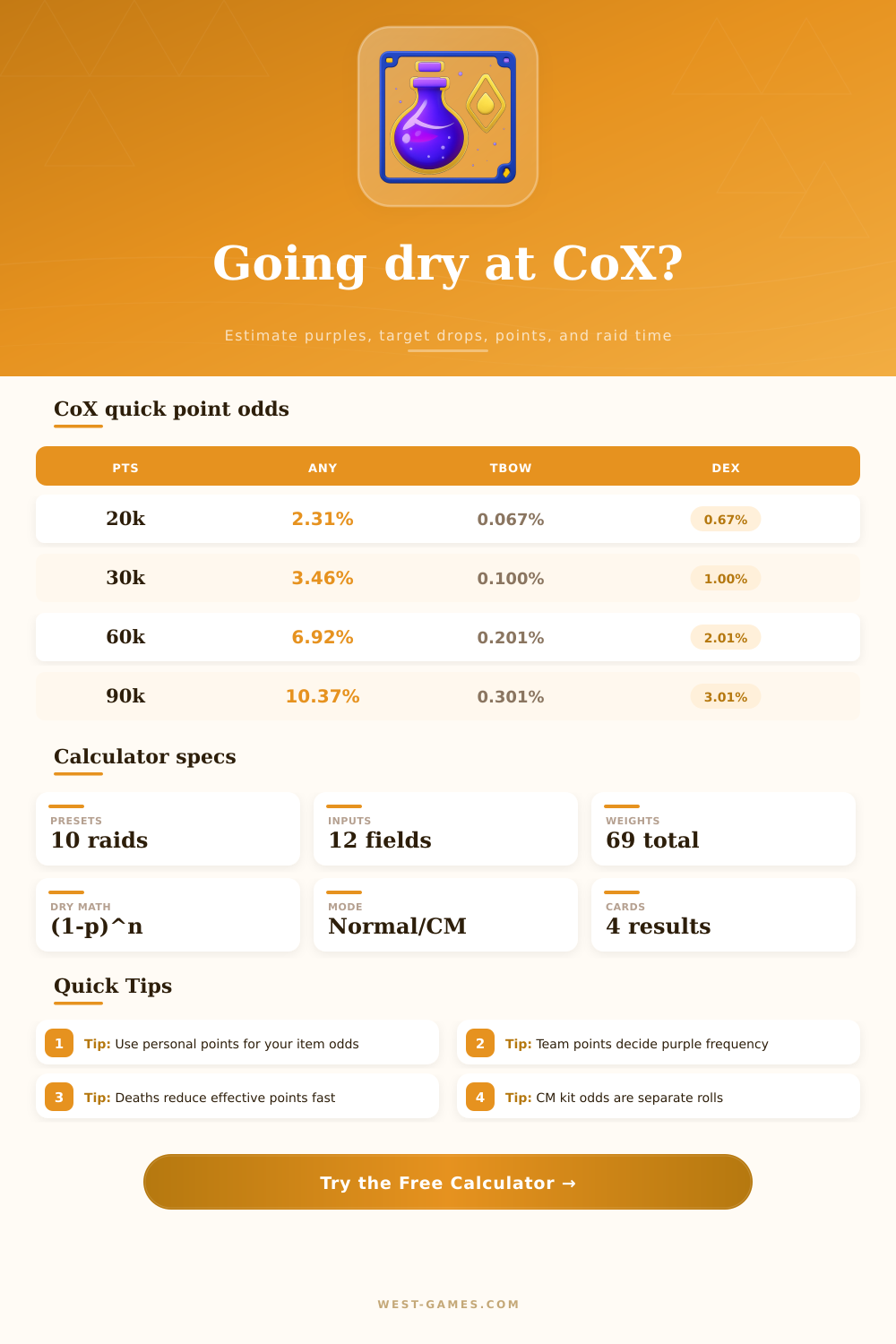
| Points | Any unique | 1 in X | Use case |
|---|---|---|---|
| 20,000 | 2.31% | 43.4 | Learner solo |
| 30,000 | 3.46% | 28.9 | Solid solo share |
| 45,000 | 5.19% | 19.3 | Strong CM solo |
| 60,000 | 6.92% | 14.5 | Duo-level share |
| 90,000 | 10.37% | 9.6 | Trio team chest |
Formula used here: unique chance = effective points / 867,500, capped below certainty for practical raid planning.
| Item group | Weight | Share | 30k chance |
|---|---|---|---|
| Dex or Arcane scroll | 20 each | 28.99% | 1.00% |
| DHCB or Buckler | 4 each | 5.80% | 0.20% |
| Claws, Bulwark, Ancestral piece | 3 each | 4.35% | 0.15% |
| Tbow, Kodai, Elder maul | 2 each | 2.90% | 0.10% |
The item roll happens after a unique is selected. The calculator lets you switch to an older 84-weight comparison model.
| Reward | Where | Planning rate | Notes |
|---|---|---|---|
| Metamorphic dust | Timed CM | 1 / 400 | Separate from unique table |
| Twisted ancestral kit | CM | 1 / 75 | Cosmetic kit roll |
| Olmlet pet | CoX chest | Points based | Estimated from points |
| Any unique | Normal or CM | Points based | Uses team and personal points |
Cosmetic and pet planning lines are estimates for grind pacing, not a replacement for checking current in-game news or wiki updates.
| Setup | Typical points | Personal share | Watch out for |
|---|---|---|---|
| Solo | 25k-35k | 100% | Deaths hurt odds hard |
| Duo | 55k-75k | 40%-60% | Uneven Olm points |
| Trio | 80k-110k | 25%-40% | Splits vs FFA logic |
| Scaled | 120k+ | Varies | Longer completions |
If the group splits loot, compare team purple odds. If you only care about drops in your name, compare personal odds per hour.
| Target | Weight share | 30k personal | 50% median | 90% grind |
|---|---|---|---|---|
| Dexterous prayer scroll | 20 / 69 | 1.00% | 69 raids | 229 raids |
| Dragon hunter crossbow | 4 / 69 | 0.20% | 346 raids | 1,150 raids |
| Dragon claws | 3 / 69 | 0.15% | 462 raids | 1,534 raids |
| Twisted bow | 2 / 69 | 0.10% | 693 raids | 2,300 raids |
Median means a 50% chance to have seen the target at least once, not a promise that the drop arrives by that raid count.
Maybe you’re trying to complete a prayer set; you’re missing the Dexterous scroll, and you might want to get into Chambers of Xeric. Or maybe you want more damage; you see that someone’s running around with a Twisted bow on their back and you think, “I’d love one of those.”
You head in there with a plan, and grind away with the knowledge that math is transparent: the rolls will be random, but you know the odds of getting a specific item, and you have a good idea of what sits atop weighted table. You know exactly how many points you’ll need to get that unique roll. It’s fair. There’s no hiding behind curtain here.
Understanding Your Loot Odds
But then, after 50 raids, the chest drops, and you’re greeted by common loot once more. And it just really sucks. But its perfectly normal to feel frustrated. So we run through the math in the calculator above, showing your true odds and explaining why that dry spell occur. It allows you to sort through signal (your performance) and filter out noise (the bad luck).
Most people get confused by how personal points differ from team points, as all these points together contributes to the purple special item drop at the end of raid. Suppose your group gets ninety thousand points, which gives team about a ten percent chance at getting unique drop. This is not a personal chance for you, but a chance for whole team. So if you were responsible for throwing down thirty thousand of the points yourself, you’re fighting for a third of the prize here. That’s the entire source of your personal odds; they don’t matter unless you understand what percentage of the points you threw into pot.
This brings us back to “bigger is better,” except this time being in a larger group can lowers your own personal drops-per-hour, even though you have higher chances of getting purples as a team overall. That said, the tool takes into account that your points get diluted by other peoples points (you enter total number of raid points and your own contribution). It also considers any deaths, which is really important. Getting killed cuts down on your actual points dramatically, and many people don’t realize how much a death can negatively impact their probability curve. Make too many mistakes in Olm phase and you could erase an hour of grinding work.
The calculator counts all personal points lost due to a death, since after all they’re effectively decreasing your share of the loot pool, not just subtracting your points. This encourages you to consider both speed at which you complete content and the likelihood of dying. Sometimes, taking longer but avoiding death altogether has a higher payoff than charging through and having to reset the room.
The interface also allows you to calculate approximately how many hours would of been needed to gain enough confidence to obtain your desired item. Depending on what you’re after. Say a Twisted bow, the math will probably make you think twice. It could mean dozens of hours of playtime, plus hundreds of raids, before you’d even stand a 90% chance of getting the drop. That’s a grind that some people are fine with while other folks finds themselves looking at the exact same ceiling for far too long.
The page lays all of this out clearly with its reference tables which list the number of raids one should expect based off their confidence level. Right off the bat you’ll know exactly how many hours of playing lie between yourself and the half way point on the median scale.
There’s also a whole layer of challenge mode added in on top that has its own rewards, which don’t play by same rules as the rest (metamorphic dust and cosmetic kits). They also drop items independently of the point-based system. Because they need their own kind of planning logic, I treat those separately too. Adding them to your unique item probability will throw things off. It is best to consider them bonus objectives; secondary goals, instead of ones you’re trying to shoot for directly if you’re going after something specific or just farming for dust. That distinction will keep you from overestimating the likelihood of obtaining a particular weapon when pursuing cosmetics.
It’s all about playing harder but also smarter. Knowing your true chances will guide the decision to stay on current path (even if you run out again) or try something else with a higher chance of success for the same amount of time, effort, or money. The math isn’t lying; it’s telling you exactly how far up the mountain you have to climb. It’s showing you where you’re at so you can decide if this is worth your continued effort. It also helps you see if there’s a better way to achieve similar results faster.
Knowing the chances takes away some of the sting in grinding, whether it’s for loot or just for fun. Instead of cursing fate as “bad luck,” you realize that it’s simply a waiting game with numbers you can control. You can stop being disappointed and learn to accept the grind for what it is: a deliberate delay.