🏎 Rocket League MMR Calculator
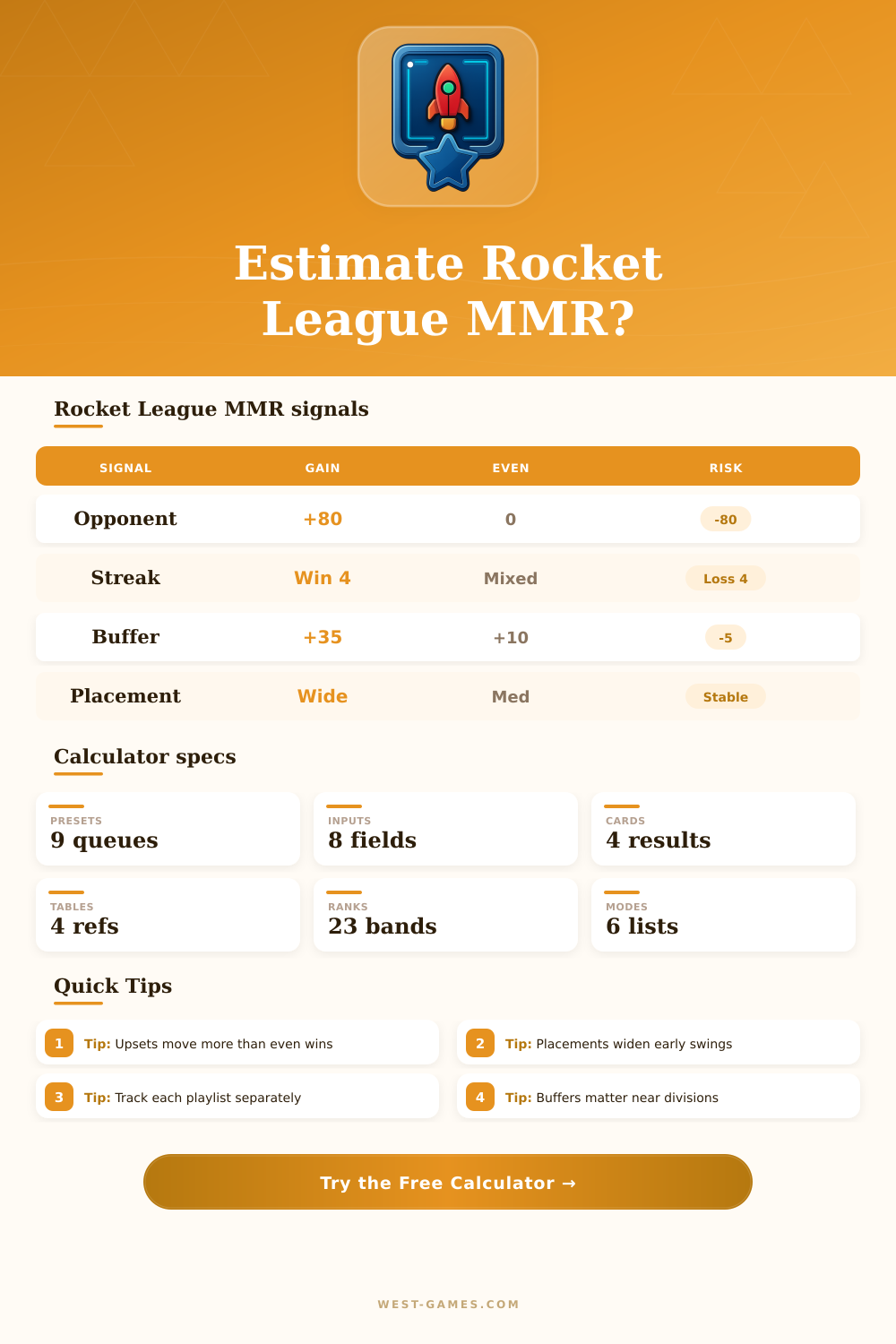
Estimate Rocket League ranked movement from playlist, current MMR, visible rank and division, lobby strength, result, streak pressure, placement uncertainty, and promotion buffer.
| Rank band | Low | Mid | Next pressure |
|---|---|---|---|
| Bronze | 100 | 220 | Silver setup |
| Silver | 260 | 420 | Gold setup |
| Gold | 500 | 620 | Plat setup |
| Platinum | 700 | 840 | Diamond setup |
| Diamond | 940 | 1080 | Champion setup |
| Champion | 1190 | 1330 | GC setup |
| Grand Champ+ | 1430 | 1600+ | SSL chase |
Bands are planning estimates. Real thresholds vary by playlist, season, tracker source, and hidden calibration state.
| Factor | Raises swing | Lowers swing | Use in calc |
|---|---|---|---|
| Opponent gap | Higher lobby | Lower lobby | Win odds |
| Placement state | New account | Stable queue | K-factor |
| Streak | Same result | Mixed games | Pressure |
| Party MMR | Wide gap | Even team | Range |
| Forfeit | Less clear | Full match | Confidence |
A strong upset win can gain more than an even win; a favorite loss can drop more than a close expected loss.
| Position | Promotion | Demotion | Planning note |
|---|---|---|---|
| Div I low | Far | Close | Protect floor |
| Div II | Moderate | Moderate | Stable band |
| Div III | Close-ish | Safer | Good climb spot |
| Div IV | Very close | Safe | Rank-up push |
| Rank edge | Variable | Variable | Tracker matters |
Promotion and demotion are not always symmetric because rank protection, hidden thresholds, and prior volatility can blur the edge.
| State | Swing | Range | Best input |
|---|---|---|---|
| Stable | Normal | Tight | Tracker MMR |
| Soft reset | Medium | Wider | Recent lobbies |
| Placements | High | Wide | Match history |
| New list | Very high | Very wide | Conservative |
| Party gap | Uneven | Wide | Team average |
Uncertainty affects the confidence range as much as the expected MMR change itself.
Standing at the foot of a new rank always make you tense. You see your MMR tick up (or down), and worry about next match: Will it move you closer? Or will it set you back? It’s always felt like a gamble, but it isn’t; it’s math masquerading as chaos.
Most players think of their climb through ranked solely as a test of pure skill. They fail to account for all underlying variables that determines how much; or little, rating they’ll gain (or lose). That’s what these tools is designed to explain. Once you feed the calculator with your own context, it does all heavy lifting. It frees you from guesswork of whether a tight loss was just a random blip on the radar or an indicator of where you really sit.
How the Ranking System Works
Relative strength is heart of an MMR system. You input your current rank, and then average rank for the other side of lobby and the model spits out your expected chance to win. So if you’re much better than someone else, you don’t get as many points. Sounds unfair? Wait; it stops players who are bad at the game from winning easy games and then snowballing all the way up ranked ladder. On the flipside, if you take down a higher-ranked team, you recieve more points, since that means you’ve overcome the odds. That keeps center of the ranked ladder competitive and packed with ranked player.
That’s why point value changes when you start climbing into Champion or Diamond. The closer you are to top, the more even the spread becomes between players, and the tougher the competition. It’s all laid out nicely in reference table on the page.
Skill level of opponent isn’t everything. Context does matter too. Surprisingly, recent performance have an impact on how far they think you’ll move. Win streaks cause the game to adjust through volatility adjustment or rank protection. That will tend to shrink gain each time you win since it slows down runaway inflation. Losing, however, can be brutal because system wants to rapidly undo any perceived over-rating. That sucks, but it’s mathematically required if we want rank to have integrity. To account for this, you can tell the tool what your current streak is and it will adjust its estimate to match. You’re either going up or you’re coming down so that becomes an addition or subtraction from predicted swing. The idea that “the game is rigged” becomes a measurable bonus or penalty.
There’s also another factor where most casual players don’t even think about: playlist selection. Individual mistakes gets lost in a sea of three teammate for standard 3v3. That makes it relatively more stable. There’s nothing to buffer for a duel 1v1 though. Miss one boost call, make one mistake on rotation, and the game is over. That causes greater variance in terms off MMR movement. Other extra playlists like dropshot or rumble run with smaller player bases. Sometimes matchmaker will throw you into games with people not near your typical skill band. That means bigger swings in what rating you expect to move.
The calculator splits those playlist. You shouldn’t treat an equivalent duel climb and standard climb the same way. You’ll have false expectations for how fast things move and how stable they should of be.
Point swings increase due to uncertainty from placement matches and returning after a long time away. It doesn’t has as much information to go on. So it adjusts your rating more dramatically in order to reach your real level faster. That’s why your rating can seem volatile in the beginning, while it settles down into a consistent grind once you’ve got some matches under your belt (a.k.a. “mature” account). It helps calm early-season frustration if you understand this part of the calibration process. You’re not getting punished. You’re just getting measured.
The input buffers give you a visual for how near/far you are from promotion thresholds. They’re different than rank and division. Being one win away from promotion feels different then being five wins away from promotion, which affects how you mentally prepare for every single match. In practice, climbing is more about managing probabilities over time than it is about any one heroic play.
No, you don’t get to choose every teammate’s decision making or the outcome of each kick-off. But what you do get to choose is what information you accept as feedback from the system. Then by comparing that feedback with your own movements, you can see patterns emerge in your behavior. These patterns are actualy obscured by raw rank icons. They turn the climb from a mysterious event into a string of decisions that you can manage. And clarity this offers is worth a hell of a lot more than one promotion screen.