🎮 Deadlock MMR Calculator
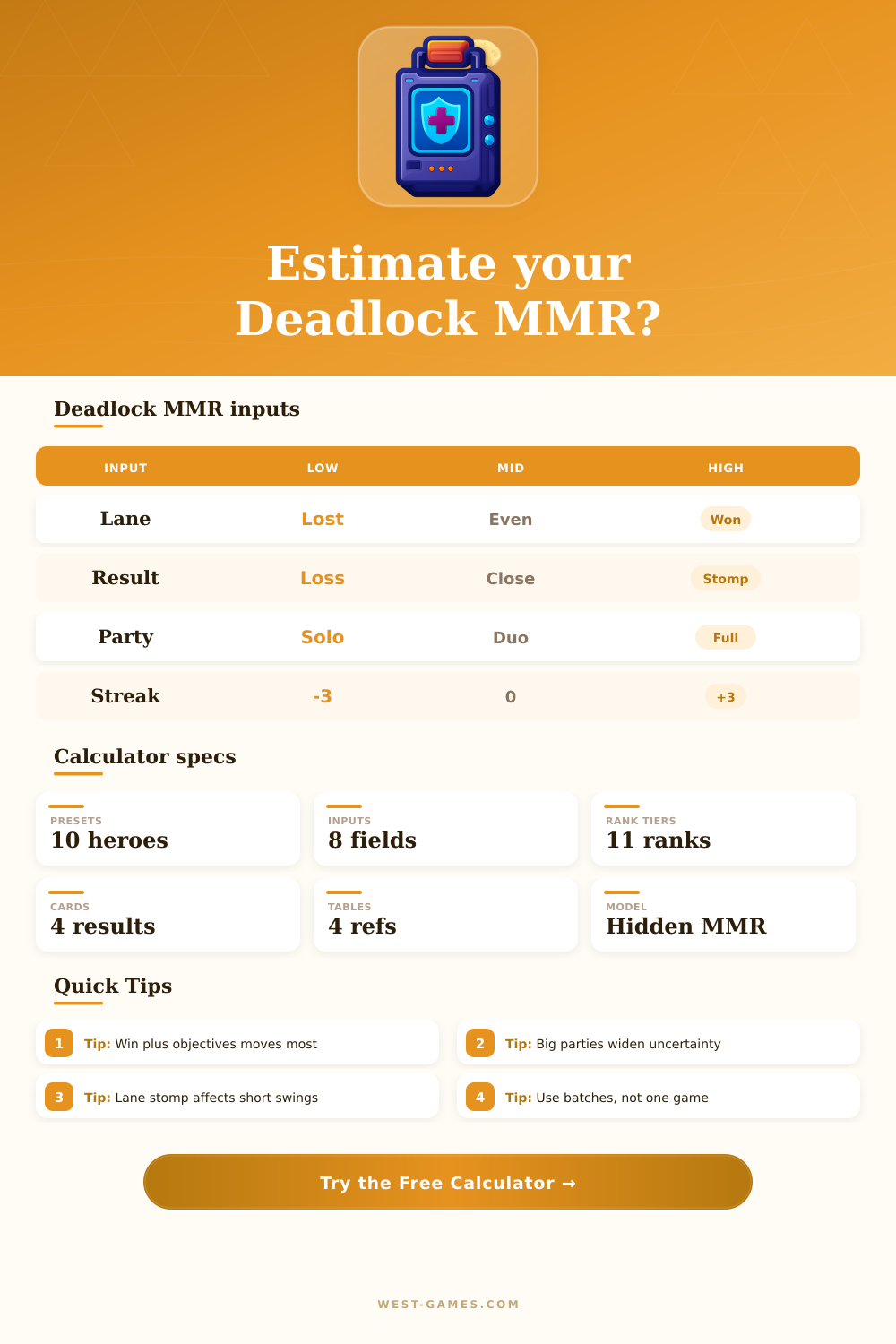
Estimate hidden skill movement from hero role, lane result, match result, objective impact, party size, uncertainty, and recent streak pressure.
| Rank | Model MMR | Subrank feel | Pressure |
|---|---|---|---|
| Initiate | 300-599 | I-VI | New ladder |
| Seeker | 600-899 | I-VI | Basics |
| Alchemist | 900-1199 | I-VI | Stable lane |
| Arcanist | 1200-1499 | I-VI | Macro starts |
| Ritualist | 1500-1799 | I-VI | Team fights |
| Emissary | 1800-2099 | I-VI | Median area |
| Archon | 2100-2399 | I-VI | Sharper tempo |
| Oracle | 2400-2699 | I-VI | High skill |
| Phantom | 2700-2999 | I-VI | Elite pressure |
| Ascendant | 3000-3299 | I-VI | Top lobbies |
| Eternus | 3300+ | I-VI | Peak ladder |
These are calculator bands for estimating movement, not official hidden MMR breakpoints.
| Result | Base | Best add-on | Warning |
|---|---|---|---|
| Loss | -34 | Good lane softens | Throws still hurt |
| Close loss | -22 | Objectives matter | Streak can widen |
| Close win | +28 | Even performance | Party masks signal |
| Win | +36 | Lane plus map | Low impact caps |
| Stomp win | +48 | First rotate | May be mismatch |
The calculator then applies lane, objective, streak, party, hero role, and uncertainty modifiers.
| Signal | Low | High | Role notes |
|---|---|---|---|
| Lane | -45 | +45 | Carry weighted |
| Objectives | -18 | +34 | Push weighted |
| Streak | -28 | +28 | Volatility cue |
| Party | Solo | Six stack | Band widens |
| Uncertainty | Stable | Placement | Swing expands |
Lane stomp is not enough by itself; the model rewards match result plus meaningful map pressure.
| State | Band | Use case | Read as |
|---|---|---|---|
| Stable | +/- 35 | Many games | Tighter read |
| Normal | +/- 55 | Usual ladder | Moderate read |
| Volatile | +/- 80 | Role swaps | Wide read |
| Placement | +/- 115 | Few games | Very wide |
| Full party | + extra | Team queue | Attribution fog |
Use several matches together before judging a climb or drop; one Deadlock game can be noisy.
After a good warmup you’re sharp and ready to queue up for another match in Deadlock. You run down your lane and get an early kill or two. You dominate your lane. Then you see post-game screen with a minimal MMR increase, if any. It might even be a decrease.
At some point it will happen to just about all of us. And what frustrates many people is thinking that their rank is progressing by a simple win-loss binary when in reality it’s doing a complex assessment of how much value you added to your team. While your badge may not move incrementally after a single game, your hidden skill rating are moving each and every time because it looks at nuances in how you performed beyond what’s shown on the end score board.
How Ranking Really Works in Deadlock
But these context variables is abstract. How do we turn them into a prediction of swing? That’s where the calculator comes in… It crunches all this stuff into a prediction of the swing. It doesn’t just ask if you won; it also considers how much you dominated your lane matchup and how much you helped control the map.
Different hero roles produce value in different ways. An Abrams can be a frontline brawler who gets killed lots, but opens up opportunities for teammate to push objectives. That counts as high impact, even though their K/D is poor. But Vindicta, a sniper, has a ton of individual early game responsibility: if he loses lane pressure, the whole match can fall apart.
So our model takes those kind of variations into consideration, don’t punish the support player for no farm; hold carry accountable when he fails to scale. Lanes have an immediate feedback loop. Perform well and you win your lane quicker. This puts map wide pressure on the other team while they scramble to respond. Underperform and you’re often stuck defending instead, reducing objective chances.
But even when your lane goes right, you can still be held back without converting it into walker control or urns. That’s where objective impact kicks in. Proving your ability to secure critical resources shows a team effort and an understanding of macro, something the matchmaking system rewards very much because it believes this correlates with long-term consistency better than raw skill during isolated skirmishes.
The other part of the noisier equation is party size. In solo queue, where there are no outside factors to either blame or lean on, the signal is as clear as it can be about your own skill level. When playing in bigger stacks, the signal gets obscured. Since the system doesn’t know who carried the game and who just happened to ride their coattails, it has to widen its confidence band for group play.
That way players aren’t unfairly dropped if one of their friends is struggling with a loss, but it also slows down their climb time in the event they’re on a win streak, because now the algorithm isn’t quite sure those gains should of go to them 100 percent. A safety measure that trades volatility for accuracy.
The strength of the ranking is subject to a lot of uncertainty, which drives it up and down more aggressively. The system has to figure out where new accounts go, so they gets bigger swings. The same happens to people who haven’t played for a while and are re-joining. As time goes on, the system gets a better sense of what bracket you should be in, and starts making smaller, more accurate changes.
This leads to the observation that initially climbing the ladder can feel spiky; you jump big, then sudden plateau. It’s made worse by streaks. If you’re on a winning streak, then each game could cause a little bit more increase, because the system checks if maybe you really do deserve to be here in the next bracket. Losing causes you to not drop off too fast. It gives you the benefit of the doubt that you just had bad luck or were subject to variance instead of having dropped massively in skill level.
That’s how I try and keep track of those invisible changes. Rather than obsessing over the outcome of a single game, consider patterns across five or even ten matches. If your lane is stable and your objectives are consistantly in sight, that’ll trump random flashes of brilliance every time. Your rank will follow suit, but it won’t always reflect what’s going on behind the scenes.
That lagging rank badge is typically offset by several games while the system levels out outliers. Don’t get caught up in instant gratification from a single flawless game, focus on the process and be patient, and the results will eventualy follow. Pick whatever hero supports map control best and do your part regardless; over time the numbers will catch up with your true ability.