🎮 League of Legends MMR Calculator
Estimate hidden MMR from visible rank, LP gain and loss, lobby strength, streak state, and placement calibration.
Tier and division create the baseline MMR the account appears to occupy before hidden signals are applied.
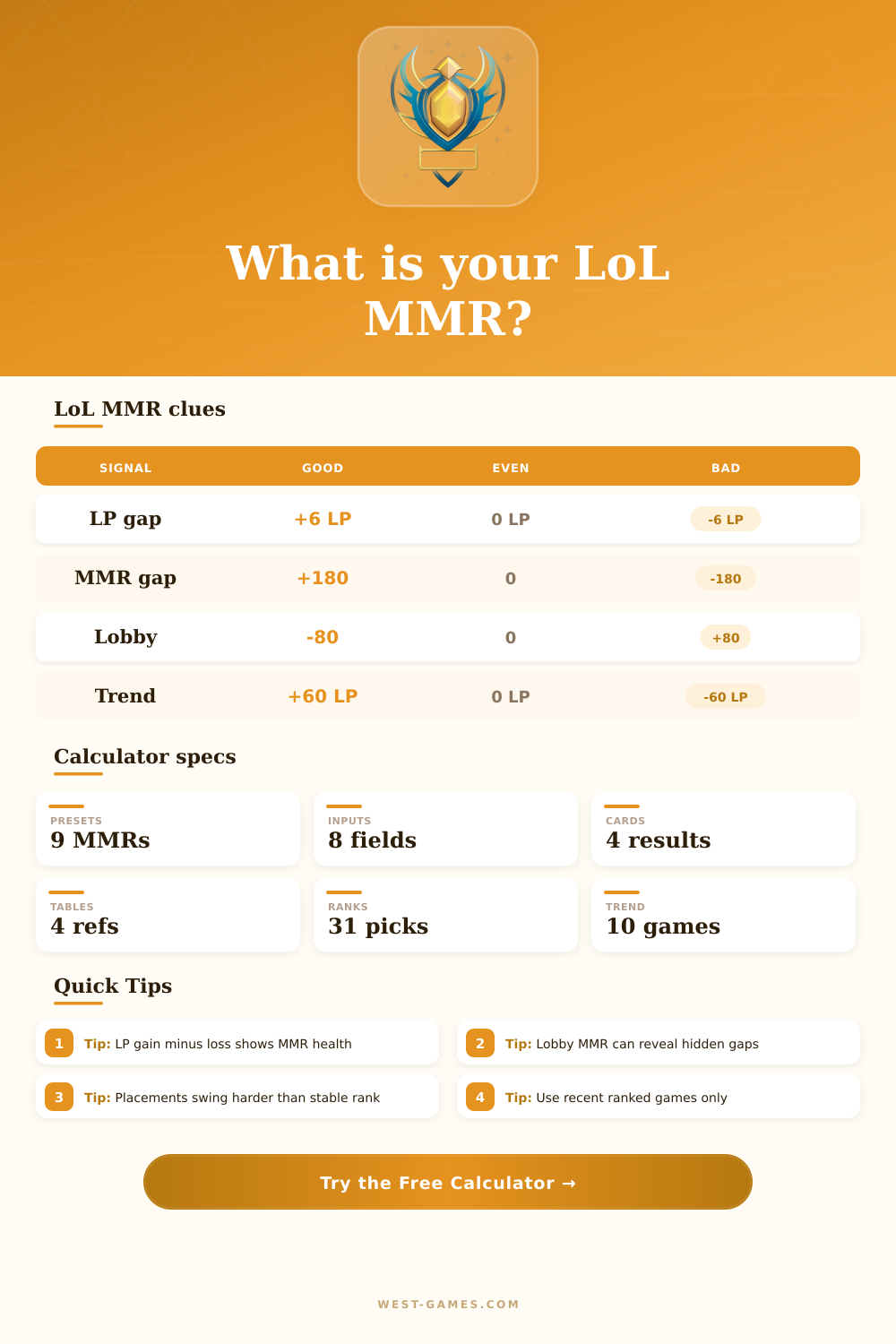
Winning more LP than you lose usually means hidden MMR sits above the visible rank anchor.
If your lobby average is higher than your visible rank, the model nudges hidden MMR upward.
Enemy average MMR does not define your account, but it changes expected win chance and LP trend.
Win streaks add short-term confidence while loss streaks increase the chance that the next block is volatile.
Placements, new accounts, and fast climbs move more sharply than mature accounts with stable histories.
| Tier | IV | II | I |
|---|---|---|---|
| Iron | 400 | 600 | 700 |
| Bronze | 800 | 1000 | 1100 |
| Silver | 1200 | 1400 | 1500 |
| Gold | 1600 | 1800 | 1900 |
| Platinum | 2000 | 2200 | 2300 |
| Emerald | 2400 | 2600 | 2700 |
| Diamond | 2800 | 3040 | 3160 |
| Master+ | 3300 | 3700 | 4100 |
These are calculator anchors, not official Riot MMR values.
| LP pattern | Signal | MMR read |
|---|---|---|
| +28 / -14 | Explosive | Far above rank |
| +24 / -18 | Healthy | Above rank |
| +20 / -20 | Neutral | Aligned |
| +18 / -23 | Heavy | Below rank |
| +15 / -28 | Suppressed | Repair needed |
| Enemy gap | Odds | Readout |
|---|---|---|
| -180 or less | 60%+ | Your team favored |
| -80 to -179 | 55%-59% | Slight edge |
| -79 to +79 | 45%-54% | Even lobby |
| +80 to +179 | 41%-44% | Enemy edge |
| +180 or more | Under 40% | Very hard lobby |
| State | Base shift | Volatility |
|---|---|---|
| Stable account | 0 MMR | Normal |
| In placements | +90 MMR | High |
| New ranked account | +130 MMR | Very high |
| Fast climbing account | +220 MMR | Very high |
| Returning or decay repair | -40 to -120 | Medium |
The loading screen silently judges as you grip your phone, queuing up for another ranked match in League of Legends. You look down at your LP bar and can’t help but wonder why you lost 15 LP even though the game went poorly. How come I only picked up 22 after grinding out a win? It sure feels like the system’s punishing you for effort, but more often than not, it’s simpler then frustration lets on.
Hidden under that sticker on the box called “rank” is the real thing, MMR. And the distance between them determine every swing of your progress bar. Knowing that hidden metric makes the difference between steady climbers and players who spin their wheel in one place forever.
How MMR Affects Your LP Gains and Losses
Once you input some recent game result, this calculator do all the heavy lifting for you, no need to guess any longer about whether you’re getting matched fairly or not. First, it anchors based off your current rank or Division. It assumes an initial baseline MMR value for each rank step, which is what Riot use as a starting point for all following calculations.
Then it consider the gap between how many LP you get on wins versus losses. That’s usually the most transparent indicator of your true hidden score compared to your outward-facing badge. Are you seeing way more on the positive side then negative? Your hidden MMR is probably higher than your rank and the system is priming you for larger LP swings in upcoming games so it can push you up.
While many players think that only the bright profile picture icon determine lobby composition, MMR is actualy what matters most. When you queue up, the matchmaking algorithm doesn’t just look at your visible rank. It also looks at your average MMR (the hidden score) compared to your opponents’ and weighs how much that specific game will affect your personal advancement. So if you’ve noticed you’re always getting put into lobbies filled with higher-ranked players, there’s likely something in your hidden score that’s skewed above its corresponding badge.
It sets up a vicious cycle where you feel overwhelmed by your opponents, even though the system think the match should be fair. Rather than blaming your teammate for being unlucky, understand that statistically, you already have upper hand.
There are also calibration states that change the intensity with which the system corrects you following any given match. Matches that has volatile placement results, like those in placement matches or after extended breaks away from playing, carry more weight then they do when things is settled into a steady rhythm of seasonal play. The way it works is shown in the reference table on the page which demonstrates what impact your account status have on the sensitivity of those changes.
Someone starting fresh will see bigger jumps up (or downs) as the system gathers information about their actual skill level while a seasoned vet with hundreds of games under his belt will see smoother, easier-to-predict swings even if he’s riding a hot streak. The other wrinkle is streaks: Momentum, both winning and losing, inflates short-term confidence score. Defenses will make tweaks that guard against falling off the cliff too fast after a loss; conversely, it’s easier to get ahead of yourself when things are going well.
Instead of obsessing over one result in a game, look at the past 10 (or even 20) and you’ll be able to spot the trends. The tool plots them out for you to see if your trajectory leans up or down. Climbing involve simple math. Most climbers focus on advanced mechanics or perfecting champion picks and never think about the math behind their climb. However, knowing how much hidden score you have lets you know if it’s worth pushing for a promotion in divisions or if it’s better to pause and shore up the fundamentals. You should of known that sooner.
If your LP gain always exceeds your loss, then keep playing; the system has shown what it wants by how people are actually playing, so you must be ready. If not, change your mentality, your badge can’t see what the matchmaker does, which is that there is more weakness than strength in your game right now. It’s never a linear path up, but having a sense of the invisible forces below will make every game feel less like a gamble, and more like a strategic step up.