🎮 GPU Benchmark Calculator
Estimate Benchmark or RT frame rate, 1% lows, and bottlenecks before you turn the world on.
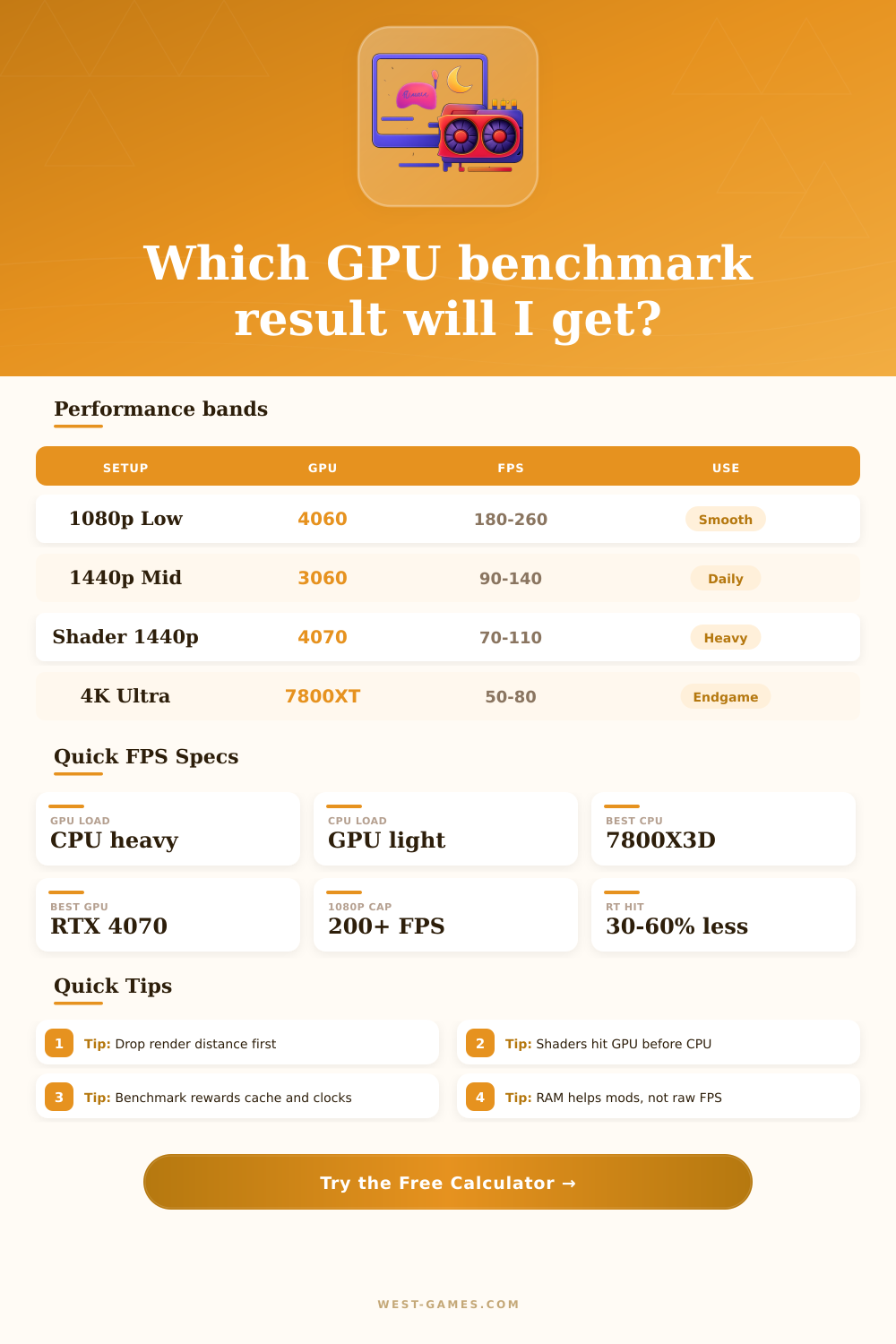
| Setup | 1080p vanilla | 1440p shaders | Note |
|---|---|---|---|
| i3-12100F + 1660S | 120-180 | 55-85 | Budget start |
| R5 5600 + RX 6600 | 150-220 | 70-105 | Smart value |
| i5-13600K + 4070 | 220-320 | 100-160 | High refresh |
| 7800X3D + 7800XT | 260-400 | 120-190 | Elite fit |
These bands assume modern drivers, sensible settings, and no extreme background load. Real modpacks or shaders can shift the result fast.
| Scenario | CPU | GPU | Good for |
|---|---|---|---|
| Competitive 240 Hz | 7800X3D | RTX 4060 | Tight Benchmark |
| Daily 1440p | 12400F | RTX 3060 | Balanced play |
| Shader showcase | 13600K | RTX 4070 | Lighting packs |
| Heavy modded world | 5800X3D | RX 7800XT | Chunk stress |
Benchmark usually prefers the strongest single-core chip you can fit into the budget. RT shifts more of the burden toward the GPU.
| Setting | Benchmark effect | RT effect | Note |
|---|---|---|---|
| Render distance | Big CPU hit | Moderate hit | Chunk work |
| Simulation distance | Tick heavy | Tick heavy | Entities |
| Shaders | GPU heavy | GPU heavy | Visual cost |
| Mods | RAM hungry | Light impact | Pack load |
The biggest FPS wins usually come from lowering chunks, then lowering shaders, then cleaning up background tasks.
| Background load | Render target | Sim target | Note |
|---|---|---|---|
| Superflat | 6-10 | 4-6 | Fastest lane |
| Overworld | 10-14 | 6-8 | Normal play |
| Village or raid | 8-12 | 6-8 | Mob heavy |
| Nether or end | 10-16 | 6-10 | More effects |
If the world feels stuttery, cut simulation distance before you chase a tiny graphics gain.
A GPU benchmark helps to test how a graphics card works especially for games. It creates very demanding scenes like games in real time that stress the GPU and the CPU to show their limits. For every benchmark there are two methods.
One does some calculations and measures the time to end where a slower time is bad. The second does similar calculations during a set time to see how many you can end
How to Test and Compare Graphics Cards
GPU benchmark charts rank graphics cards according to expected performance. The lists show average frames per second in low, medium, high or ultra settings. Full list of gaming GPU benchmarks include tests of graphics cards and chips through thousands of PC games to find the best FPS results.
That list bases on comparisons with thousands of separate ratings, and the data updates regularly with new benchmarks for graphics cards.
Some benchmark tools are betetr than the others. 3DMark Time Spy is a good place to start because online data is free and probably has results for your card, so comparing is simple. 3DMark has special tests for various hardware levels.
Steel Nomad is another good stress test, but because it is relatively new, benchmarks for most GPUs, especially old ones, are hard to find. FurMark is free, gives a number and most importantly does not load the CPU, because it is purely GPU-based.
Unigine has some tools, and the newest is Superposition. Shadow of the Tomb Raider has a free trial version with access to the benchmark, which helps for comparisons because it is a popular game through the years. For GPU support for ray tracing, there is Bright Memory: Infinite Ray Tracing Benchmark on Steam, which is free and runs in a loop.
GravityMark shows skills of modern GPUs by rendering a huge amount of objects in real time. Even older GPUs like the GTX 1060 can take tension by increasing the number of objects.
Check the framerate using MSI Afterburner or a benchmark tool as an alternative way. If it falls under 24, the game is no longer playable. Under 60 it is choppy but still okay.
Always remember to check which game you test because some games lock the framerate.
The trouble with GPU benchmarks is that a GPU has much more than only a compute score. One ranking site is not entirely precise, and there is always something about resolution and particular games, but it gives a general idea. For a better picture, look at the newest reviews of GPU vendors.