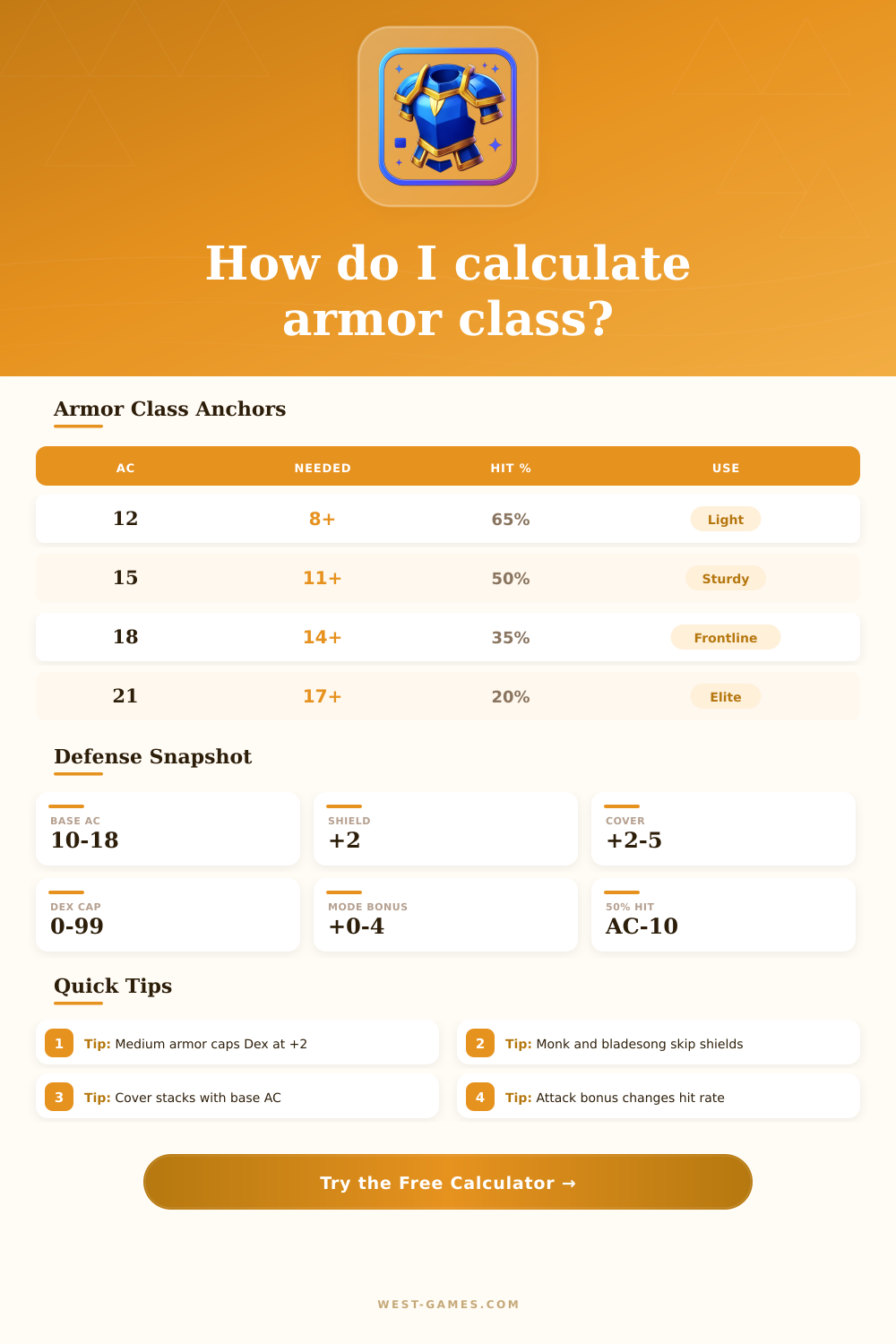
🛡 Armor Class Calculator
Build AC from armor, Dex caps, shields, cover, and class defenses before you lock the sheet.
Standard armor uses the armor table, then adds shield, cover, magic, and misc bonuses.
| Armor | Base | Dex rule | Notes |
|---|---|---|---|
| Padded | 11 | Full Dex | Cheap light shell |
| Studded | 12 | Full Dex | Best light AC |
| Breastplate | 14 | Max +2 | Quiet medium pick |
| Plate | 18 | Ignore Dex | Heavy anchor |
Use the armor table as the base line, then compare how much of your Dex score still matters in the chosen shell.
| Mode | Formula | Shield | Best for |
|---|---|---|---|
| Standard | Armor + Dex cap | Yes | Most builds |
| Monk | 10 + Dex + Wis | No | Mobile skirmish |
| Barbarian | 10 + Dex + Con | Yes | Rage tanking |
| Bladesong | 13 + Dex + Int | No | Arcane duelist |
If your mode blocks shields or armor, the calculator ignores those sources and shows the skipped piece in the breakdown.
| Source | Value | Stacks | Note |
|---|---|---|---|
| Shield | +2 | Flat | Simple AC bump |
| Half cover | +2 | Situational | Common field bonus |
| Three-quarters | +5 | Situational | Strong position |
| Magic bonus | +1 to +3 | Flat | Item or spell boost |
Flat bonuses stack cleanly, but cover is the first thing to change when the battlefield shifts.
| Atk | vs AC 15 | vs AC 18 | vs AC 21 |
|---|---|---|---|
| +3 | 12+/45% | 15+/30% | 18+/15% |
| +5 | 10+/55% | 13+/40% | 16+/25% |
| +7 | 8+/65% | 11+/50% | 14+/35% |
| +10 | 5+/80% | 8+/65% | 11+/50% |
The attack table shows why every extra AC point matters most when an enemy is already near the breakpoint.
Armor Class, usually shortened to AC, shows how hard it is to hit a character. In D&D 5th Edition it ranks among the most important traits of any player, because it determines how easily they get hit in combat. AC does not always depend only on the armor a creature is wearing, and that is what makes the concept a bit confusing at first.
Although the name Armor Class suggests a strong connection with armor, indeed it is like this in some ways. Armor directly strengthens AC. Similarly help high dexterity or magic items like slippers of speed or a magic ring.
How Armor Class (AC) Works
Really AC mixes dexterity bonus, worn armor, natural protection like scales, magic and extra bonuses. The system measures the difficulty to damage a character, creature or thing by means of attack, including armor, evasion and magic protection.
The word comes from the game Chainmail of 1971 for miniatures, that inspired D&D. Here was a league for duels one-against-one, that decided whether attack hits or fails according to weapon of attacker and armor of defender
Basic AC without armor or shield equals 10 plus dexterity modifier. Average people without bonuses, without armor and with zero dexterity modifier has AC 10. Armors divide into three types: light, medium and heavy.
In light armor character mostly depends on his physical ability for escape. Medium limits dexterity bonus to two, while heavy entirely ignores dexterity.
Attacker rolls d20 and adds right bonuses. If the total matches or surpasses the AC of target, the atack hits. Armor Class so is the lowest number, that attack must reach to succeed.
Failed roll can glance off, bounce away or be absorbed.
Spells also change AC. Guardian of Faith gives bonus of two to AC, Mage Armor sets it to 13, Shield adds five and Haste adds two along with other benefits. Classes as monks or barbarians have unarmored defensive bonuses, while heavy armor users rely on themselves by means of complete plate.
Each can wear armor, but only experts know to wear it well. Without proper skill it gives penalty in checks of Strength or Dexterity, saving throws or attacks, and ban to cast spells.