🌡️ Thermal Paste Lifespan Calculator
Find out how long your CPU thermal paste will last & when to replace it
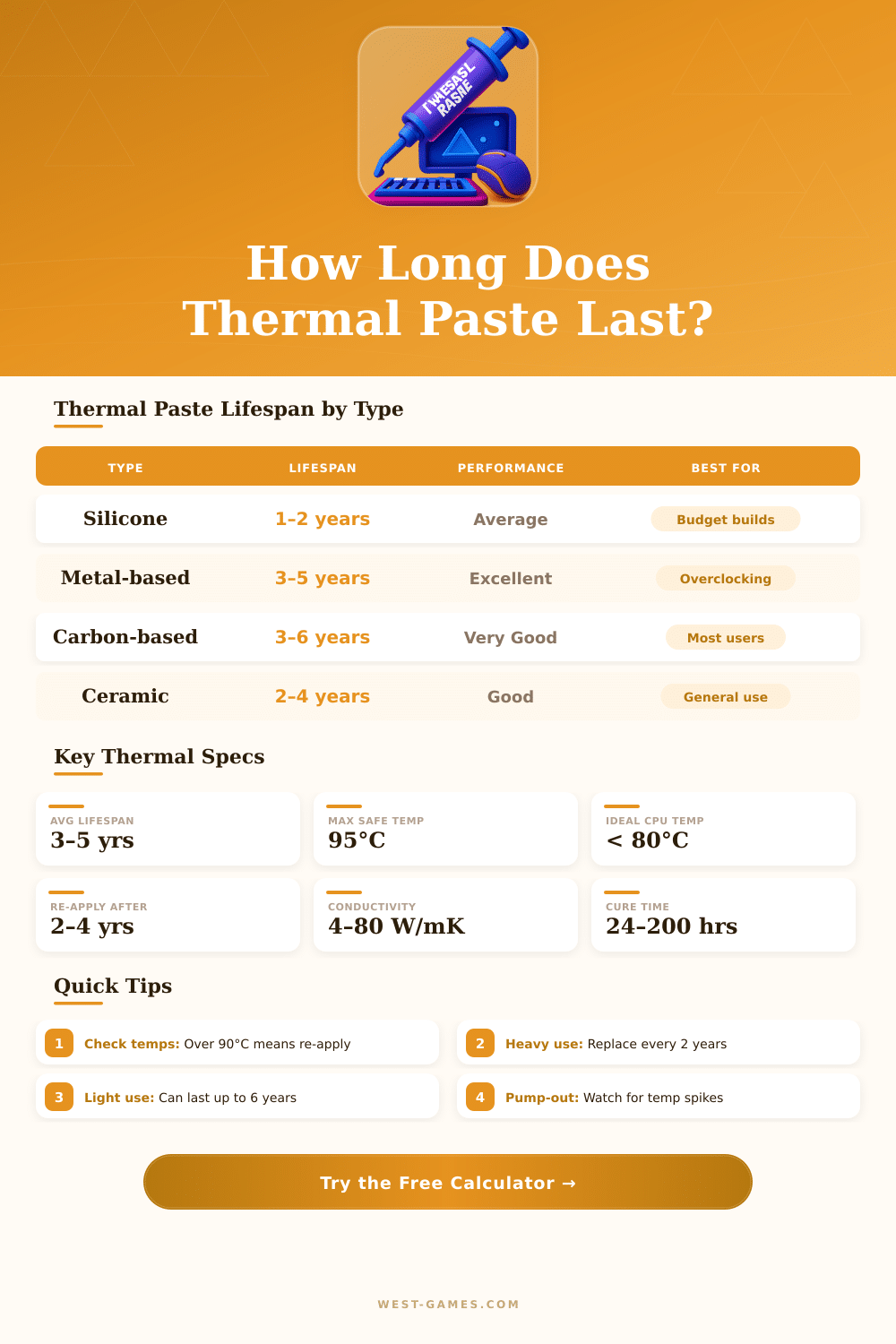
| Type | Conductivity (W/m·K) | Avg Lifespan | Electrically Safe | Best For |
|---|---|---|---|---|
| Silicone-based | 0.5 – 1.5 | 1 – 2 years | ✅ Yes | Budget, beginner builds |
| Ceramic-based | 4 – 8 | 3 – 5 years | ✅ Yes | General PC builds |
| Carbon / Graphite | 6 – 12 | 4 – 6 years | ✅ Yes | Mid-range to high performance |
| Metal-based (Liquid Metal) | 38 – 73 | 5 – 7 years | ❌ No | Extreme OC, enthusiasts only |
| Phase-change compound | 4 – 10 | 3 – 5 years | ✅ Yes | High-end air/AIO coolers |
| Usage Pattern | Hours/Day | Typical CPU Temp | Recommended Interval |
|---|---|---|---|
| Light (web, office) | 1 – 4 hrs | 45 – 60°C | Every 4 – 6 years |
| Moderate (gaming, streaming) | 4 – 8 hrs | 65 – 80°C | Every 3 – 4 years |
| Heavy (rendering, editing) | 8 – 12 hrs | 75 – 90°C | Every 2 – 3 years |
| Extreme (24/7 server, OC) | 16 – 24 hrs | 80 – 95°C | Every 1 – 2 years |
| Symptom | Likely Cause | Temp Impact | Action |
|---|---|---|---|
| CPU temps +10–15°C higher than before | Dried / cracked paste | High | Replace immediately |
| Thermal throttling under load | Poor heat transfer | High | Replace immediately |
| Random shutdowns / BSOD | Overheating from bad paste | High | Replace & check cooler |
| Paste visible as dry / chalky | Compound separation | Medium | Replace soon |
| Gradual temp creep over months | Paste slowly drying out | Medium | Plan replacement |
Thermal Paste has many names. One also calls it thermal building, thermal fat, thermal paste, thermal jelly, fat for CPU, material for heat sink or simply TIM. No matter what one says, it does the same task.
Thermal Paste is meant to cover little tiny spaces between the chip and the heat sink. Surfaces of chips and bases of heat sinks commonly have tiny holes and bumps. Because air traps heat, those spaces hold it and stop its escape.
Thermal Paste: What It Is and How to Use It
The paste closes those holes and forms a bridge, through which heat moves from the CPU to the heat sink. Basically, it works as a heat bridge, that removes air between the two parts and helps to better cool.
You lay Thermal Paste between the cover of the chip and the heat sink. It applies before the setup of the heat sink. The ideal is a thin layer.
Enough amount equal to half a grain for a pair of CPU and heat sink, whether in laptops or in desktop computers. If one uses too much paste, that might increase the thermal resistance than help.
One can apply it in different ways. The X-form is commonly suggested, because it reduces risk of tiny bubbles. Some like a spot big as a grain or a line above the chip.
With a spot or line, the paste spreads when one presses the heat sink down, like this filling spaces and pushing out air. If one spreads it before, it can close air inside, in case the surfaces are not fully smooth. The chioce depends on the model of the chip.
A line above the central part works for many Intel-chips, while a spot in the centre helps for some AMD-chips.
Among popular Thermal Paste choices are Arctic MX-4, MX-5, MX-6, Noctua NT-H1, Arctic Silver 5, Thermal Grizzly Kryonaut and Thermal Grizzly Conductonaut. The Arctic MX-4 sells best, because it is easy to work with and works well. Thermal Grizzly Kryonaut is rated among the best for its results, but it costs more and can be harder too apply.
Liquid metal like Conductonaut does not work for normal users and is used mostly for serious overclocking attempts.
The Arctic MX-4 stores carbon tiny particles to close little holes, which gives high heat flow and quickly removes heat from the CPU or GPU. Thermal Paste works with both air and water cooling systems.
Reapplying paste every four to five years is good practice. Some types last longer. Those pastes that come already laid on heat sinks can serve years without problems.
Heavy usage and high heats can quickly use up the paste. In laptops, reapplying commonly drops temperatures a lot, sometimes even by around thirty degrees. The quality of the paste and theaccuracy of its application both matter a lot.