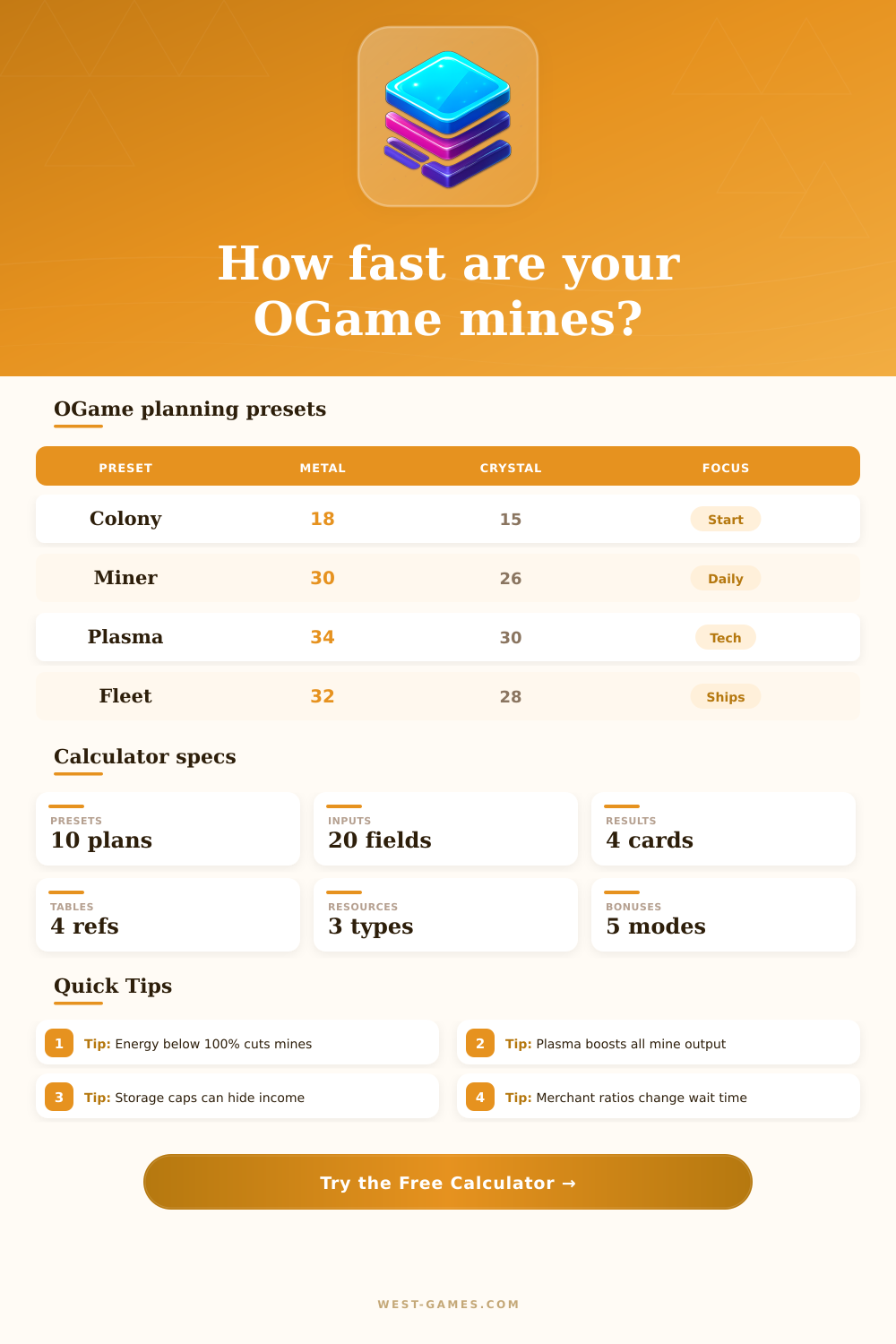
🌌 OGame Resource Calculator
Estimate metal, crystal, and deuterium mine output from mine levels, universe speed, energy, plasma tech, geologist, class bonuses, crawlers, storage, merchant ratios, target costs, and time to afford.
| Item | Base formula | Energy formula | Important factor |
|---|---|---|---|
| Metal mine | 30 x L x 1.1^L x speed | 10 x L x 1.1^L | Plasma +1% per level |
| Crystal mine | 20 x L x 1.1^L x speed | 10 x L x 1.1^L | Plasma +0.66% per level |
| Deut synth | 10 x L x 1.1^L x speed | 20 x L x 1.1^L | Temperature multiplier |
| Solar plant | Energy only | 20 x L x 1.1^L | No temperature effect |
| Solar satellite | Energy only | Temp / 4 + 20 each | Hot planets help energy |
Production uses hourly base output multiplied by economy speed, bonuses, and energy coverage. Server settings or lifeform rules may require manual bonus adjustments.
| Bonus | Modeled value | Affects | Planner use |
|---|---|---|---|
| Geologist | +10% | Mine output | Officer package |
| Collector | +25% | Mine output | Class package |
| Alliance class | +5% | Mine output | Optional package |
| Crawlers | 0-50% | Mine output | Manual percent input |
| Plasma tech | 1/0.66/0.33% | Metal, crystal, deut | Per technology level |
The calculator adds officer, class, crawler, and other production boosts as percent bonuses, then applies resource-specific plasma multipliers.
| Target | Metal | Crystal | Deut |
|---|---|---|---|
| Metal mine upgrade sample | 4,096,000 | 1,024,000 | 0 |
| Astrophysics research | 4,000,000 | 8,000,000 | 4,000,000 |
| Plasma technology research | 2,000,000 | 4,000,000 | 1,000,000 |
| Nanite factory upgrade | 1,000,000 | 500,000 | 100,000 |
| Battleship batch each | 45,000 | 15,000 | 0 |
Preset costs are planning examples. Use the custom cost fields for exact building levels, fleet batches, or research levels from your account.
| Planning item | Good band | Warning band | What to adjust |
|---|---|---|---|
| Energy coverage | 100% or more | Below 95% | Plant, sats, fusion, crawlers |
| Storage window | No cap before login | Overflow in 8-12h | Storage or collection timing |
| 3:2:1 merchant | Balanced trade | Crystal shortage | Trade metal surplus early |
| 2.5:1.5:1 merchant | Conservative | Longer conversion | Check deut reserve first |
| Production target | One bottleneck | All three short | Wait, trade, or transport |
Merchant conversion here is an estimate that values all resources through the selected ratio and compares target value against current stock plus hourly production value.
| Preset | Best use | Resource pressure | Energy note |
|---|---|---|---|
| Fresh Colony Starter | Early mine planning | Metal first, then crystal | Solar plant usually enough |
| Balanced Miner Planet | Daily account growth | Metal and crystal balance | Satellites support high mines |
| Cold Deut Synth Planet | Fuel production | Deut tank and low temperature | Cold planets need more energy sources |
| Plasma Tech Upgrade | Research timing | Crystal and deut bottleneck | Production gain can justify wait |
| Late Collector Planet | High-economy mining | Storage and crawler cap | Large surplus needs fleet safety |
The dynamic grid below compares your current plan to one-level mine upgrades and a plasma-tech bump using the same energy and bonus settings.
At some point in your OGame career, upgrading buttons becomes clickety-clicking in the dark: you don’t know if you’re winning or losing. Your mines is full of something and you can’t help but think “should I upgrade?” You only find out three days later that there was no excess of crystals.
Numbers alone aren’t enough. Planning resources isn’t about big numbers, it’s about knowing how they fit together: Where do resources come from? How fast do they gets used up? What holds them back? Where do they go when they’re stored? The calculator does all the math for you.
Why You Need a Resource Calculator
A mine is not an island by itself. It needs to be fed before it can spit out resource. Unless you have enough satellites and solar plants to feed its consumption, your output will scale accordingely. Eighty percent energy coverage means that everything run at that rate on the planet too. That’s very inefficient. A lot of new players are putting up mines but neglecting their lack of energy. Despite having high tech buildings, their mining efficiency is stalled.
Look at table below. This gives you an idea how much energy each building consumes. As you can see, a metal mine is far less efficient then a deuterium synthesizer on a cold planet.
The building blocks are the energy coverage. The ceiling is the bonuses. These is flat percent increases from the Collector class and Geologist officer. They will also be stacked with alliance buffs and crawler events. This happen before the energy throttle reduces them. This is why insulating your base output is key. You need to maintain surplus energy so you don’t get throttled when a big crawler event arrives, allowing you to capture the maximum bonus available temporarily. Otherwise you will waste it on an energy-constrained planet.
Another big problem is storage space. Sure, you’re churning out a million metal per hour. But what happens when your tanks fill up in just six? That sweet income goes right down the drain. This tool will calculate how much you’re producing versus your offline time. If you’re nearing storage capacity, it’ll alert you.
That’s particularly important on cold worlds where temperature modifiers realy boost deuterium production. You can wake up with a tiny tank and your fuel reserves capped for the night. Log in to see a high mine level but zero in your bank. Rather than grind for those final few levels, planning your gathering based off storage capacity is far more helpful.
Trading with merchants makes things even more complicated (not many do it right). Trading surpluses for shortfalls seems easy enough. But the ratios make a difference. What appears reasonable, say, three-to-two-to-one; isn’t necessarily the case. You want crystal to finish research. You sell some metal cheaply. Instead of speeding up production, this stretches the duration by making you wait longer for what you need. The merchant conversion calculation estimates how much this impacts when you get what you’re after. Is there reason to wait or trade now? The answer is in the mathematics, which may mean you should of waited though you want to trade.
Timing is about margins. It’s a game of marginal gains. It is about marginal efficiency. Your job isn’t to have everything all at once. Your job is to eliminate bottlenecks one-by-one. You must understand how storage, bonuses, and energy work together, whether you are preparing for a batch of battleships or ensuring your mines get fed.
Random upgrades becomes a coherent strategy when you understand how the numbers fit together and what they’re telling you. It’s like this, the numbers don’t lie. But they only talk to you if you ask the right questions. Every click is an investment, not a habit.