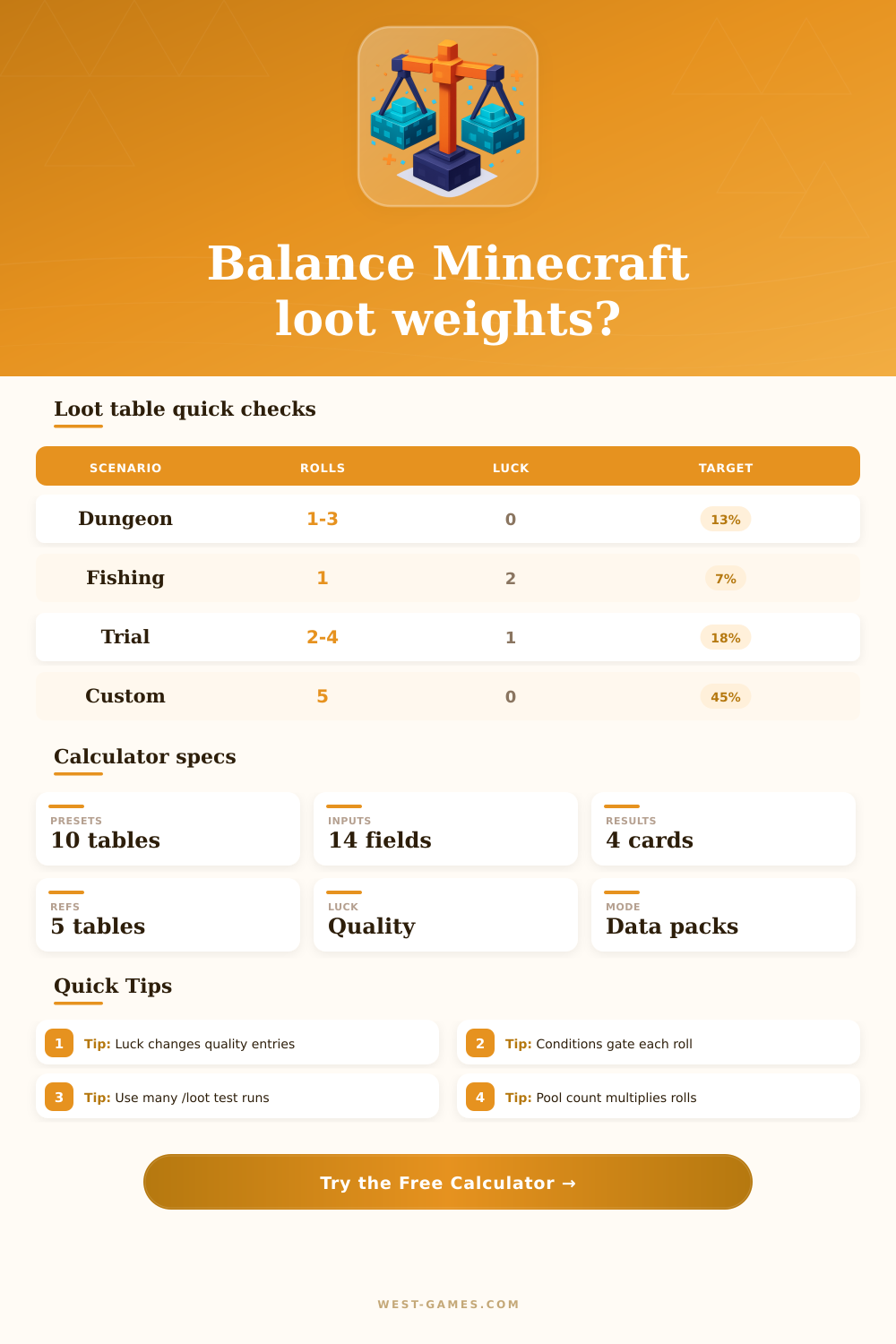
💎 Minecraft Loot Table Weight Calculator
Balance Minecraft loot tables by comparing entry weight, quality, luck attribute, conditions, pool rolls, bonus rolls, target chance, expected items, and data-pack testing samples.
| Preset | Target | Rolls | Balancing use |
|---|---|---|---|
| Dungeon Chest Diamond | Diamond stack | 1-3 | Chest reward rarity with several competing entries |
| Bastion Ancient Debris | Ancient debris | 2-6 | Rare high-value treasure inside a large pool |
| Fishing Treasure Book | Enchanted book | 1 | Quality and luck-sensitive treasure behavior |
| Trial Vault Reward | Trial key | 2-4 | Modern reward pool with conditions and repeats |
| Data Pack Crate | Custom reward | 5 | High-control custom server crate tuning |
Presets are not a replacement for the live JSON file. They are fast starting points for checking weight pressure and expected item counts.
| Entry setup | Luck value | Effective weight idea | Practical meaning |
|---|---|---|---|
| Weight 20, quality 0 | Any | 20 | Luck does not change the entry |
| Weight 20, quality 2 | 3 | 26 | Lucky players see the entry more often |
| Weight 20, quality -2 | 3 | 14 | Lucky players see the entry less often |
| Weight 1, quality -2 | 1 | 0 | The entry can be removed from selection |
| Weight 0, quality 1 | 2 | 2 | Luck can enable a normally inactive entry |
This calculator floors the luck-adjusted value and clamps it at zero, matching the usual way builders reason about effective loot weights.
| Condition location | Common examples | Calculator input | Effect |
|---|---|---|---|
| Pool condition | random_chance, killed_by_player | Pool condition pass | Can cancel the whole pool before rolls |
| Entry condition | entity_properties, damage_source | Target condition pass | Can remove the target from a roll |
| Function condition | set_count, enchant_randomly | Stack min and max | Changes count or item details after selection |
| Alternative entry | alternatives, group, sequence | Other entry weight | May change which entries truly compete |
| Nested table | loot_table entry | Pool count or custom | Needs a separate pass for deep accuracy |
For nested tables, run the calculator once for the parent entry and again for the child table if you need a full expected value chain.
| Test scenario | Command idea | Sample size | What to compare |
|---|---|---|---|
| Chest table smoke test | /loot spawn ~ ~ ~ loot namespace:chests/test | 100 runs | Obvious missing or overpowered entries |
| Player reward test | /loot give @s loot namespace:rewards/crate | 1,000 runs | Observed target hit rate versus calculator |
| Mob death test | /kill test entity loop | 2,500 runs | Condition and looting-style behavior |
| Luck A/B test | /attribute @s minecraft:generic.luck base set X | 1,000 each | Quality entries before and after luck |
| Function chain test | /data get entity or storage logs | 500 runs | Stack count and NBT function outputs |
The test forecast card estimates expected target hits from your entered run count, so you can spot large implementation mistakes quickly.
| Metric | Formula idea | Inputs used | Meaning |
|---|---|---|---|
| Effective weight | floor(weight + quality x luck) | Target weight, quality, luck | Target's selectable weight after luck |
| Per-roll target chance | Pool pass x entry pass x target share | Conditions and total pool weight | Chance one pool roll returns the target |
| Total rolls | Pool count x average rolls | Roll range and bonus roll range | Expected number of independent selections |
| At least one target | 1 - (1 - p)^rolls | Per-roll chance and expected rolls | Chance of one or more target hits |
| Expected items | Rolls x p x average stack | Stack min and max | Average target item quantity per table call |
Real loot tables can use nested entries, functions, and predicates. Use the breakdown to isolate the part of the JSON you are balancing.
Hours go into crafting the perfect dungeon chest. You balance rare diamonds against gold and iron. Testing it twice, just to make sure it feels right. You hand it over to your players, only to find them drowning in enchanted books or staring blankly at empty voids where treasure once sat. It’s at this meeting of our intuition and probability that most server admins loses their sanity.
Loot tables don’t give a damn about what’s fair; they only deal with weights, conditions, and the cold math of random rolls. And getting that balance correct takes more than guesswork; you need to know exactly how the game engine select items behind the scenes. In theory, this is a pretty straightforward mechanic, but it gets tricky when you’re dealing with all those variables in practice.
How to Balance Loot Tables Correctly
Each item have some amount of weight associated with it, the larger the weight, the more likely an item will be picked out of the pool. To add another layer to vanilla Minecraft, there’s also the issue of luck and quality, where player’s luck score is multiplied by any positive or negative quality tied to an item. So if you’re very lucky, then items with positive quality is much, much more likely to show up, while items with negative quality goes completely unnoticed. It’s a subtle interaction until you break your economy.
This makes sense because you may assume that a diamond is always “rare.” However, a lucky player sitting next to a dock fishing might find that the rarity of that diamond swing wildly. The tool above calculate all this for you, taking care of the multiplication and clamping so you can get an idea of how truly rare something is before publishing your pack.
Conditions are another problem in loot table design. It’s easy to take a look at a raw weight and say a pool looks nice. But you also have to consider the chance of a roll ever happening. If there is a 20 percent chance of failing a condition, that roll won’t happen. This is made worse by bonus rolls. A bonus roll doesn’t only adds items, it adds variance. Consider a pool with six fixed rolls versus a pool with one guaranteed roll and five bonus rolls. Then throw some low-weight rares into the mix. That will behave quite different than. The tool includes some reference tables breaking down these situations, demonstrating how dungeon chests differs from trial vault rewards in structure.
The last step is testing. After a few attempts, your eyes deceives you. Randomness requires sample size, and you can’t believe your own vision after only a handful of attempt. That’s why running a thousand simulated draws shows if what you think is balanced actualy is. It shows if what you think is balanced actually is. If something is supposed to happen five percent of the time, then you want to observe that result across hundreds of trials, not tens. The calculator predicts how many times on average you should hit it based off the number of tests you intend to run. This lets you know if your data pack does what you expect before subjecting it to real players.
The luck variable is one many builders simply disregard, thinking people will just play around with neutral stat builds. They won’t. Enchantments and potions, such as Luck of the Sea, increase Luck. Suddenlly that rare drop become common. The common filler goes away. By tweaking the quality value, you can set how sensitive this is. High quality items rewards those who are lucky without affecting its rarity for anyone else. It’s nothing big, but it’ll matter over time in retaining players.
But all that boils down to is balancing what the player thinks they should of get with what they actually do get. Rare items has to feel earned but not impossible. Common items need to fill your pockets, not clog your inventory. Tackling those variables separately, rolls, conditions, quality, weight, lets you adjust each individually, keeping everything in balance. The math may be unforgiving but the results is repeatable. Learning how the engine’s weighting your inputs makes a seemingly random drop table something you can predictably work on. You don’t guess anymore when a chest seems empty; instead you know precisely where to dial down the weights. And that’s what takes a functional server and makes it a well tuned experience.