⚡ Whole House Surge Protector Lifespan Calculator
Estimate how long your surge protector will last based on joule rating, surge frequency, and usage conditions
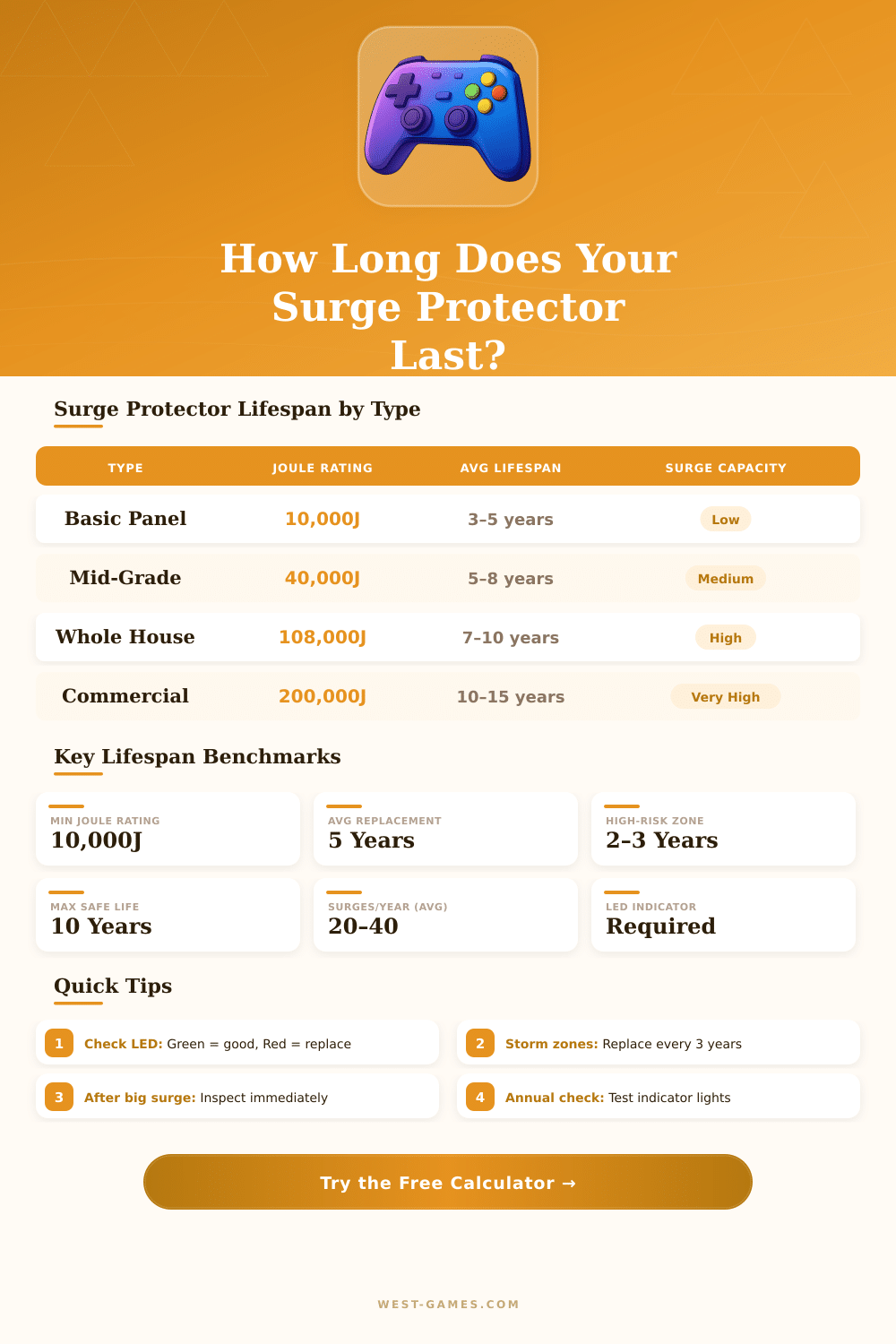
| Type | Joule Rating | Expected Lifespan | Surges Absorbed (avg) | Replacement Signal |
|---|---|---|---|---|
| Basic Panel Mount | 10,000 – 20,000 J | 2 – 4 years | 30 – 60 events | LED turns red or no light |
| Mid-Grade Whole House | 36,000 – 72,000 J | 5 – 8 years | 100 – 200 events | LED indicator + annual test |
| Premium Whole House | 72,000 – 108,000 J | 7 – 10 years | 200 – 350 events | Diagnostic display / LED |
| Commercial Grade | 108,000 – 200,000 J | 10 – 15 years | 350 – 600 events | Remote monitoring |
| UL Listed Type 1 | 40,000 J (min) | 5 – 10 years | 120 – 300 events | Visual indicator required |
| Climate / Risk Level | Avg. Surges/Year | Lifespan Reduction | Recommended Joule Rating | Replace Every |
|---|---|---|---|---|
| Low Risk (dry inland) | 5 – 15 | None | 10,000 J+ | 7 – 10 years |
| Moderate (average US) | 15 – 40 | 10 – 20% | 36,000 J+ | 5 – 7 years |
| High Risk (storm-prone) | 40 – 100 | 30 – 50% | 72,000 J+ | 3 – 5 years |
| Extreme (coastal / FL / TX) | 100 – 250+ | 50 – 75% | 108,000 J+ | 2 – 3 years |
| Surge Source | Typical Energy (J) | Frequency | Risk to Protector |
|---|---|---|---|
| HVAC / Motor Cycling | 10 – 50 J | Daily | Low |
| Utility Grid Switching | 50 – 300 J | Weekly | Moderate |
| Nearby Lightning Strike | 500 – 5,000 J | Seasonal | High |
| Direct Lightning Strike | 5,000 – 50,000+ J | Rare | Catastrophic |
| Power Line Disturbance | 100 – 1,000 J | Monthly | Moderate |
| Large Appliance Startup | 5 – 30 J | Daily | Very Low |
A Whole House Surge Protector is a device that aims to guard electrical devices against spikes of voltage. Those spikes last only a moment commonly only microseconds, and can ruin electronics if one leaves them without protection. A sudden increase of voltage that lasts at least three nanoseconds is called a surge.
The protector stops excessive flow of electricity from reaching the devices that are plugged into it.
What a Whole House Surge Protector Does
Common reasons for voltage spikes are overloads of electricity, lightning strikes, mistakes in wiring and breaks in energy. Storms with lightning, damage to power lines or nearby devices that commonly turn on also can create surges with thousands of volts. Compared to a simple power strip, a Whole House Surge Protector carries more parts and protects against those risks.
Power strips and surge protectors seem alike, even though they work differently. A simple strip only extends the number of outlets that are available. Protectors do that too, but they block surge energy so that it does not arrive and destroy the devices.
Commonly they have thick bodies, solid build from the maker and warranties or insurance promises. Main features to check are the limiting voltage, time of reaction and amuont of joules.
Talking about joules, surge protectors are not rated by watts. The joule rating is really important. Choosing a model with a high joule value is a reliable way.
Around 3 000 to 4 000 joules for protection is a good result. Some versions offer even more, for instance one with 5 280 joules four surge guard, together with 12 outlets and USB ports.
The Tripp Lite Protect It 12-Outlet Surge Protector is a good option for a home desk or shared space. It has automatic shutoff for the main electricity, lots of outlets and connections for coaxial cables and phones. Brands like Tripp Lite, APC and CyberPower are worth checking.
Getting a protector with a light that shows when the guard is working helps, because the user then knows when it will stop working.
A UPS is a more advanced device with extra protective levels that immediately switches a computer to battery power. A Whole House Surge Protector stays more basic and simply cuts the power when it overloads. For serious guard of a computer, a UPS is better.
Surge protectors come with extension cables of various lengths, which allows electronics to work from a bit of distance. A quality protector will not stop a computer from getting the power that it needs. Even so, linking protectors in a chain or mixing them with a UPS can cause problems.
For small surges in the house, a regular protector works well. But a direct blow of lightning requires a Whole House Surge Protector that is connected tothe main electrical panel.