⚡ Surge Protector Lifespan Calculator
Estimate how long your surge protector will last based on usage, joule rating, and surge history
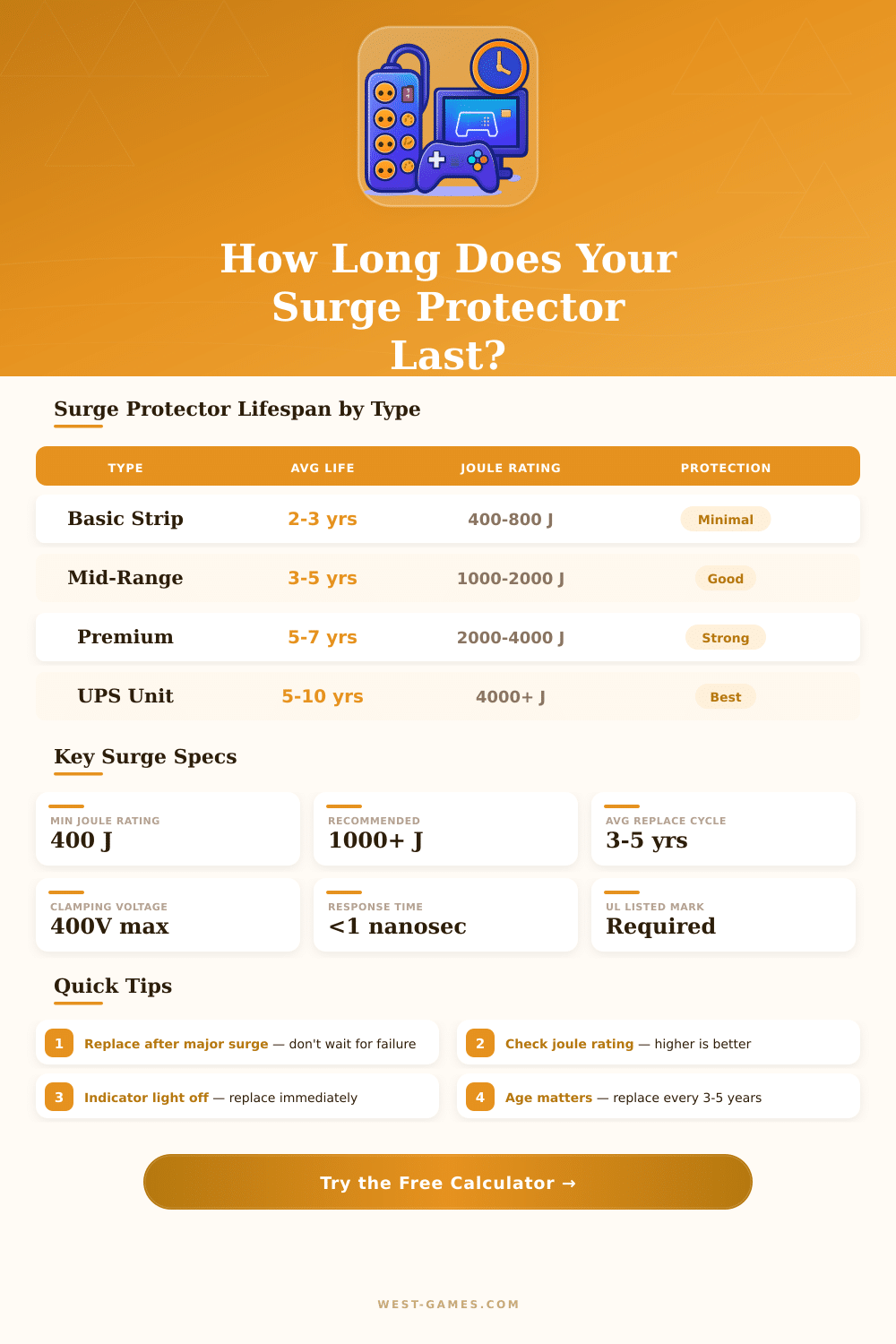
| Type | Joule Rating | Expected Lifespan | Best For | Status |
|---|---|---|---|---|
| Basic Power Strip | 0 — 400 J | No real protection | Low-risk devices only | Not Recommended |
| Entry-Level Surge Protector | 400 — 800 J | 1 — 2 years | Lamps, fans, chargers | Minimal |
| Standard Surge Protector | 800 — 1500 J | 2 — 4 years | TVs, printers, routers | Adequate |
| Mid-Range Protector | 1500 — 2500 J | 3 — 5 years | Computers, monitors | Good |
| Premium Surge Protector | 2500 — 4000 J | 5 — 7 years | Gaming rigs, workstations | Excellent |
| Whole-Home Protector | 40,000+ J | 10+ years | Entire household | Best |
| UPS (Battery Backup) | Varies (+ battery) | 5 — 10 years (battery 2–5 yr) | Servers, critical equipment | Best |
| Specification | What It Means | Minimum Recommended | Ideal Value |
|---|---|---|---|
| Joule Rating | Total energy the MOVs can absorb before failing | 1,000 J | 2,000+ J |
| Clamping Voltage | Voltage at which the MOV activates to divert surge | 400V | 330V or lower |
| Response Time | How fast the surge is suppressed | <1 nanosecond | <1 nanosecond |
| UL 1449 Certification | Industry safety standard for surge suppressors | Required | UL 1449 3rd Ed. |
| MOV Count | Number of Metal Oxide Varistors inside the unit | 3 MOVs (L-N, L-G, N-G) | 3+ with thermal fusing |
| Indicator Light | Shows if surge protection is still active | Required feature | LED always visible |
| Surge Type | Typical Energy | Joules Consumed | Replace After? |
|---|---|---|---|
| Appliance Switch-On (fridge, AC) | Low (1–5 J) | ~1–5 J each | No (unless hundreds) |
| Minor Power Fluctuation | Low–Med (5–50 J) | ~5–50 J each | Only if frequent |
| Utility Grid Switching | Medium (50–200 J) | ~50–200 J each | Check indicator light |
| Nearby Lightning Strike | High (500–2000+ J) | 500–2000+ J each | Yes — replace immediately |
| Direct Lightning Strike | Extreme (10,000+ J) | All capacity depleted | Yes — replace immediately |
Voltage spike is one of those quiet enemies of our electronics, they happen in just some microseconds, but that much is enough to destroy your devices. The task of a Surge Protector is fairly easy: if a sudden increase of voltage happens (talking about at least three nanoseconds of extra energy), it blocks that dangerous electricity from reaching anything connected to it.
What causes such spikes? Many reasons, really. Overloads of electricity are clear culprits, but lightning strikes, badly done wiring and loss of energy can all send thousands of volts running through your cables.
How Surge Protectors Keep Your Devices Safe
Even devices that commonly switch between on and off can create such surges. Damage in the power lines during storms or simply bad wiring in the home can also cause them. Here is the role of a Surge Protector, they are basically guards for your electronics.
Here is where many folks get confused: power strips and Surge Protectors seem almost the same. What is the difference? A simple power strip only makes it eaiser to add more outlets to the wall.
A Surge Protector does the same task, but it also filters dangerous spikes of voltage before those reach your devices. You can spot a real Surge Protector by its thick body, brand mark and info about the guarantee printed on it, especially about protection policy for gear. When buying, pay attention to the maximum voltage, response time and the rating in joules.
What about that rating in joules? Do not ignore it. Bigger values point to stronger protection against surges.
Models range from around 790 joules at the bottom range up to 5 280 joules or more. A value between 3 000 and 4 000 joules seems like a good balance four reliable and stable protection.
Surge Protectors come in many types. Some have six outlets, others have eight or even twelve. Many now carry USB and USB-C ports for charging phones and tablets.
The lengths of cable cords also range, which helps when your outlets sit hidden in difficult places. Some higher class models include connections for phones and coax cables, very handy if you have a home office. Look for a light that shines while the protection works; if it goes dim, the device no longer protects.
If you want something stronger, consider a UPS, an uninterruptible power supply. It is basically a Surge Protector with power, that switches to battery as soon as the main energy fails. A regular Surge Protector only kicks in when it gets too much energy.
Brands like Tripp Lite, APC and CyberPower offer good models of both.
Small surges at home? A basic Surge Protector handles them well. But a direct lightning strike is a whole other matter.
Then you need a wholehouse Surge Protector, connected directly to your main electrical panel. Most lightning stops before reaching your house, but a fallen tree on power lines or rough wind can still cause a surge that your Surge Protector will catch. Plugging a computer directly into the wall is not dangerous, modern power supplies have built-in protection, but a Surge Protector gives real calm.
Replacing a burned motherboard costs a lot.