🔊 Subwoofer Lifespan Calculator
Estimate how long your subwoofer will last based on usage habits, quality, and environment
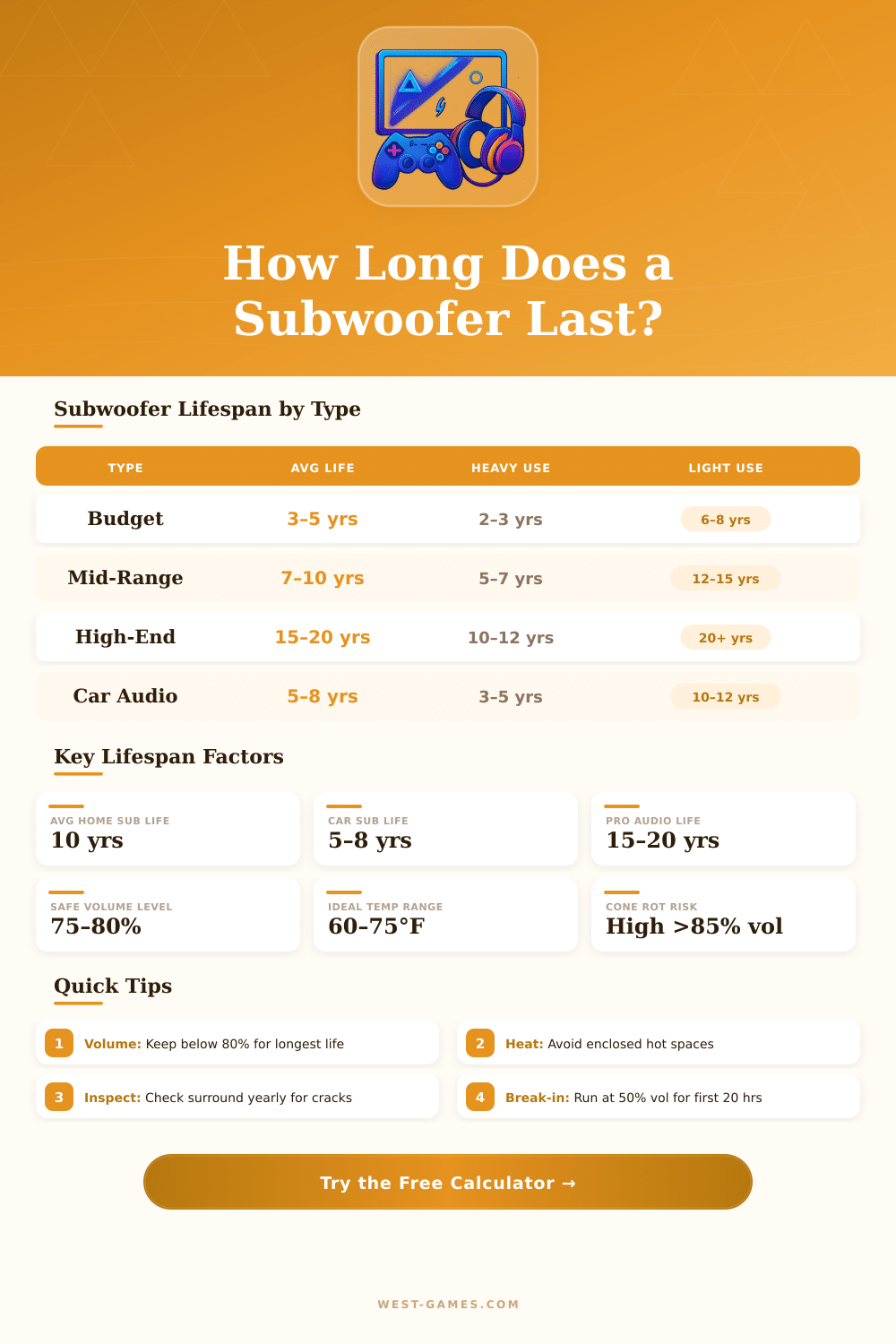
| Subwoofer Type | Avg Lifespan | Heavy Use | Light Use | Key Failure Point |
|---|---|---|---|---|
| Budget Home | 3–5 years | 2–3 years | 6–8 years | Foam surround rot |
| Mid-Range Home | 7–10 years | 5–7 years | 12–15 years | Amplifier failure |
| High-End Home | 15–20 years | 10–12 years | 20+ years | Capacitor aging |
| Budget Car Audio | 3–5 years | 2–3 years | 6–8 years | Voice coil burnout |
| Mid-Range Car Audio | 5–8 years | 3–5 years | 8–12 years | Surround deterioration |
| High-End Car Audio | 8–15 years | 6–8 years | 15–20 years | Box pressure damage |
| Pro / Studio | 15–25 years | 10–15 years | 25+ years | Driver re-foam needed |
| Portable / Bluetooth | 2–4 years | 1–2 years | 4–6 years | Battery degradation |
| Condition | Effect on Life | Cause of Damage | Prevention |
|---|---|---|---|
| Ideal (60–75°F / 16–24°C) | +20–30% life | None — optimal range | Maintain room temp |
| Hot Room (>85°F / 30°C) | –20–35% life | Amp thermal stress | Add ventilation |
| High Humidity (>70% RH) | –25–40% life | Surround rot, corrosion | Dehumidifier nearby |
| Direct Sunlight / UV | –30–50% life | Cone & surround degradation | Keep out of sunlight |
| Vehicle Trunk | –15–25% life | Vibration, heat spikes | Secure mounting |
| Outdoor Exposed | –40–60% life | Moisture & UV exposure | Use outdoor-rated unit |
| Symptom | Likely Cause | Remaining Life Est. | Fix? |
|---|---|---|---|
| Distortion at low volume | Voice coil damage | Weeks to months | Replace driver |
| Crackling / popping | Loose surround / spider | Months — if caught early | Re-foam repair |
| No output / cutting out | Amp board failure | Already failed | Amp repair / replace |
| Rattling / buzzing | Loose port, screw, or cone | Years if fixed quickly | Tighten / reseal |
| Reduced bass output | Surround rot / magnet shift | 1–3 years | Re-foam surround |
| Burning smell | Overheated voice coil or amp | Hours to days | Stop use immediately |
| Visible cone tears | Over-excursion / impact | Already degraded | Cone repair or replace |
subwoofer, occasionally simply called sub, is a kind of speaker designed for making low sounds. Those deep sounds commonly call bass or sub-bass. For usage at home, the usual range of sounds for subwoofer is between 20 and 200 Hz.
This is much lower than the level that a standard woofer can reach. Little speakers simply do not work well with deep sounds, hence a subwoofer covers that gap.
What a Subwoofer Is and How It Helps
A woofer and subwoofer are entirely separate parts. A woofer already deals with fairly low sounds, but a subwoofer goes even more down. The word “woofer” is not simply a short form of subwoofer.
A subwoofer receives signals that usually stay under 100 Hz, or it carries an internal filter called a low-pass filter that only allows such signals. All deep tones get sent from the chip directly to the subwoofer. The most many subwoofer units end up on the floor, because they form the biggest part of teh whole system.
An active subwoofer brings mighty bass in many stereo or home cinema systems. It gives depth, impact and freedom to the sound of music and cinema. First created for musical usage, subwoofer units became really liked in home cinema because of there strong impressions.
Owning one of them creates a more gripping experience for both music and film content. Deep bass with good control and balance really changes everything.
To reach good bass response, the best place for a subwoofer usually is in the front corner of the room, a bit pulled away from the wall. Also the size of the room matters. When the space is under 200 square feet, closed subwoofer units commonly work more well.
Closed models have less maximum output, but their low ends drop with a gentle slope instead of the more dramatic cut that subwoofer units with tubes have.
Subwoofer units come in all sorts of sizes. From little 6.5-inch and 8-inch versions to huge 18-inch beasts. Different sizes work for various systems and needs.
One finds subwoofer units designed for cars, home setups, ships and also professional audio.
A subwoofer is almost needed, unless the shape of the room does not manage to handle low sounds without shaking the walls. Here, one should spend money on treatment of the room. A subwoofer is useful also for video games.
Strong effects like shots and explosions get more life. Even steps in games can sound clearer. A great speaker system with a subwoofer delivers bass that one feels in the body, and it makes both old and newgames more pleasant.
When the main speakers already manage to play 40 Hz well before they drop, a subwoofer does not necessarily matter for music, unless one listens to live music. It really depends on what the main speakers can do in the room.