🎯 KD Ratio Calculator
Calculate your Kill/Death ratio, KDA, and performance rating for any FPS game
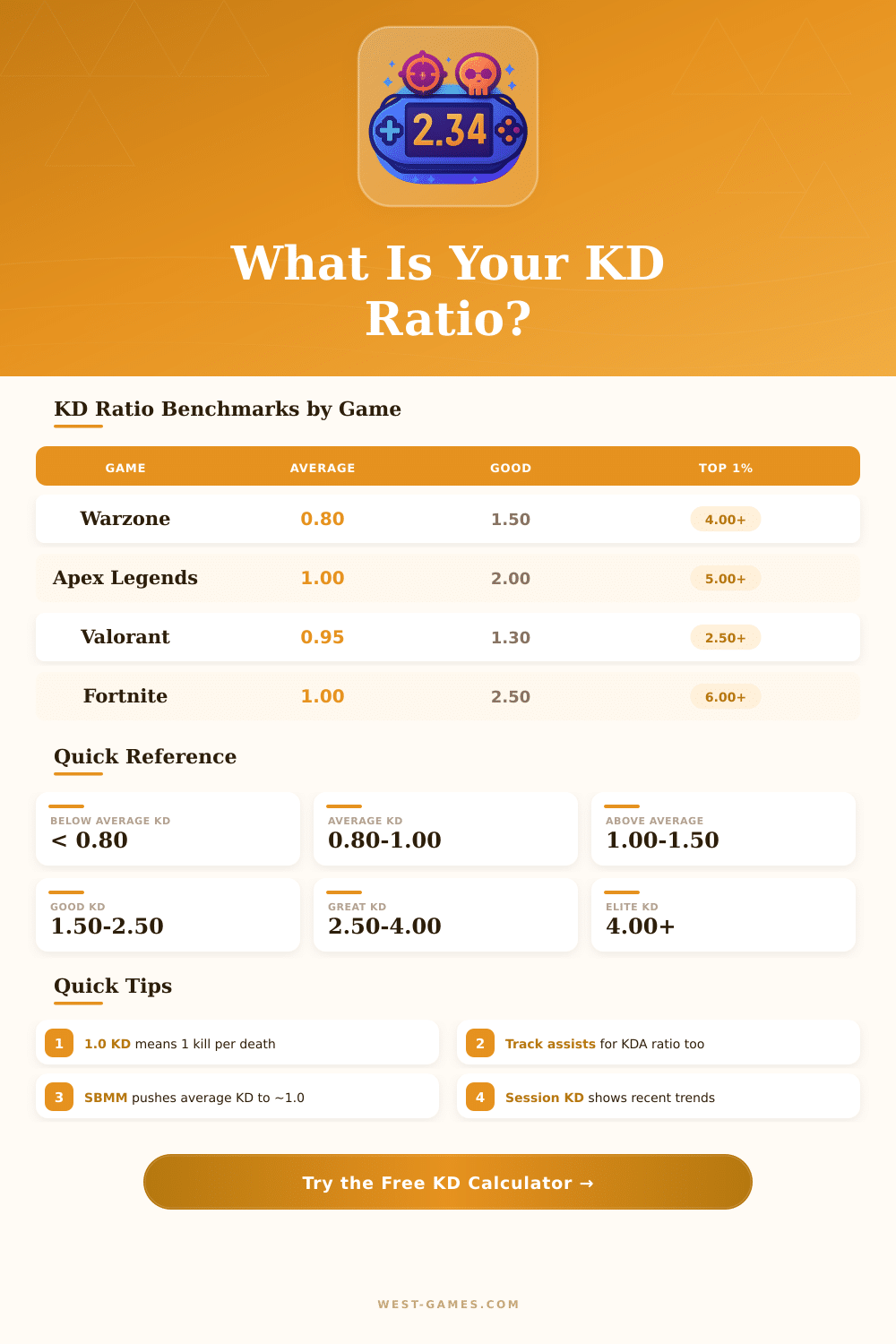
| Game | Avg KD | Good KD | Top 5% | Top 1% |
|---|---|---|---|---|
| CoD: Warzone | 0.80 | 1.50 | 3.00 | 4.00+ |
| Apex Legends | 1.00 | 2.00 | 3.50 | 5.00+ |
| Valorant | 0.95 | 1.30 | 1.80 | 2.50+ |
| Fortnite | 1.00 | 2.50 | 4.00 | 6.00+ |
| CS2 / CS:GO | 0.90 | 1.20 | 1.60 | 2.00+ |
| Overwatch 2 | 1.05 | 1.80 | 2.80 | 3.50+ |
| Rainbow Six Siege | 0.90 | 1.20 | 1.60 | 2.00+ |
| PUBG | 0.90 | 2.00 | 4.00 | 6.00+ |
| Kills | Deaths | KD Ratio | Rating |
|---|---|---|---|
| 10 | 20 | 0.50 | Below Average |
| 10 | 12 | 0.83 | Average |
| 10 | 10 | 1.00 | Average |
| 15 | 10 | 1.50 | Good |
| 20 | 10 | 2.00 | Very Good |
| 25 | 10 | 2.50 | Great |
| 30 | 10 | 3.00 | Excellent |
| 50 | 10 | 5.00 | Elite |
| Current Stats | Target 1.0 KD | Target 1.5 KD | Target 2.0 KD |
|---|---|---|---|
| 50K / 100D (0.50) | +50 kills | +100 kills | +150 kills |
| 80K / 100D (0.80) | +20 kills | +70 kills | +120 kills |
| 100K / 100D (1.00) | At target | +50 kills | +100 kills |
| 200K / 200D (1.00) | At target | +100 kills | +200 kills |
| 500K / 500D (1.00) | At target | +250 kills | +500 kills |
| Metric | Formula | Example (20K/10D/8A) | Result |
|---|---|---|---|
| KD Ratio | Kills ÷ Deaths | 20 ÷ 10 | 2.00 |
| KDA (Full Assists) | (Kills + Assists) ÷ Deaths | (20 + 8) ÷ 10 | 2.80 |
| KDA (Half Assists) | (Kills + 0.5 × Assists) ÷ Deaths | (20 + 4) ÷ 10 | 2.40 |
| Kill Per Game | Kills ÷ Games | 20 ÷ 5 | 4.00 |
| Death Per Game | Deaths ÷ Games | 10 ÷ 5 | 2.00 |
Talk with any player for five minutes, and he mentioned your kd ratio, this is the stat that all love to discuss. The kd ratio measures the ratio between kills and deaths and it gives a simple guess how many enemies you beat against the times that you die. The math?
Very simple. You divide the number of your kills by the number of your deaths, like this you get your kd ratio.
What is KD ratio and how to improve it
Let me explain with some examples, so that it becomes clear. Assume that you killed 10 enemies, but died 5 times. This results in 10 divided by 5, so 2.0.
Two kills for every death (nice balance). Or imagine 6 kills against 3 deaths, and you still have 2.0. If you sadly kill only 1 and die 2 times, then your kd ratio falls to 0.5.
And here are big cases: some player with 357 kills over 231 deaths ends at around 1.55.
When your kd ratio matches 1.0, you are in full balance. This means like a 50/50 chance in your fights. The more you raise this number, the more well you play overall.
More kills always help to raise the ratio, so the trend upward is alwyas wanted.
Even so there is one weird case that confuses many. If you kill 5 enemies without losing a life even once, you can not really count kd ratio, because division by zero does not work. Hence the game counts it as 5.0, nice problem solved!
Looking at the whole group of players, the average kd ratio moves between 0.9 and 1.0. This makes sense if you think: every kill requires a death somehow. Many players stay under 0.75, which surprises some.
Being under 1.0 does not show that you are bad, but their is always room to improve.
Around 1.0 is seen as a solid level, without big complaints. Reach 1.5, and you play well. Getting to 2.0 or more, this already is impressive.
Above 3.0, you enter an exclusive zone. In Warzone especially, 3.5 to 4.0 place you in the upper 0.1 percent. In competitive shooters pro players commonly have around 4.0 or more.
In CS the best pros end between 1.1 and 1.5 for matches, and staying above 1.0 for team wins is enough honestly.
To raise your kd ratio, do not chase only kills all the time. Fewer deaths are also important. Know every corner of the map and play smart, this helps a lot.
Vehicles like tanks can reach 5:1 ratio, while helicopters go even higher.
Even so kd ratio does not describe everything. In games like Conquest it is only one measure. Your record of wins and losses you must consider also.
You could be a killing machine, but lose matches, if your strategy fails. Goodplay with a stable kd ratio commonly results in better fun moments.