🔌 HDMI Cable Lifespan Calculator
Estimate how long your HDMI cable will last based on type, usage, and environment
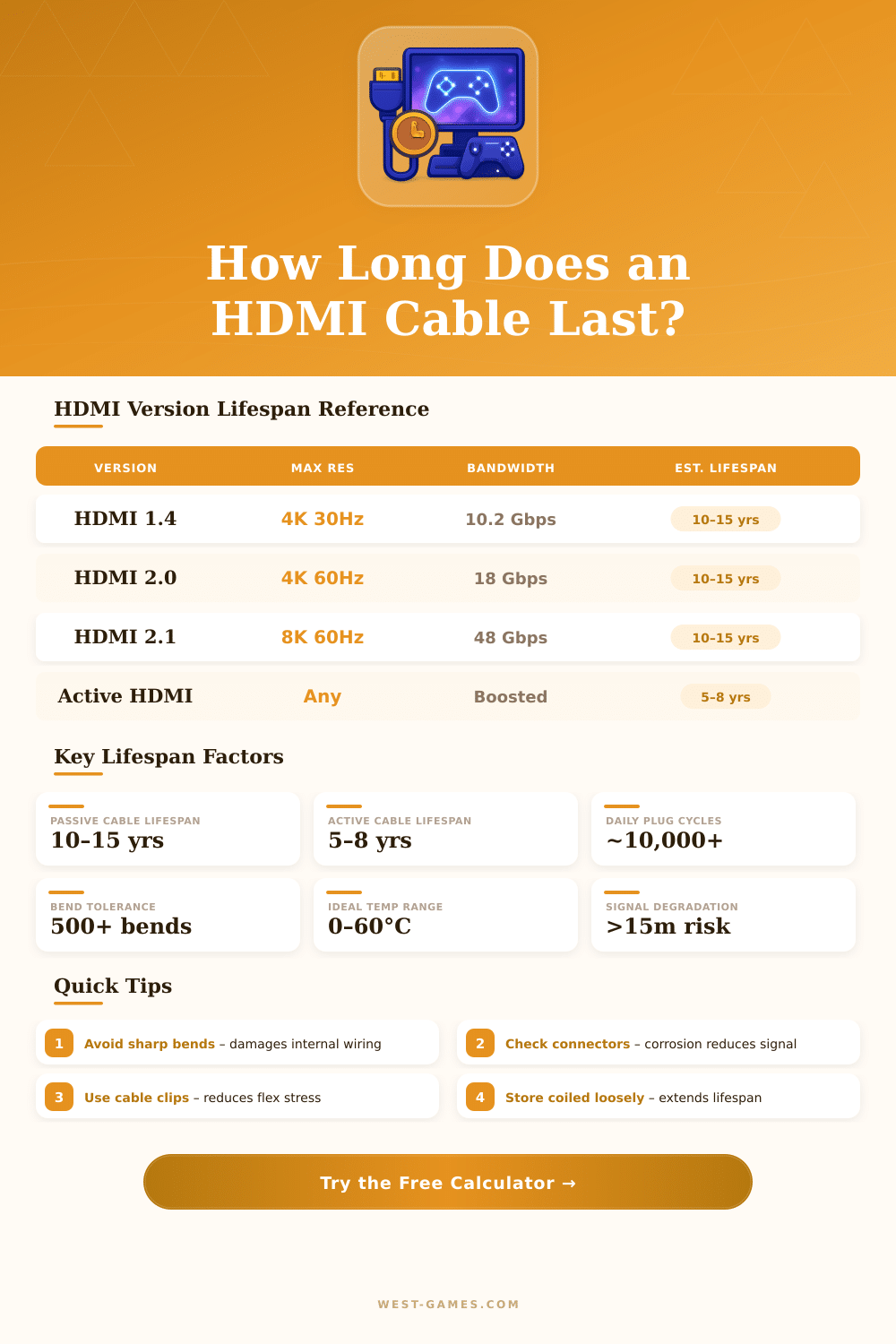
| HDMI Version | Max Resolution | Bandwidth | Max Passive Length | Est. Cable Lifespan |
|---|---|---|---|---|
| HDMI 1.0 – 1.2 | 1080i / 1080p | 4.9 Gbps | 5m (16ft) | 10–20 years |
| HDMI 1.3 – 1.4 | 4K 30Hz | 10.2 Gbps | 10m (33ft) | 10–15 years |
| HDMI 2.0 / 2.0b | 4K 60Hz / HDR | 18 Gbps | 5–8m (16–26ft) | 10–15 years |
| HDMI 2.1 (48G) | 8K 60Hz / 4K 120Hz | 48 Gbps | 3–5m (10–16ft) | 10–15 years |
| Active HDMI (copper) | 4K / depends | Up to 18 Gbps | Up to 30m (98ft) | 5–8 years |
| Active Optical (AOC) | 4K / 8K | Up to 48 Gbps | Up to 100m (328ft) | 5–8 years |
| Failure Factor | Impact on Lifespan | Typical Symptom | Prevention |
|---|---|---|---|
| Frequent plug/unplug | −30% to −60% | Loose connection, no signal | Use HDMI switcher |
| Sharp bends / kinking | −20% to −50% | Flickering, image artifacts | Route cable gently |
| Heat exposure (>50°C) | −20% to −40% | Signal degradation | Keep away from heat sources |
| High humidity / moisture | −15% to −35% | Corrosion, audio dropout | Use sealed connectors |
| UV / outdoor exposure | −30% to −50% | Jacket cracking, signal loss | Use UV-rated cables outdoors |
| Cable over 10m (passive) | −10% to −25% | Signal dropout at long runs | Use active/optical cable |
| Flat / ultra-slim design | −15% to −30% | Internal wire damage | Avoid routing under carpets |
| Budget connector (no strain relief) | −20% to −40% | Connector breaks off | Use cables with strain relief |
HDMI cable stands for High Definition Multimedia Interface. This kind of cable forms the core of all current home media setups, allowing smooth sending of high quality sound and picture signals from different devices to screen tools. By means of one single link they ensure clear image in high definition together with multi-channel sound.
Currently there are four main kinds of HDMI cable that differ chiefly according to their highest speed. In bigger speed, cable carries more sound and picture data. Like this the speed becomes a key element during the choice of the right cable, because it points out what picture resolutions and color details it is able to process.
How to choose the right HDMI cable
HDMI 2.0 requires 18 Gbps. For HDMI 2.1 you need 48 Gbps. A cable that only handles 4K may limit bandwidth, color sampling or force a drop of extra information to 4:2:0.
If you have a PS5, Xbox Series X or strong computer for games, then an HDMI 2.1 cable should be used to use the full skill of the gear. It means 4K sight at 120 Hz together with VRR, ALLM and HDR without delay. High dynamic range boosts accuracy of colors and contrast, which gives a better gaming experience.
An HDMI cable that backs HDR suits games well with rich graphical elements and detailed landscapes.
From simply looking at a cable, one can not tell its version. They all look the same, and differ only by means of golden connections or more shiny outer cover. Quality of digital signals does not fail because of the maker of the used cable.
A cable at a hundred dollars will work just as well as one at five dollars, if both are in good state. Expensive brands simply waste money. Digital signals either succeed ore fail.
Monoprice and Zeskit rank among popular and cheap options, that truly reach certified 48 Gbps skill. Optical cables from Zeskit work well for bigger distances. When cable length goes past 20 feet, fiber optical tools like those from Ruipro become needed.
For 1080p, passive copper HDMI cable usually works up to 30 to 50 feet. In 4K sight at 60 Hz, better limit passive cables to 15 to 25 feet for safety. Active optical cables fit 4K sending up to 328 feet.
Stiff cables risk damaging input ports, so check their flexibility before you buy. The ideal cables include everything needed in a pack for less than ten dollars. New HDMI 2.2 standard launches Ultra96 HDMI cable with up to 96 Gbps width.
It adds a Protocol for Guidance of Delay, which helps to sync sound and image. Picking thecheapest from the newest HDMI cable standard stays a good plan.