💾 Laptop Hard Drive Lifespan Calculator
Estimate how long your HDD or SSD will last based on usage patterns, age, and drive type
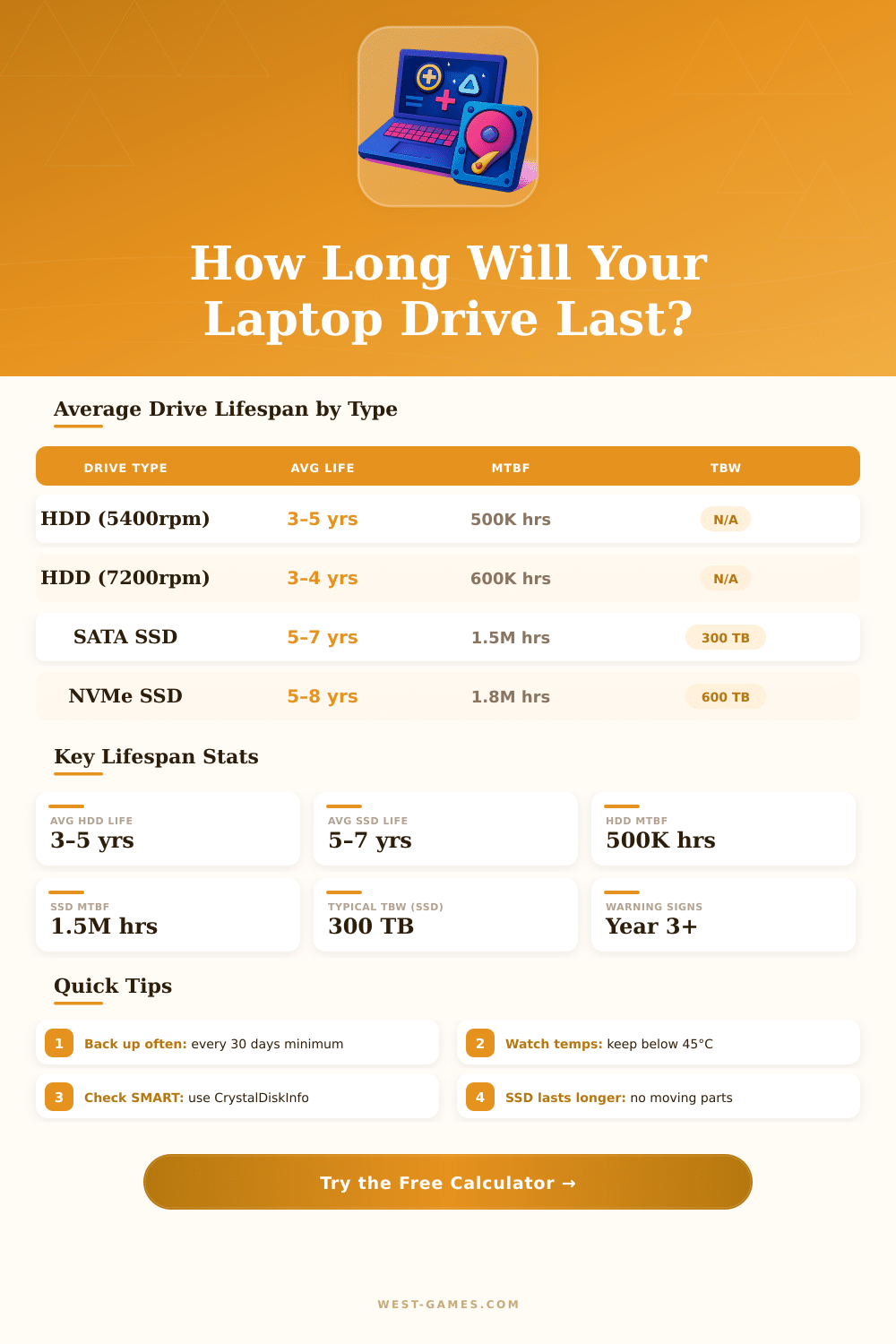
| Drive Type | Avg Lifespan | MTBF | TBW (Writes) | Failure Risk |
|---|---|---|---|---|
| HDD 5400 RPM | 3–5 years | ~500,000 hrs | N/A | Moderate |
| HDD 7200 RPM | 3–4 years | ~600,000 hrs | N/A | Moderate–High |
| SSHD Hybrid | 3–5 years | ~700,000 hrs | ~75 TB | Moderate |
| SATA SSD (2.5") | 5–7 years | ~1,500,000 hrs | 150–600 TB | Low |
| NVMe M.2 SSD | 5–8 years | ~1,800,000 hrs | 300–1200 TB | Low |
| Symptom | Likely Cause | Urgency | Action |
|---|---|---|---|
| Slow startup / loading | Fragmentation, aging heads | Watch | Run diagnostics |
| Clicking / grinding noise | Read/write head failure | Critical | Back up NOW |
| File errors / corruption | Bad sectors developing | Critical | Replace ASAP |
| Frequent BSODs | Disk read failures | Critical | Replace immediately |
| Drive not detected | Controller or cable fault | Emergency | Professional recovery |
| Occasional slowdowns | Full drive or background I/O | Watch | Free up space |
| Temperature | °C Range | °F Range | Life Impact |
|---|---|---|---|
| Optimal | 25–35°C | 77–95°F | Full rated lifespan |
| Normal | 35–45°C | 95–113°F | –5% to –10% |
| Warm | 45–55°C | 113–131°F | –20% to –30% |
| Hot – Dangerous | 55–65°C | 131–149°F | –40% to –50% |
| Critical | >65°C | >149°F | Imminent failure risk |
The Laptop Hard Drive is one of the main parts in every such device. Hard drives, or HDDs, for a long time stayed the favorite choice for storage in laptops, because they proved themselves reliable and cheap. It operates by means of spinning magnetic plates together with read and write heads that save and pull out data.
The most common drives for laptops belong to 2.5-inch models and they use either an IDE interface or SATA interface. Those two types of links differ physically so that one does not risk using the wrong variant.
Laptop Hard Drives and SSDs
Laptop hard drives usually cost a bit more than those for desktops. Also, they warm up more, sometimes sound louder and commonly offer less space. The spin speed of laptop Laptop Hard Drive units usually reaches from 5000 to 5400 RPM, because models at 7200 RPM are not common in stores.
One knows laptop hrad drives because of their relative slowness. Movie files, songs and similar stuff apparently flow well from a magnetic drive, but during system changes or play, everything slows noticeably.
Solid-state storage now rules almost every laptop. SSD beats HDD by means of speed and boosts the whole activity clearly. Among reliable makers of drives are Samsung, Seagate, Toshiba, Western Digital, Crucial and Kingston.
In the inside of many laptops one finds either a SATA hard drive ore SSD or standard M.2 NVMe SSD. One can remove both kinds from the device and connect them to other tools to get data. Some laptops even have two links, which allows to show two internal drives.
Such models commonly are older, built as workstations or for heavy games.
Internal Laptop Hard Drive units offer sizes like 1 TB, 2 TB and 5 TB. One can split a hard drive into parts. For instance, a 160 GB HDD can be split into different sections for Windows, music, programs and other data, so that nothing mixes inone space.
External hard drives work well for backups and extra space. They operate plug-and-play without need of programs. All laptops accept such external hard drives, and they work with brands like Dell, Asus, Samsung and HP.
Portable versions of external hard drives are sold by Seagate, Western Digital and Toshiba. A portable SSD delivers bigger capacity for less money, plus it beats a Laptop Hard Drive by means of speed and stability, especially for folks that commonly drop their stuff.
One can play games from external hard drives without loss of game quality. Load times can suffer because USB does not match the data flow speed of internal SATA or NVMe. USB 3.0 even so helps a lot.
Games from Steam run well from external drives, and one can make a new folder to install them there.