🔧 GPU Reflow Lifespan Calculator
Estimate how long your GPU reflow repair will last based on damage level, method, and usage habits
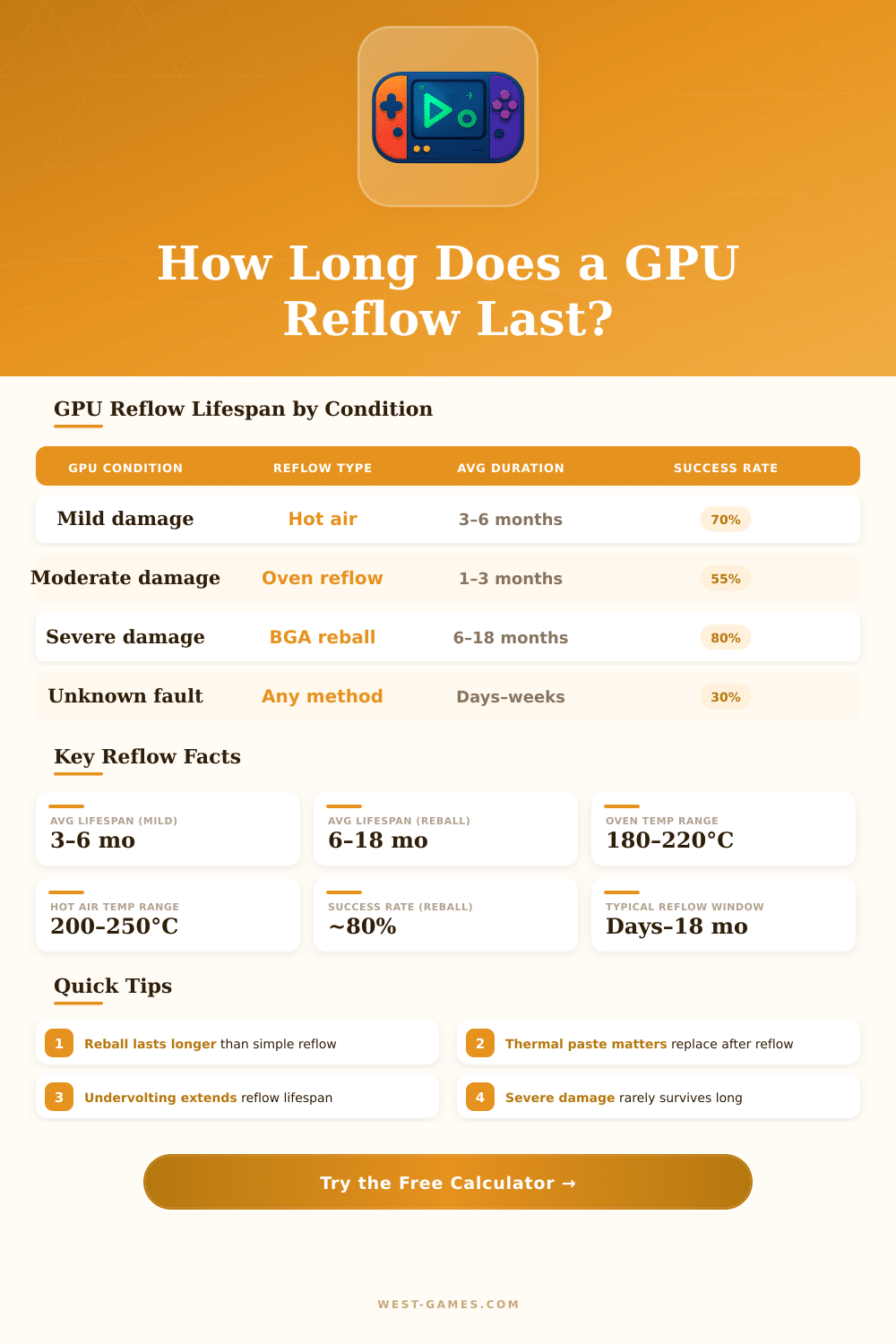
| Method | Avg Lifespan | Success Rate | Temp Range | Skill Level | Risk |
|---|---|---|---|---|---|
| DIY Oven Reflow | 1–3 months | 45–60% | 180–200°C | Beginner | High |
| Hot Air Gun (DIY) | 2–6 months | 50–65% | 200–230°C | Intermediate | Medium |
| Pro BGA Station | 3–12 months | 65–75% | 210–250°C | Advanced | Medium |
| BGA Reball | 6–24 months | 75–90% | 220–260°C | Professional | Low |
| Flux + Heat Gun | 1–4 months | 40–55% | 190–220°C | Beginner | High |
| Damage Level | Likely Cause | Best Method | Expected Lifespan | Outlook |
|---|---|---|---|---|
| Mild – Artifacts / Flicker | Cold solder joints | Hot air / Reball | 3–12 months | Good |
| Moderate – Crashes | Partial BGA failure | Reball preferred | 1–6 months | Fair |
| Severe – No POST | Full BGA separation | Professional reball | Days–6 months | Poor |
| Unknown Fault | Unclear – trial repair | Any | Days–3 months | Uncertain |
| Post-Mining Wear | Thermal fatigue | Reball + repaste | 2–8 months | Variable |
| Usage Pattern | Daily GPU Load | Thermal Cycles/Day | Lifespan Multiplier |
|---|---|---|---|
| Office / Low Load | <20% | 1–2 | +40% |
| Casual Gaming | 40–60% | 2–4 | Baseline |
| Heavy Gaming | 70–90% | 4–8 | −30% |
| 24/7 Mining / Render | 95–100% | Minimal cycles, continuous heat | −60% |
**Note:** The info in this article come from actual experience and discussions in the community about reflow of GPU.
The reflow of GPU are made up of heating up the GPU for melting the solder bumps under it. On purpose one heats the cracked or breaking solder joints so that the chip repeat firm tie with the main board. That warming helps replace the bumps on the chips in their main position, what can bring back the GPU for a bit more time.
How GPU Reflow Works and Its Dangers
Reflow means to those cracked links fix and reconnect. It helps to also melt the bottom alloy beards, that appears from several metals by means of process, that yet is not well understood.
GPU failures are too common cause in older iMacs and MacBooks. Symptoms can be not turning on with grey either black screen or booting only in safe mode. They happen because of failure in the soldered ties between the GPU and the board.
Some GPUs are hit by the Nvidia bumpgate scandal. Heating them in around 200°C, one softens the filler material and the bumps between the chips and teh base, so that they reconnect, but repeated warm cycles in the end will destroy them.
For good reflow, one must escape any liquid flow or buildup. Thermal checks are also needed, ideally two sensors. One checks the bottom part of the board under the GPU, and the second the own circuit of the GPU.
The board can preheat in an oven in around 100°C for spreading the heat equally, later use warm air of up for reach the write temperature of the GPU. Special infrared ovens with precise temperature control work well, because they can be set with detailed profiles of warming, holding and cooling.
Heat gun works also, but ovens more closely copy the reflow profiles of production. Melted helper ovens are ideal for that. Even so, reflow by means of heat gun is a lot harder and less precise.
The worst risks are to burn the main board or melt random other parts.
Here the tender moment. Almost all semiconductor packages except ceramic ones collect moisture in the polymer. If one simply puts the chip in a reflow oven without proper process, sudden expansion of that trapped moisture could explode the GPU package and hurt other parts.
Cooking electronics in a home kitchen oven also can release toxic steam.
Reflow does not always truly settle the base problem. GPU failure commonly comes from gaps in the tie between chips and base, and reflow can not fully order that. The GPU in the end will need whole replacement.
If heating and bending caused the original damage, one must address also the roots, for example clean the fans and the fins of the heatsink. Second reflow on a board, that already failedonce, widely do not help.