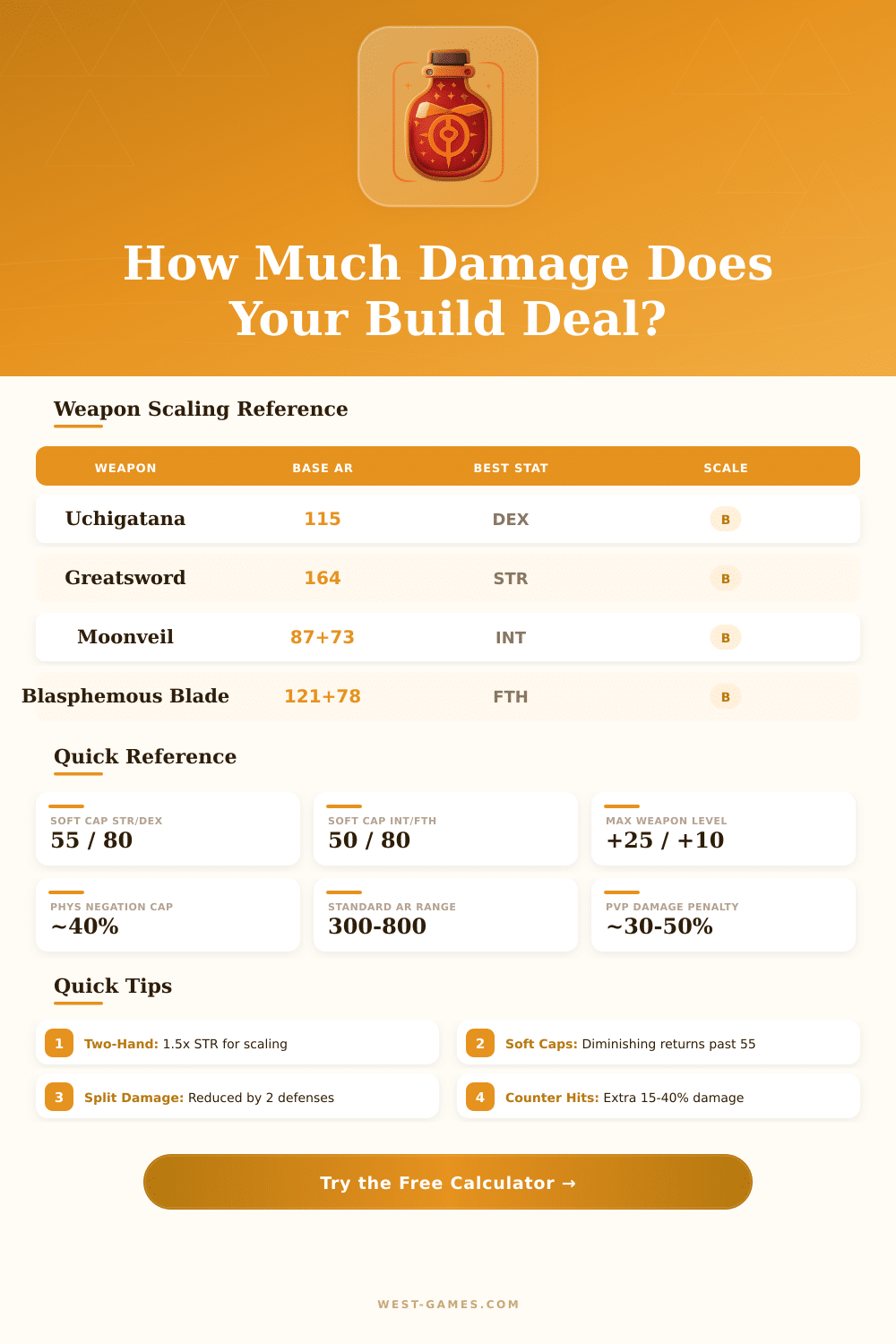
⚔️ Elden Ring Damage Calculator
Estimate your Attack Rating, scaling bonuses, and final damage against enemies
| Weapon | Type | Phys AR | Elem AR | Best Scaling |
|---|---|---|---|---|
| Lordsworn Straight Sword | Straight Sword | 229 | — | STR/DEX C/C |
| Uchigatana | Katana | 237 | — | DEX B |
| Claymore | Greatsword | 264 | — | STR/DEX C/C |
| Greatsword (Colossal) | Colossal Sword | 326 | — | STR B |
| Moonveil | Katana | 178 | 149 (Magic) | INT B |
| Blasphemous Blade | Greatsword | 242 | 156 (Fire) | FTH B |
| Rivers of Blood | Katana | 178 | 130 (Fire) | ARC B |
| Dark Moon Greatsword | Greatsword | 197 | 170 (Magic) | INT B |
| Coded Sword | Straight Sword | 0 | 216 (Holy) | FTH B |
| Giant-Crusher | Colossal | 330 | — | STR A |
| Enemy / Boss | Phys Def | Phys Neg % | Weak To |
|---|---|---|---|
| Standard Soldier | 100 | 15% | Strike |
| Crucible Knight | 130 | 35% | Lightning |
| Margit, the Fell Omen | 112 | 22% | Bleed / Fire |
| Godrick the Grafted | 118 | 18% | Fire / Poison |
| Radahn | 125 | 25% | Scarlet Rot |
| Malenia, Blade of Miquella | 105 | 10% | Fire / Frost |
| Radagon / Elden Beast | 140 | 30% | Fire / Bleed (Radagon) |
| Player (Bull-Goat Set) | 155 | 38% | Strike / Magic |
| Modifier | Bonus | Condition | Stacks? |
|---|---|---|---|
| Counter Hit (Spear Talisman) | +15% to +40% | Attack during enemy action | Yes |
| Charged R2 | +13% to +30% | Fully charge heavy attack | Yes |
| Two-Hand STR Bonus | 1.5x effective STR | Two-handing weapon | N/A |
| Shard of Alexander | +15% skill | Weapon Skill damage | Yes |
| Red-Feathered Branchsword | +20% at low HP | HP below 20% | Yes |
| Ritual Sword Talisman | +10% at full HP | HP at max | Yes |
| Lord of Blood Exultation | +20% for 20s | Blood loss triggered nearby | Yes |
| Flame, Grant Me Strength | +20% Phys+Fire | Incantation buff | Yes |
| Golden Vow | +15% ATK / +10% DEF | Incantation / Ash of War | Limited |
Elden Ring splits its Damage into two main categories: physical and elemental. Knowing how it works can help with the choice of weapons and spells.
Physical Damage comes from attacks with melee weapons against enemies. It splits into four kinds: normal, striking bitter, and piercing. Normal Damage is commonly just called physical, and it works as a baseline for those attacks that are not especially sharp, heavy or slim.
How Damage Works in Elden Ring
Weapons like axes and straight swords use normal Damage. Also many heavy blade weapons fall into this category, for instance halberds and colossal swords. Even some spells, like rotten breath and rocky sling, do physical Damage.
Only few enemies truly are weak against normal Damage, except those that widely resist physical Damage. Physical Damage is considered the best of the basic kinds.
Elemental Damage covers fire, holy, lightning and magic. Fire works well against many enemies. Magic widely also wroks, although enemies with high resistance to magic appear already early in the game.
Lightning and magic commonly work alike in function.
While you look at statistics of a weapon, the left side shows basic Damage, and the right shows the scaling part. For instance, the uchigatana, which is the starting weapon for samurai, can have 115+18 attack power, which is the total Damage that it does. Ashes of war can change both the basic Damage and the scaling of a weapon.
Here is where the troubles start. Weapons with two kinds of Damage suffer from the problem of split Damage. Every kind of Damage passes through the same resistance of the enemy.
So a weapon that does striking and holy Damage must beat striking resistance and then holy resistance separately. A weapon with only one kind of Damage only faces one resistance wall, which commonly gives bigger real Damage. In older games from FromSoftware, that made elemental infusions almost never worth it.
In Elden Ring on the other hand, the boost in Damage through infusions is so big that it usually deserves the choice, unless the boss clearly resists that element.
The increase of Damage in late game commonly hurts. After the main area enemies become very hard to hurt. Even average enemies take big chunks of health from normal attacks.
The amount of extra Damage climbs higher than healing and vigor, to stay competitive. In prior titles from FromSoftware 25 to 30 vigor was enough for the endgame, but in Elden Ring 40 to 60 vigor is what most builds require. Some bosses have basic combo attacks that almost instantly kill players.
The DLC content follows the same pattern, where everything does massive Damage even threw heavy armor and big shields.
Using items like scorpion rings and mixed physics, one can boost Damage, which truly changes things, turning 100-140-basic blows into 500 Damagagainst the right enemy.