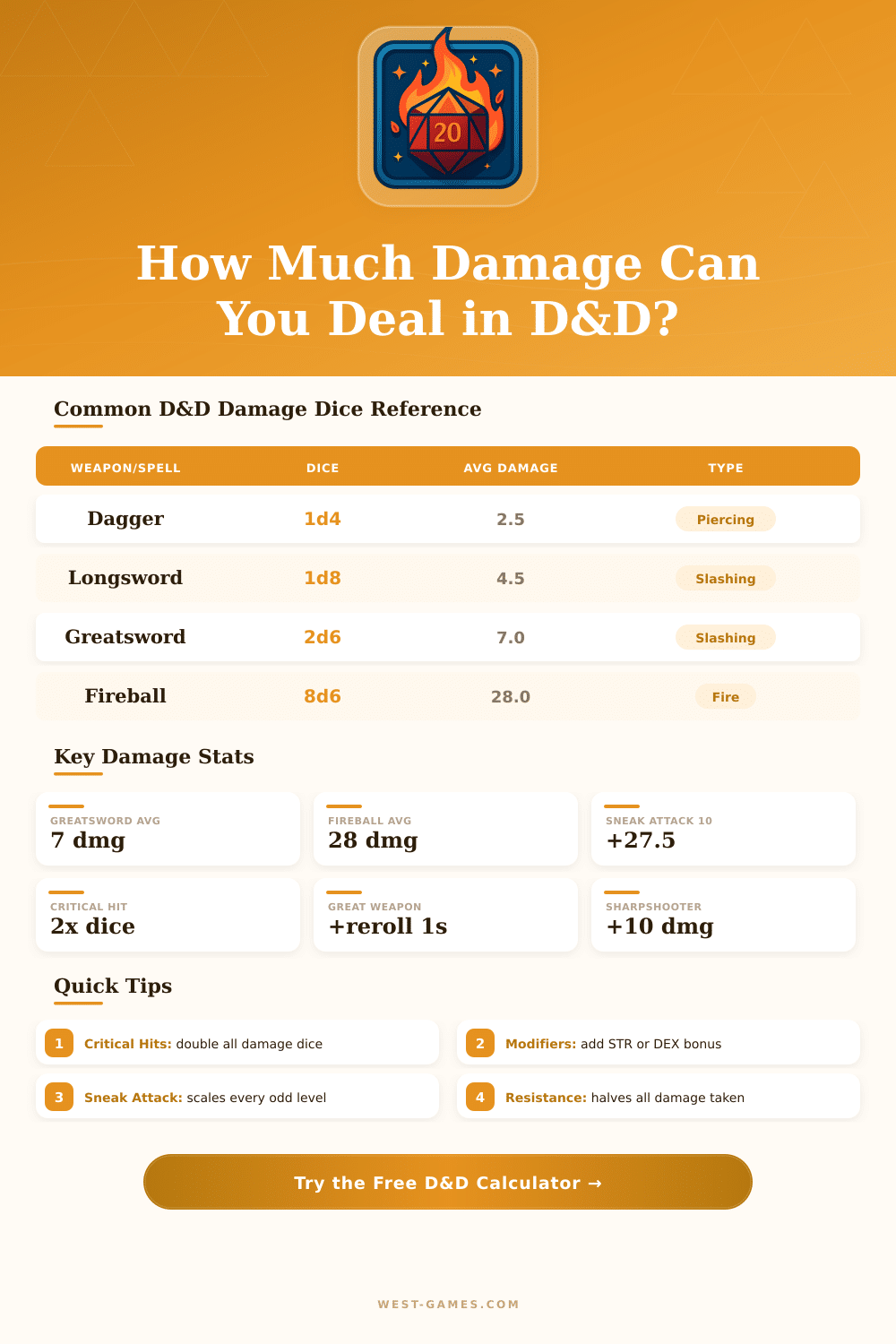
⚔️ D&D Damage Calculator
Calculate average, minimum, and maximum damage for any weapon, spell, or ability in D&D 5e
| Weapon | Dice | Avg (no mod) | Min / Max | Type |
|---|---|---|---|---|
| Dagger | 1d4 | 2.5 | 1 / 4 | Piercing |
| Handaxe | 1d6 | 3.5 | 1 / 6 | Slashing |
| Shortsword | 1d6 | 3.5 | 1 / 6 | Piercing |
| Longsword (1H) | 1d8 | 4.5 | 1 / 8 | Slashing |
| Longsword (2H) | 1d10 | 5.5 | 1 / 10 | Slashing |
| Rapier | 1d8 | 4.5 | 1 / 8 | Piercing |
| Battleaxe (2H) | 1d10 | 5.5 | 1 / 10 | Slashing |
| Greataxe | 1d12 | 6.5 | 1 / 12 | Slashing |
| Greatsword | 2d6 | 7.0 | 2 / 12 | Slashing |
| Maul | 2d6 | 7.0 | 2 / 12 | Bludgeoning |
| Hand Crossbow | 1d6 | 3.5 | 1 / 6 | Piercing |
| Heavy Crossbow | 1d10 | 5.5 | 1 / 10 | Piercing |
| Longbow | 1d8 | 4.5 | 1 / 8 | Piercing |
| Spell | Dice | Avg Damage | Max Damage | Save / Attack |
|---|---|---|---|---|
| Fire Bolt (cantrip) | 1d10–4d10 | 5.5–22 | 10–40 | Ranged Attack |
| Guiding Bolt | 4d6 | 14 | 24 | Ranged Attack |
| Magic Missile | 3×(1d4+1) | 10.5 | 15 | Auto-hit |
| Scorching Ray | 3×2d6 | 21 | 36 | Ranged Attack |
| Fireball | 8d6 | 28 | 48 | DEX Save |
| Lightning Bolt | 8d6 | 28 | 48 | DEX Save |
| Disintegrate | 10d6+40 | 75 | 100 | DEX Save |
| Eldritch Blast | 1d10–4d10 | 5.5–22 | 10–40 | Ranged Attack |
| Chromatic Orb | 3d8 | 13.5 | 24 | Ranged Attack |
| Divine Smite (1st) | 2d8 | 9 | 16 | On hit bonus |
| Rogue Level | Sneak Attack Dice | Avg (SA only) | Max (SA only) | Crit Avg (doubled) |
|---|---|---|---|---|
| 1–2 | 1d6 | 3.5 | 6 | 7 |
| 3–4 | 2d6 | 7 | 12 | 14 |
| 5–6 | 3d6 | 10.5 | 18 | 21 |
| 7–8 | 4d6 | 14 | 24 | 28 |
| 9–10 | 5d6 | 17.5 | 30 | 35 |
| 11–12 | 6d6 | 21 | 36 | 42 |
| 13–14 | 7d6 | 24.5 | 42 | 49 |
| 15–16 | 8d6 | 28 | 48 | 56 |
| 17–18 | 9d6 | 31.5 | 54 | 63 |
| 19–20 | 10d6 | 35 | 60 | 70 |
Damage in DND is simply a number that lowers the hit points of a character when it receives an attack. It appears everywhere in fight (for instance a swing of a sword), a well aimed arrow or fireball that bursts above the field. Each of those can injure or even kill even the most tough monsters.
The thing with Damage even so is: it is not simply points, how many times you can get hit. Really it mixes stamina, toughness, the desire to maintain the fight and honestly a bit of chance. When a monster suffers Damage, that can show as real wounds, near disappearance because of loss of blood or only the slow weakening of tiredness after long struggle.
How Damage Works in DND 5e
To count Damage in DND 5e, everything is easy. Roll the die for the weapon, then add the relevant bonuses. In attacks with weapons, one adds the skill that matches with the kind of weapon, Strength for melee, Dexterity for ranged.
For instance, a knife rolls 1d4 for piercing Damage. Big swords add 2d6 for Damage, what gives higher average than the 1d12 of big axe or lance. Weird thing however: Damage rolls almost never use d20. They stay at d6, d8, d10, d12 or whatever the weapon requires.
Roll 2d6 means two six-sided dice, that gives 2 to 12 points totally.
Damage types have thirteen kinds: acid, beating, cold, burning, force, lightning, necrotic, piercing, poisonous, psychic, radiant, cutting and thunder. Force Damage acts mostly neutral, not elemental typical. Radiant and necrotic relate too cosmic energies, good against evil ones.
And are not real elements.
Resistance halves the Damage, rounding down. Poison honestly is one of the most difficult types to build around. Options to use it are very limited.
Poisoning weapons cost a lot and quickly, what does not value the expense, and the most many class features with poisonous finish feel weak.
The biggest single attack that you will see in high levels without magic? Fall Damage. It does 20d6 Damage.
Quite a lot to flatten even a high level character. And then there is something like fire attacks, that mix burning Damage in an explosion (for instance, 5d8 in a 15-foot radius). Spells change the types also.
For instance, booming blade adds 1d8 thunder Damage, if the target moves before your next turn.
For Damage each round or DPR, use this base: chance to hit times average Damage per attack, plus whatever extra Damage that does not double on critical hit. The core even so is: melee attacks do not grow almost as quickly as cantrips and spells, when one reaches high levels; andthat happens because most campaigns never arrive over there.