🔭 Binocular FOV Calculator
Calculate true field of view, apparent FOV, exit pupil, eye relief & twilight factor
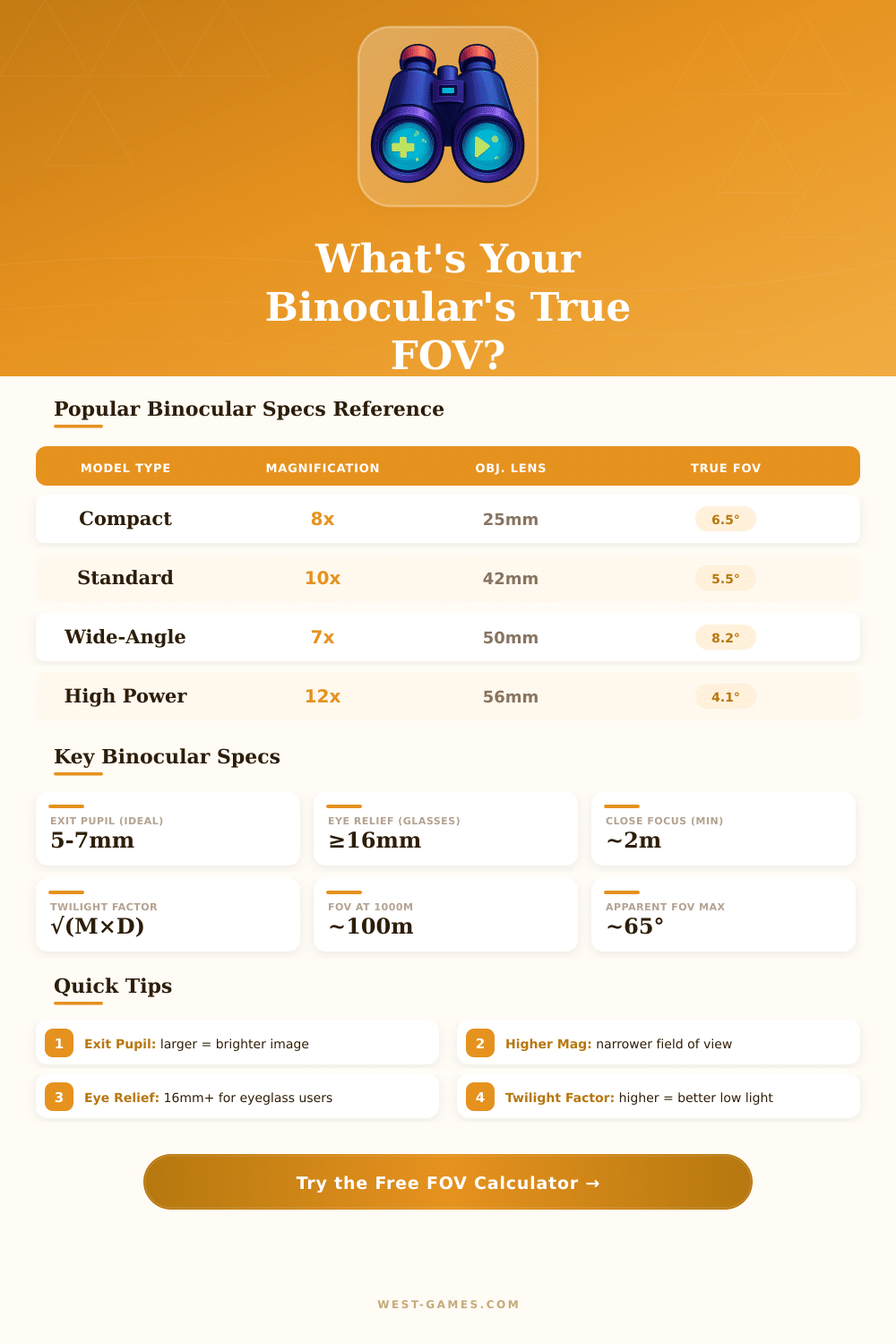
| Use Case | Magnification | Obj. Lens | True FOV | Exit Pupil | Best For |
|---|---|---|---|---|---|
| Birdwatching | 8x | 42mm | 6.5° | 5.25mm | All-day use, bright image |
| Birding (wide) | 7x | 42mm | 8.0° | 6.0mm | Fast-moving birds, wide view |
| Hunting | 10x | 42mm | 5.5° | 4.2mm | Distance targets, daylight |
| Marine / Boating | 7x | 50mm | 7.0° | 7.1mm | Low-light, wide scan |
| Astronomy | 15x | 70mm | 4.4° | 4.7mm | Deep-sky, star clusters |
| Stadium / Sports | 12x | 50mm | 4.1° | 4.2mm | High magnification sports |
| Safari / Wildlife | 10x | 56mm | 5.8° | 5.6mm | Low-light wildlife viewing |
| Compact Travel | 8x | 25mm | 6.3° | 3.1mm | Portability, daytime only |
| Theater / Opera | 4x | 30mm | 10.0° | 7.5mm | Indoor, short distance |
| Hiking | 8x | 32mm | 6.5° | 4.0mm | Lightweight, bright enough |
| Measurement | Formula | Example (10x42, AFOV 55°) | Notes |
|---|---|---|---|
| True FOV (°) | AFOV ÷ Magnification | 55 ÷ 10 = 5.5° | Angular coverage you actually see |
| FOV at Distance | Distance × tan(True FOV) | 1000 × tan(5.5°) = 96m | Width of view at target distance |
| Exit Pupil (mm) | Objective ÷ Magnification | 42 ÷ 10 = 4.2mm | Larger = brighter image |
| Twilight Factor | √(Magnification × Objective) | √(10 × 42) = 20.5 | Higher = better low-light performance |
| Relative Brightness | Exit Pupil² | 4.2² = 17.6 | Compare models at a glance |
| Apparent FOV (°) | True FOV × Magnification | 5.5 × 10 = 55° | Eyepiece design determines this |
Note: This text bases on real data from different discussions about optics and manuals.
The FOV of Binocular or simply FOV, shows the scope of the scene that one can see through the optics. It shows how far and broad the view is at a certain distance. Makers commonly measure the FOV in feet for 1,000 yards.
What Field of View Means for Binoculars
So, if Binocular have FOV of 420 feet, that means that the visible area reaches 420 feet at a distance of 1,000 yards. Some companies prefer metres for 1,000 metres, for instance 131 metres.
One must know some kinds of FOV. The angle FOV is measured in degrees. One can convert it to linear FOV, multiplying teh angle value by 52.5.
For instance, Binocular with 8 degrees of angle field gives linear FOV of 420 feet at 1,000 yards. The apparent FOV describes the angle of the enlarged view through the Binocular. Big apparent FOV ensures a wider view, even at high power.
Before one counted the apparent FOV, multiplying the real field by the power.
The FOV clearly relates to the power. When the power grows, the FOV usually shrinks. Binocular of type 20×50 only reach around 3 degrees of real FOV, even with double power.
On the other hand, 8x-models can have 8 degrees or even more. For instance, some Japanese ultra-wide 8x-versions promise up too 10 degrees.
Power and size of the lens ranks among the main traits of Binocular. Even so, one should note also the FOV. The power with lens size decides about the size and brightness of the image, while the FOV acts on the visible part of the landscape.
In one series of Binocular, models with 30 to 32 mm have widely the broadest FOV, then come 40 to 42 mm, and lastly 50 to 56 mm. Compact versions in the same line commonly suffer because of the narrowest FOV.
To widen the FOV, one must add cost and weight, because it requires more complex optical build with more glass, including bigger and extra parts. The height of the eyepiece limits the field. The ratio between the focal lengths of lens and eyepiece defines the power.
Even two Binocular with same power, say 10×42, can have different values of FOV. One maybe shows 399 feet, the other 319. The wide version simply adds more background on the sides, but the central target stays just as big.
Such difference depends on the way the maker builtevery model.
Wide FOV is useful for certain targets. Hunters in wooded areas benefit from big FOV for tracking creatures. For scouting or cabin pursuit, it helps to cover bigger ground with the eyes.
When one watches fast creatures like coyotes, Binocular with broader FOV is the best option. The 8×42-combination offers more lightweight use, wider FOV and more comfortable eye relief for carriers of glasses compared to a 10x-choice.