⚔️ Dragon Age: Inquisition Skill Tree Calculator
Plan your Inquisitor build — allocate skill points, choose your specialization & see your full build summary
| Class | Skill Tree | Focus | Key Abilities | Recommended |
|---|---|---|---|---|
| Warrior | Vanguard | Guard & Defence | Challenge, Guard-Shattering Strike | Tanks |
| Warrior | Battlemaster | Crowd Control | War Cry, Grappling Chain | Off-tank |
| Warrior | Weapon & Shield | Melee Defence | Payback Strike, Shield Wall | Champion |
| Warrior | Two-Handed | Burst Damage | Pommel Strike, Whirlwind | Reaver |
| Mage | Inferno | Fire Damage | Immolate, Flashpoint, Fire Mine | All Mages |
| Mage | Winter | Ice & CC | Winter's Grasp, Blizzard, Deep Freeze | Support |
| Mage | Storm | Lightning | Static Cage, Stormbringer | Rift Mage |
| Mage | Spirit | Barrier & Heal | Barrier, Fade Step, Mark of the Rift | Support |
| Rogue | Subterfuge | Stealth & Escape | Hidden Blades, Shadow Strike | Assassin |
| Rogue | Sabotage | Traps & Debuffs | Caltrops, Poisoned Weapons | Artificer |
| Rogue | Archery | Ranged DPS | Full Draw, Leaping Shot | Artificer/Tempest |
| Rogue | Dual Daggers | Melee DPS | Backstab, Deathblow, Flurry | Assassin |
| Specialization | Class | Style | Signature Ability | Difficulty |
|---|---|---|---|---|
| Champion | Warrior | Defensive Tank | Call to Arms | Easy |
| Reaver | Warrior | High-Risk DPS | Rampage | Hard |
| Templar | Warrior | Anti-Magic | Wrath of Heaven | Medium |
| Knight-Enchanter | Mage | Melee Mage | Spirit Blade | Easy (OP) |
| Rift Mage | Mage | CC & Pull | Stonefist + Dispel | Medium |
| Necromancer | Mage | Summon & Fear | Simulacrum | Medium |
| Artificer | Rogue | Traps & Focus | Hail of Arrows | Medium |
| Assassin | Rogue | Burst Kill | Mark of Death | Hard |
| Tempest | Rogue | Alchemical Chaos | Flask of Frost | Medium |
| Level | Points Gained | Cumulative Points | Suggested Allocation |
|---|---|---|---|
| 1–5 | 4 pts | 4 | 1 core skill tree focus |
| 6–10 | 5 pts | 9 | Complete first tree |
| 11–15 | 5 pts | 14 | Unlock spec + 2nd tree |
| 16–20 | 5 pts | 19 | Spec tree + 3rd tree |
| 21–25 | 5 pts | 24 | Passive upgrades |
| 26–27 | 2 pts | 26 | Fill remaining gaps |
| DLC bonus | +10 pts | 36 | Trespasser DLC raises cap |
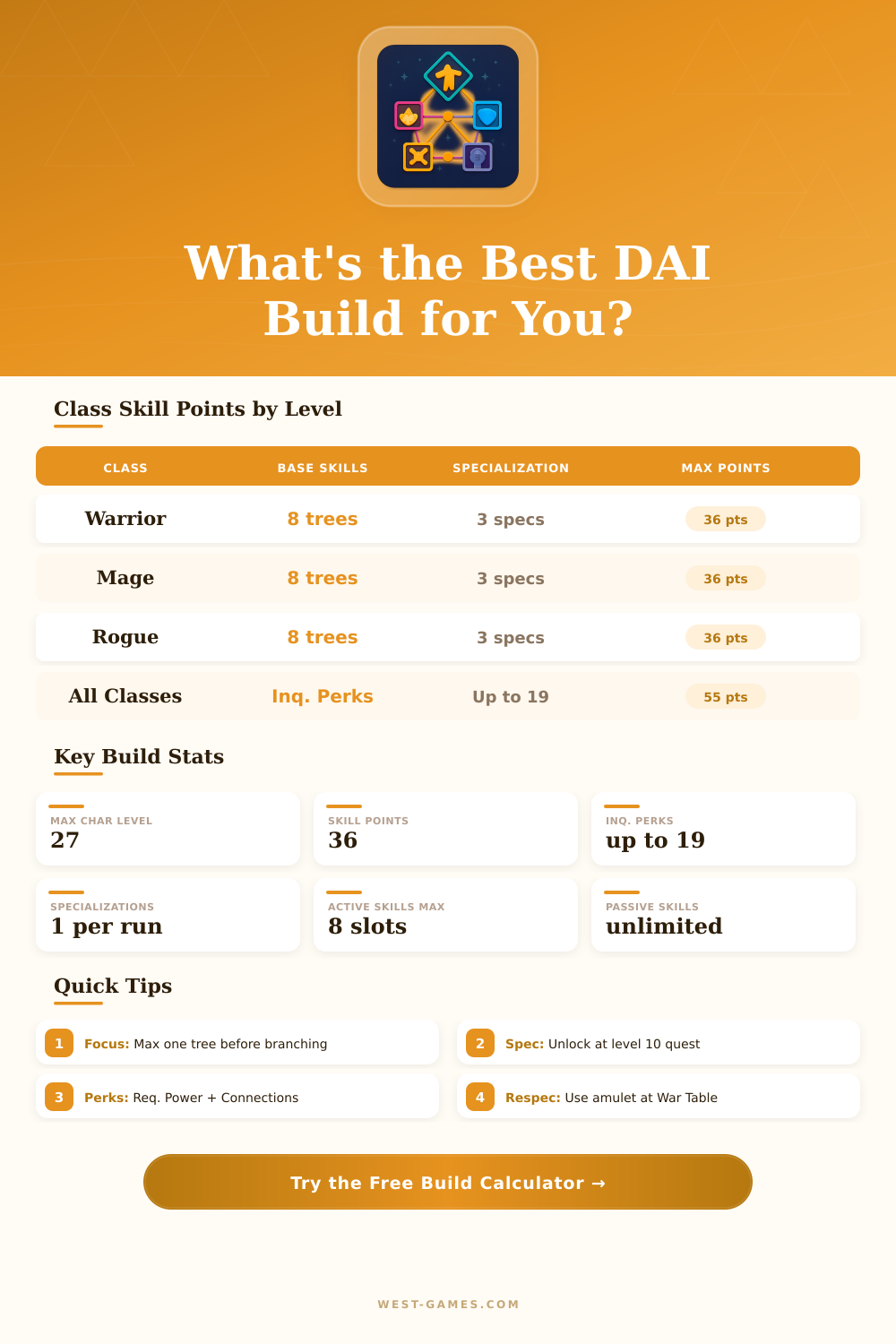
Dragon Age: Inquisition skill point are a limited resource that players must manages carefuly to ensure that the Inquisitor is as strong as possible in the game. Each level provide an Inquisitor with one skill point. By the time players reaches the maximum level for the game, they will have earned a total of 27 skill points.
However, since the Inquisitor only earns one skill point per level, players will have to make a selection of which skills they would like to purchase for there Inquisitor. The game feature skill trees that organize skills into different tiers. Each tier within a skill tree cost more skill points than the previous tier.
How to Spend Skill Points in Dragon Age: Inquisition
The first few tiers costs one skill point per skill to purchase. Skills such as Shield Bash or Immolate can be purchased at these early skill points. However, as players move into the second and third tiers for each skill tree, the cost increase to double or triple the amount of skill points required.
Players must decide whether the benefit of the skill justify the higher cost of skill points. In addition to these active skills, there are also passive skills within the trees. These skills provides additional and constant damage or defense multiplier for the Inquisitor.
To upgrade any skills, the players must first purchase the skill itself; they cant directly purchase the upgrade of a skill. Additionally, there is specialization available for players to choose. These specializations provide specific combat role for the Inquisitor.
Upon reaching level 10, players can complete a quest to unlock a specialization. If players choose a Warrior role like the Templar, their Inquisitor will have abilities that interrupt demons. If players choose a Mage role like the Knight Enchanter, their Inquisitor will have a spirit blade that players use in melee combat.
Additionally, each of these specializations have their own tiered skill. The end skills, or passives, for each specialization cost four skill point to purchase. These specializations are vital to the success of the Inquisition, as players can only have three companion with them at once.
Therefore, players should of choose a specialization that fills a gap in their current party. The playstyle that a player chooses for their Inquisitor will help with the distribution of their skill points. Aggressive playstyle will focus on active skills to do more damage with their attacks.
Defensive playstyles will focus on their passive and guard generation skill to last longer in combat. Balanced playstyles will distribute their skill points between damage and defensive skill. Support playstyles will provide abilities to reduce cooldowns of allies spells and buff them with healing aura.
Players must consider the benefit of each skill. For instance, are they going to choose the whirlwind attack that do more damage to clear enemies, or will they choose the shield wall to defend themselves in a critical situation? A common mistake that players will make is spreading their skill points too thin amongst many of the availible skill trees.
When players spread their skill points thin, their Inquisitor will not be strong enough to defeat the stronger enemies. Instead, players should focus their skill points on one tree first and then purchase a second tree to gain other beneficial skill. Additionally, they should not neglect the passive skill trees and their benefits to the Inquisitor.
Should players make a mistake in how they distribute their skill points, they can use the amulet in Skyhold to respec their character to redistribute their skill points. There are also planning tool within the game that can help players manage their skill points. These planning tools will tally how many skill points they have spent within the game compared to the total that they have earned.
Additionally, these tools can categorize their skill points; how many have they spent on active skill and how many have they spent on passive skills? These can show players how efficient they are using their skill points. Furthermore, they can show players any synergy between their chosen specialization and other skills.
These tools can help players find any imbalance before they commit their skill points to any specific skill trees.