🖥️ CPU Lifespan Calculator
Estimate how long your processor will last based on usage, temperature & workload
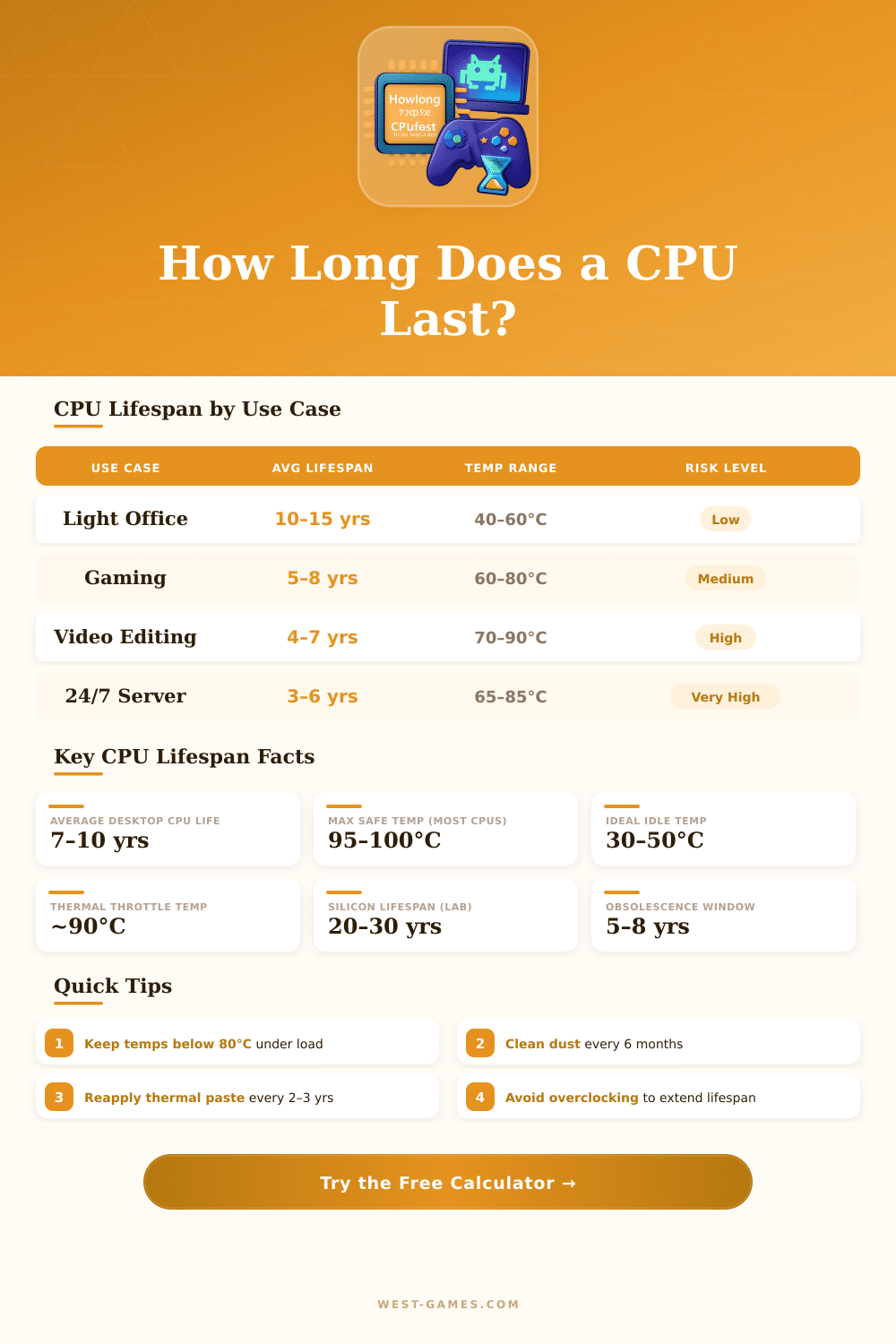
| Use Case | Typical Lifespan | Ideal Load Temp | Max Safe Temp | Risk Level |
|---|---|---|---|---|
| Office / Web | 10–15 years | 40–55°C | 85°C | 🟢 Low |
| Gaming (casual) | 7–10 years | 55–70°C | 90°C | 🟡 Low–Med |
| Gaming (intensive) | 5–8 years | 65–80°C | 95°C | 🟠 Medium |
| Streaming / Multitask | 5–8 years | 65–80°C | 95°C | 🟠 Medium |
| Video Editing | 4–7 years | 70–85°C | 95°C | 🟠 Med–High |
| Workstation / CAD | 4–7 years | 70–85°C | 95°C | 🟠 Med–High |
| 24/7 Server | 3–6 years | 60–75°C | 85°C | 🔴 High |
| Heavy OC + 24/7 | 2–4 years | 75–90°C | 95°C | 🔴 Very High |
| CPU Series | TJ Max (°C) | Throttle Temp | Recommended Max Load |
|---|---|---|---|
| Intel Core i9 (13th/14th Gen) | 100°C | 100°C | <85°C |
| Intel Core i7 (12th–14th Gen) | 100°C | 100°C | <80°C |
| Intel Core i5 (12th–14th Gen) | 100°C | 100°C | <80°C |
| AMD Ryzen 9 (7000 series) | 95°C | 95°C | <85°C |
| AMD Ryzen 7 (5000/7000) | 90–95°C | 90–95°C | <80°C |
| AMD Ryzen 5 (5000/7000) | 90–95°C | 90–95°C | <80°C |
| Intel Xeon (Server) | 91–105°C | Varies | <75°C |
| AMD EPYC (Server) | 90–95°C | 95°C | <75°C |
| Cooling Type | Temp Reduction | Lifespan Impact | Best For |
|---|---|---|---|
| Stock Intel/AMD Cooler | Baseline | Baseline | Office / Light use |
| Aftermarket Air (e.g. NH-D15) | –10 to –20°C | +1–2 years | Gaming / Mid workloads |
| 120/240mm AIO Liquid | –15 to –25°C | +1.5–3 years | Gaming / Streaming |
| 360mm+ AIO Liquid | –20 to –30°C | +2–4 years | Heavy OC / Workstation |
| Custom Water Loop | –25 to –40°C | +3–5 years | Extreme OC / Server |
CPUs are made up of quite a lot of strong parts. They can work for a really long time if everything goes well. The real lifetime of the tiny transistors in a typical consumer CPU usually reaches between 20 and 30 years before some failure will happen.
Even so, the lifetime of a CPU does not limit to ten years as a simple rule. It ranges according to several factors.
How Long Do CPUs Last?
Under normal usage, CPUs commonly stay usable for 8 to 15 years, or even 10 to 20 years or more, if one does not damage them physically or subject them to bad conditions. Some CPUs from the 1980s work quietly until today. For instance, Pentium 4 can still turn on and run well, although it lasted years of intense heat.
CPUs show surprisingly big toughness, while they are not overclocked, overheated or damagde physically in any way.
Heat acts as the main factor that shortens the lifetime of a CPU. Usually, the cooling of a desktop computer beats that of laptops, so desktop CPUs easily last more than a decade. The performance stays stable too.
One wood not notice any difference in the performance after five years for desktop CPUs. A well cooled CPU should last almost forever.
Overclocking forms an entirely other cause. It does not necessarily cause faster wear, but pushing higher voltages through the chip probably will shrink its lifetime. Although even with heavy overclocking, there were cases when CPUs worked overclocked for more than 10 years without any problem.
The lifetime of a CPU can range anywhere from 5 years with bad cooling to 20 or 30 years with low power use. Overclocking could drop the lifetime from something around 15 years to 10 years.
A typical CPU usually lasts up to 10 years, if it is not put under too high voltage. CPUs widely last 6 to 10 years with usual usage. Most CPUs can go 10 years or more without failure.
When a CPU fails, that commonly happens because of bent pins, that one can straighten with a credit card or mechanical pencil.
Even so CPUs are not entirely unbreakable. When a chip fails, it usually is because of exposure to conditions that shorten its lifetime. Keeping stable power and low temperatures matters a lot.
Other parts, like the motherboard, RAM or the power supply, tend to fail before. A CPU commonly ages before it truly dies. For gaming, a CPU should span around 10 years.
A GPU has a useful lifetime closer to 5 years. Think about a PC like a car. It can still start and drive, but it cannot go fast anymore.
That shows the difference between howlong something physically lasts and how long it stays usable for new tasks.