🔭 Astrophotography FOV Calculator
Calculate field of view, image scale, and framing for your telescope & camera combination
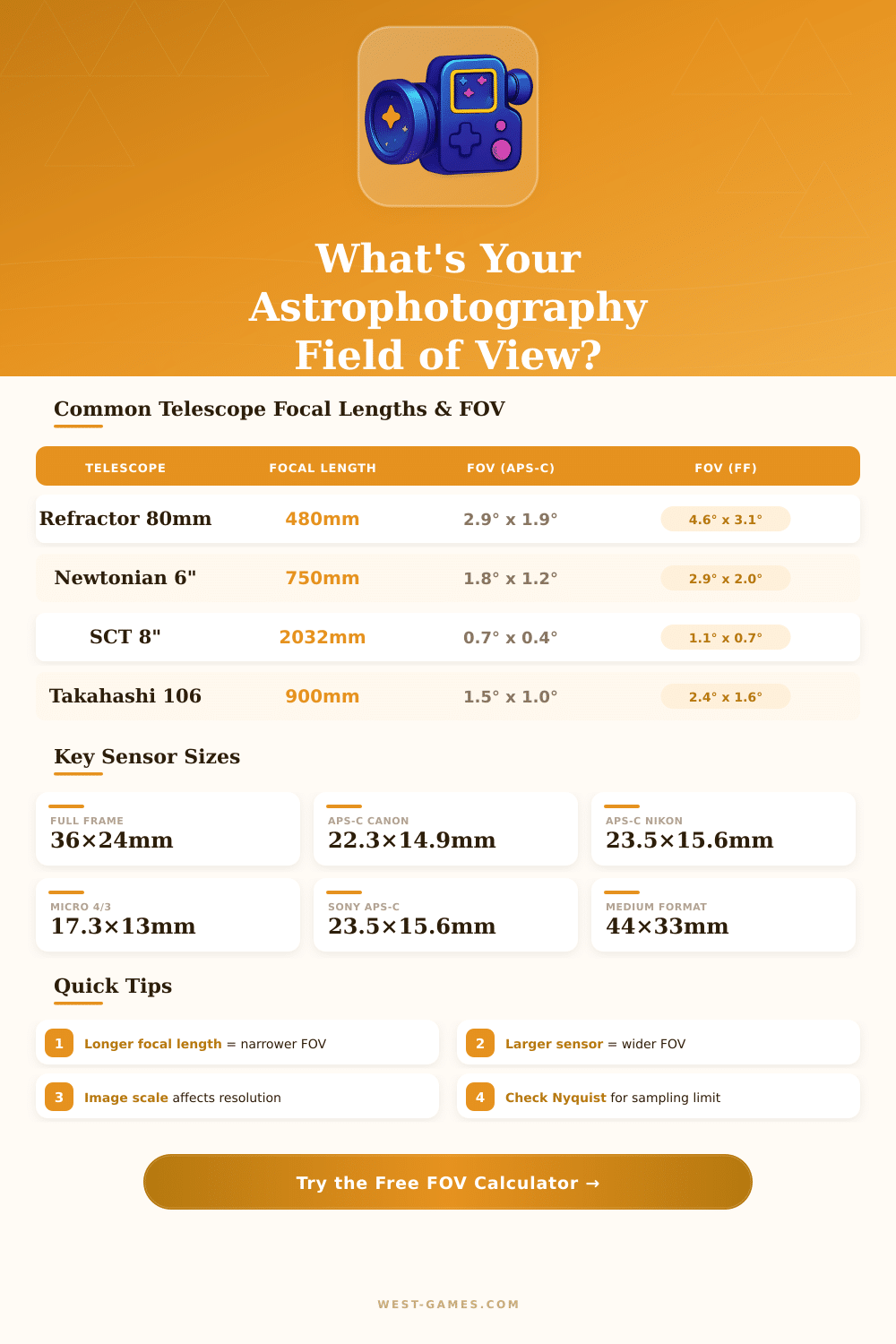
| Telescope | Focal Length | f-ratio | FOV Full Frame | FOV APS-C | Px Scale (FF, 24MP) |
|---|---|---|---|---|---|
| William Optics GT71 | 336mm | f/4.9 | 6.14° × 4.09° | 3.80° × 2.54° | 5.36"/px |
| Altair 80 Refractor | 480mm | f/6 | 4.30° × 2.86° | 2.66° × 1.78° | 3.75"/px |
| Sky-Watcher ED80 | 600mm | f/7.5 | 3.44° × 2.29° | 2.13° × 1.42° | 3.00"/px |
| Sky-Watcher 8" Newt | 1000mm | f/5 | 2.06° × 1.38° | 1.28° × 0.85° | 1.80"/px |
| Takahashi FSQ-106 | 530mm | f/5 | 3.89° × 2.59° | 2.41° × 1.61° | 3.40"/px |
| Celestron C8 SCT | 2032mm | f/10 | 1.01° × 0.68° | 0.63° × 0.42° | 0.88"/px |
| Celestron C8 + 0.63x | 1280mm | f/6.3 | 1.61° × 1.07° | 1.00° × 0.66° | 1.40"/px |
| RC8 (Ritchey-Chrétien) | 1624mm | f/8 | 1.27° × 0.85° | 0.79° × 0.52° | 1.10"/px |
| Meade 10" ACF | 2500mm | f/10 | 0.83° × 0.55° | 0.51° × 0.34° | 0.72"/px |
| Object | Catalog | Angular Size | Ideal Focal Length | Min. FOV Needed |
|---|---|---|---|---|
| Andromeda Galaxy | M31 | 190' × 60' | 300–600mm | 3.5° × 1.5° |
| Orion Nebula | M42 | 85' × 60' | 400–900mm | 1.5° × 1.2° |
| Pleiades Cluster | M45 | 110' | 200–500mm | 2.0° |
| Rosette Nebula | NGC2244 | 80' | 400–700mm | 1.5° |
| Triangulum Galaxy | M33 | 70' × 40' | 500–800mm | 1.5° |
| Crab Nebula | M1 | 7' × 5' | 800–2000mm | 15' × 10' |
| Full Moon | — | ~30.5' | 500–1500mm | 40' recommended |
| Jupiter (max) | — | 49" | 2000mm+ | 2' minimum |
| Saturn (max) | — | 20" | 3000mm+ | 1' minimum |
| Lagoon Nebula | M8 | 90' × 40' | 300–700mm | 2.0° × 1.0° |
| Pixel Scale | Sampling | Typical Use Case | Sky Condition |
|---|---|---|---|
| < 0.5"/px | Over-sampled | High-res planetary, lucky imaging | Exceptional seeing only |
| 0.5 – 1.0"/px | Well-sampled | Planetary, tight globulars | Excellent seeing needed |
| 1.0 – 2.0"/px | Ideal deep sky | Deep sky galaxies, nebulae | Average to good seeing |
| 2.0 – 3.0"/px | Slightly under | Wide nebulae, star clusters | Any sky — forgiving |
| 3.0 – 5.0"/px | Under-sampled | Widefield, Milky Way | Any sky — very forgiving |
| > 5.0"/px | Very under | Ultra-widefield landscapes | Any sky — casual |
Field of sight, or simply FOV, shows whether an object looks big in the image. That forms one of the basic ideas that will help or will block your plan for Astrophotography. While you watch the night sky outside before start to film the FOV in degrees truly deserves your attention.
The calculations for FOV bind the size of the sensor with the focal length. Here the main idea: the FOV matches twice the arctangent of the double half of the sensor size divided by the focal length. That relation helps to understand, how much real sky your camera captures.
Field of View for Night Sky Photos
There is also an easier way: one takes 57.3, divides it by the focal length of your lens, later multiply by the frame size. Anyhow, it works well.
The focal length has big weight. For broad field (imagine vast galaxies and nebulae), that stretch through the whole sky, one should choose between 50 and 300 mm. On the other hand, for narrow field everything adjusts entirely.
Objects like Andromeda, the Pleiades or Rho Ophiuchi need quite a big visible FOV, and here 135 mm lenses truly shine. And for little targets; those distant galaxies and planetary nebulae, that show barely, one needs focal lengths of 1500 mm or mroe.
Use Stellarium to make the planning much more simple. This program lets you simulate your FOV with any optics and sensor, that you have. The plugin Oculars is especially handy: simply enter the details of your DSLR sensor and lens details, and it will estimate the FOV for you.
Telescopius works the same and gives reliable results, if you enter exactly the data of your camera and telescope. One quirk: sometimes those tools turn the FOV by 90 degrees compared with what you truly wood see through equatorial mount. Good, so worth to know that.
Online calculators form another reliable option. David Campbell created one of the most used. Most of them simply need, that you enter your focal length, and it right away counts it.
They can even simulate your look through telescope with various cameras and eyes, plus help to combine mosaics. The round of computed FOV display from DSS can last some minutes, but it certainly is possible.
Focal reducers deserve thought also. They sit between your camera and telescope, and shrink the real focal length to around 50 to 80 percent of the usual value. On reflectors it also helps to reduce the coma.
Simply make sure, that you count the FOV for your exact setup before you buy one.
For watching through eyes, the formula is: the real FOV matches the apparent FOV of the eyepiece times the focal length of the eyepiece, later divided by the focal length of the telescope. Motor mount certainly helps to keep everything centered withoutcontinuous checking, although it is not fully needed.