🎲 D&D 5e Fall Damage Calculator
Calculate fall damage, dice rolls, survival odds & ability check DCs for any height
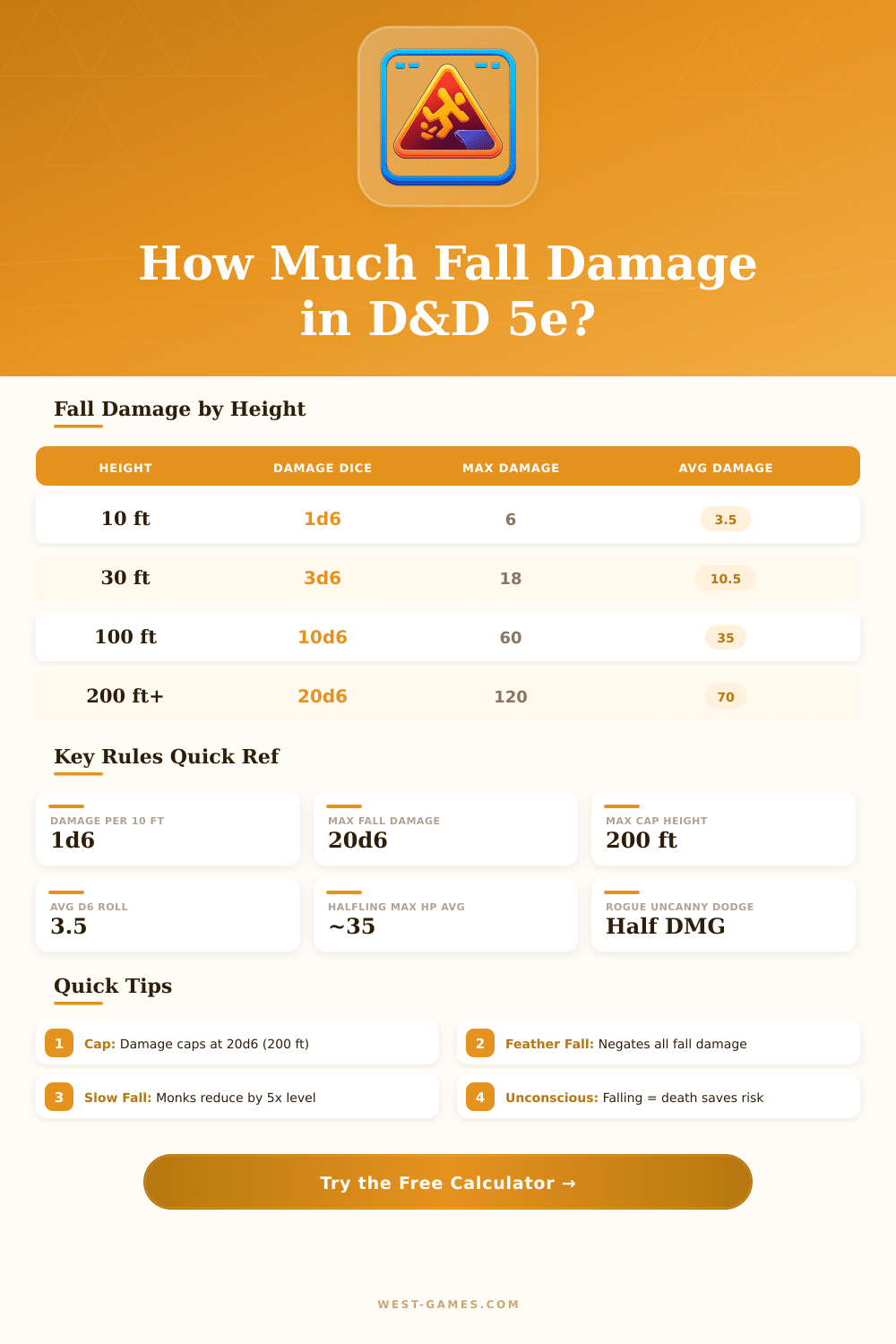
| Height (ft) | Height (m) | Dice | Min Dmg | Avg Dmg | Max Dmg |
|---|---|---|---|---|---|
| 10 ft | 3 m | 1d6 | 1 | 3.5 | 6 |
| 20 ft | 6 m | 2d6 | 2 | 7 | 12 |
| 30 ft | 9 m | 3d6 | 3 | 10.5 | 18 |
| 40 ft | 12 m | 4d6 | 4 | 14 | 24 |
| 50 ft | 15 m | 5d6 | 5 | 17.5 | 30 |
| 60 ft | 18 m | 6d6 | 6 | 21 | 36 |
| 80 ft | 24 m | 8d6 | 8 | 28 | 48 |
| 100 ft | 30 m | 10d6 | 10 | 35 | 60 |
| 150 ft | 46 m | 15d6 | 15 | 52.5 | 90 |
| 200 ft+ | 61 m+ | 20d6 (cap) | 20 | 70 | 120 |
| Character HP | Survives 30 ft? | Survives 60 ft? | Survives 100 ft? | Survives 200 ft? |
|---|---|---|---|---|
| 10 HP | ✅ Likely (avg 10.5) | ❌ No (avg 21) | ❌ No (avg 35) | ❌ No (avg 70) |
| 20 HP | ✅ Yes | ⚠ Risky (avg 21) | ❌ No | ❌ No |
| 40 HP | ✅ Yes | ✅ Likely | ⚠ Risky (avg 35) | ❌ No |
| 70 HP | ✅ Yes | ✅ Yes | ✅ Likely | ⚠ Risky (avg 70) |
| 120 HP | ✅ Yes | ✅ Yes | ✅ Yes | ✅ Likely |
| Scenario | Check | Suggested DC | Notes |
|---|---|---|---|
| Catch a ledge mid-fall | Athletics | DC 10–15 | Reduces fall by 10–20 ft (DM discretion) |
| Land gracefully (half dmg) | Acrobatics | DC 15 | Common house rule |
| Controlled fall from rope | Athletics | DC 12 | Must have access to rope |
| Tumbling roll on landing | Acrobatics | DC 15–20 | Reduces by 1d6 on success |
| Grab a creature mid-fall | Athletics | DC 20 | Grapple check required |
Fall Damage happens commonly in various games, whether those on table or video games. At its base, it works simply: your character receives wound after it climbs some height. Many systems do not trigger it except in case of fall past a defined limit and after that spot the wound grows according to the real distance of the fall.
In D&D of the 5th edition the calculation is genuinely easy. One suffers 1d6 of striking wound for every 10 feet of fall. So a 70-foot fall?
How Fall Damage Works in Games
It brings 7d6 of wound directly to you. The game limits it at 20d6 after 200 feet. After the landing you fall down unless you have some form of resistance against fall.
Adventurers meet that risk daily. It ranks between the typical dangers. Here the thrilling part: that 200-foot limit does not match with the real world.
According to physics you would reach terminal speed before that, and the whole event would last almost two seconds.
Here where it becomes interesting. In D&D fall can crush you more than in actual life would happen. Regular folks have exited 50-foot falls with only skin wounds, but in D&D?
Those same falls commonly end the character for those with normal stats. It does not match, if your hero can ignore the breath of dragon by means of weapon, why not last a simple fall? Some masters of game ignroe that by means of building wounds, where every extra 10 feet adds to the increasing pain.
Video games address this cause differently sometimes. Instead of real wound from speed, they measure it only according to distance. One can jump in water from high up and however receive wound in the touch of closed soil.
One game allows you cast Rainbow Stone off high cliff to test the depth. Literally. The brake of that stone ensures that fall would kill your character.
The problem of inconsistency becomes clear. Some games leave armored characters last silly falls, but after ten feet more everything ends sharply. One title gives magic horse that jumps through the air and entirely cancels the movement, but the rider strikes the ground from even short height?
Inevitable. It feels frustrating honestly.
Some games entirely escape Fall Damage, although one yet can fall off the map. Adding it adds weight. It reflects the real pain of fall.
It forces players think carefully and plan steps. Without it, mechanics like climbing by means of ropes lose their force. On the other hand, in open world games fall commonly only slows the research.
One team of creators changed it so that characters stay at 1 HP instead of dying fully. Fall Damage fills a role as a balancing tool, but its precise effect? Honestly it isharder than it seems.